WORDCRAFT

We are people of the Word, therefore we should be people of words.

Four courses that carry a student from the building blocks of poetry in sixth grade, through logic and classical rhetoric, to performing a poem of their own before an audience.

Grammar. The building blocks of poetry, learned the classical way, by imitation.

Logic. Reasoning well: terms, statements, valid arguments, fallacies and proofs.

Rhetoric. The art of eloquence: speaking the truth with power and grace.

Poetry. The English language in its most elevated form, read, written, and performed.

GRADES 6–9

Foundations: Poetry and Logic

Before rhetoric, a student needs a stock of words to work with and a mind that reasons in a straight line.

Grades 6–8 · one semester

Grammar of Poetry

Imitation in writingThe Grammar of Poetry student text, teacher’s edition and video course
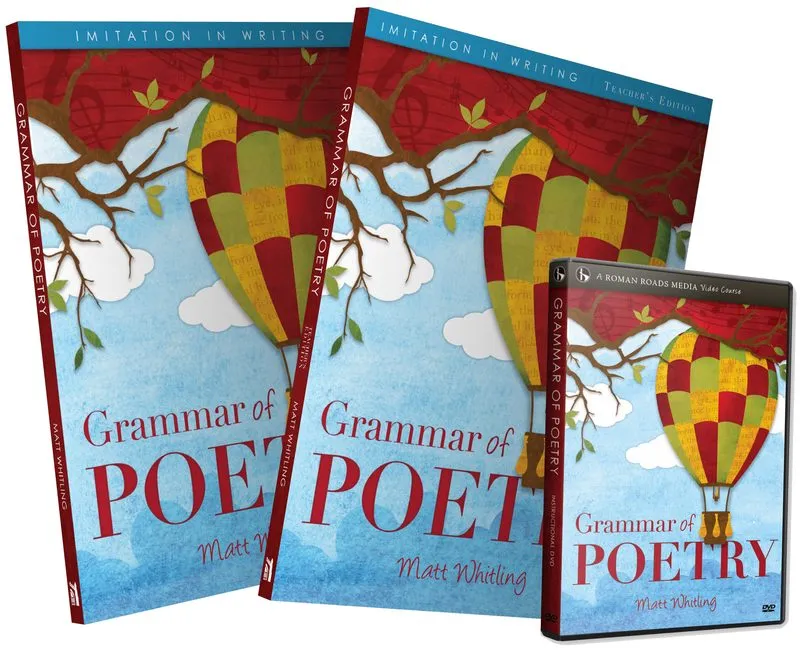
Thirty lessons that teach the mechanics of poetry by the classical method of imitation, from scansion and rhyme to ten powerful tropes, with riddles to solve, tongue twisters, and a list of over 150 poems to read alongside. Developed and taught at Logos School by its principal, Matt Whitling.

Student Text · Teacher’s Edition · video lessons
Grades 8–9 · two courses

Introductory & Intermediate Logic

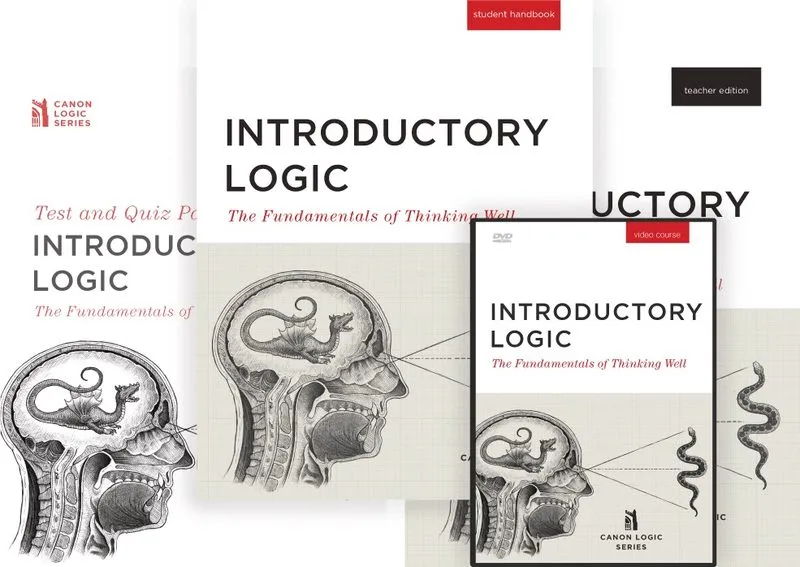
The art of reasoning wellThe Introductory Logic student text, teacher’s edition and video course

Introductory Logic lays the foundation for reasoning from the truth of God: defining terms, judging the truth of statements, building valid arguments and spotting informal fallacies. Intermediate Logic adds truth tables, truth trees and formal proof, applied to arguments from the Bible to digital electronics.

Student Text · Teacher’s Edition · Exam Pack · video lessons
RHETORIC · GRADES 10–11

FITTINGWORDSClassical Rhetoric

The art of eloquence in a spoken world.

A full year of classical rhetoric for high school. Students learn the theory of using words well, study the greatest speeches of all time, and practice the skills of effective oratory, and the year ends not with an exam but with a speech of their own.

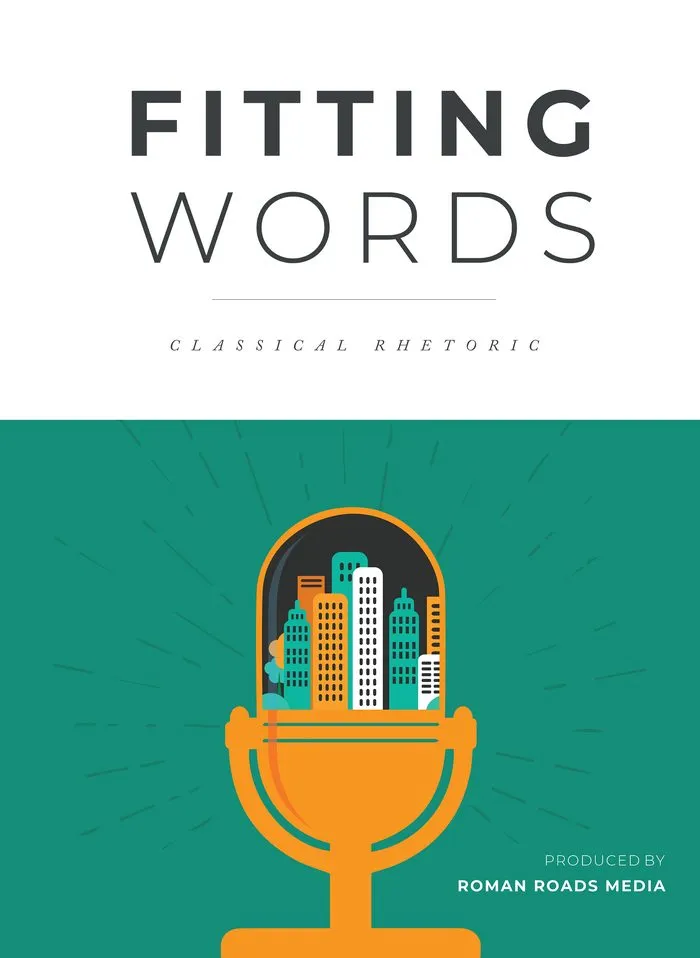
The cover of Fitting Words: Classical Rhetoric, an orange microphone holding a city skyline. See the curriculum.
30 lessonsin seven units
12 great speechesat the back, plus every speech in the Bible
5 speechesfor the student to deliver
One yearor spread over two, with schedules for both
WHY RHETORIC?

“God speaks, and we mumble.”

Brian Daigle · from the Foreword

If we want to love our neighbor, hear and understand God’s Word and persuade the lost, the Foreword argues, “then studying rhetoric is not an option; it is not an elective. It is a necessity.”

“And while everybody uses words, believers, as people of the Word, should be especially deliberate in the study and practice of using words well.”

Daniel Foucachon · From the Introduction

“Like a young knight receiving his first sword, it is crucial to remember that words are powerful and dangerous.” So the course begins with a Christian view of rhetoric before it hands over a single tool.

What rhetoric is for

“According to the great Roman orator Cicero, the threefold goal of rhetoric is to teach, to move, and to delight.” Fitting Words sets those three goals beside truth, goodness and beauty.

TEACHthe truth
MOVEto goodness
DELIGHTwith beauty

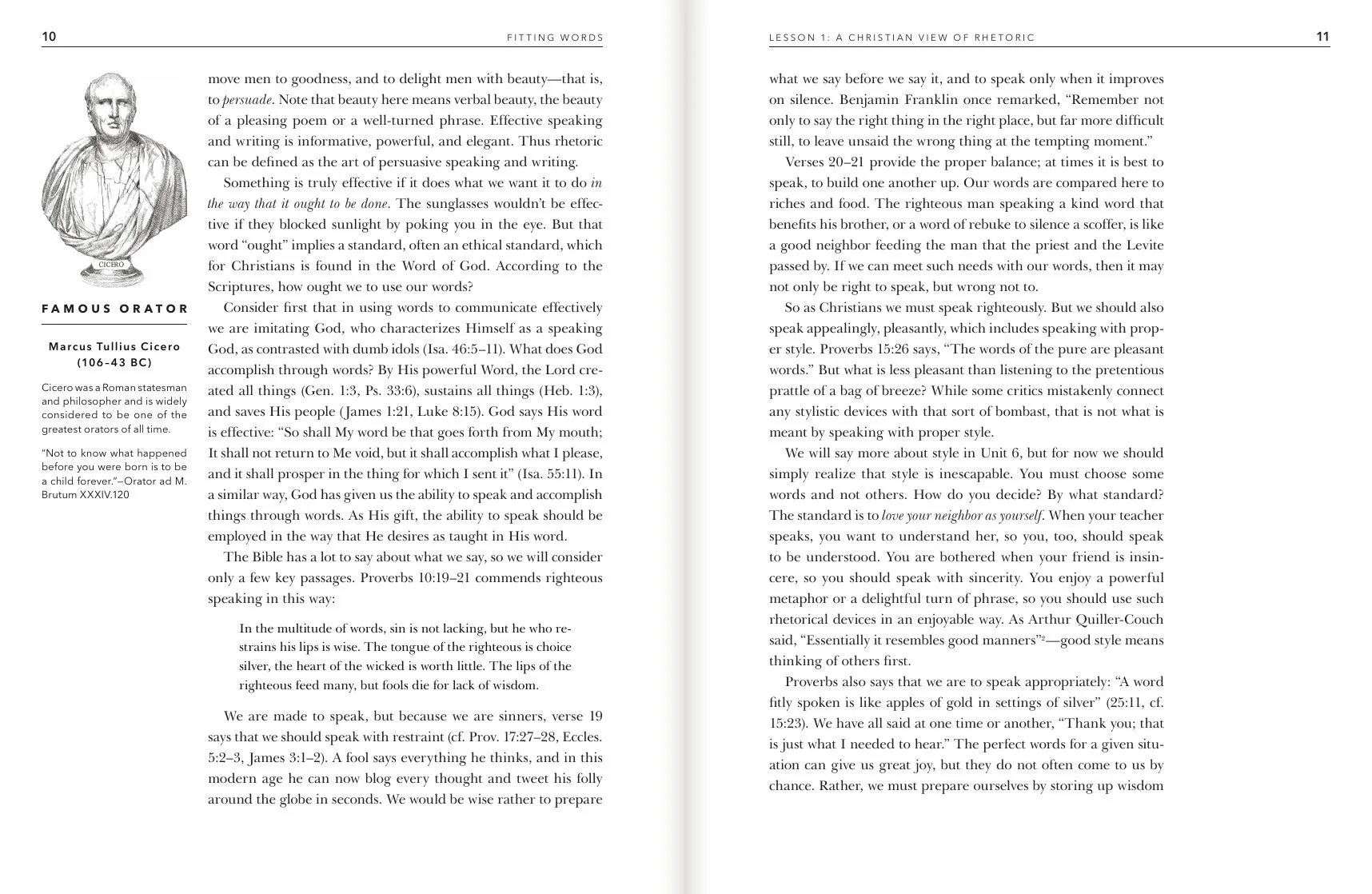
“Effectiveness in rhetoric can be measured against our ability to teach men the truth, to move men to goodness, and to delight men with beauty—that is, to persuade.” Lesson 1

HOW IT TEACHES

Theory, imitation, practice

The book teaches “through the three-fold method of theory, imitation, and practice”: the tools of classical rhetoric, the greatest orators using them, and students wielding them themselves.

Theory30 lessons

The five faculties of oratory, invention, arrangement, style, memory and delivery, taught from Aristotle, Cicero, Quintilian and Augustine and weighed against Scripture. Every lesson ends with questions for Thinking Deeper, suggestions for Reading Further, and a passage for Developing Memory.

Imitation12 speeches

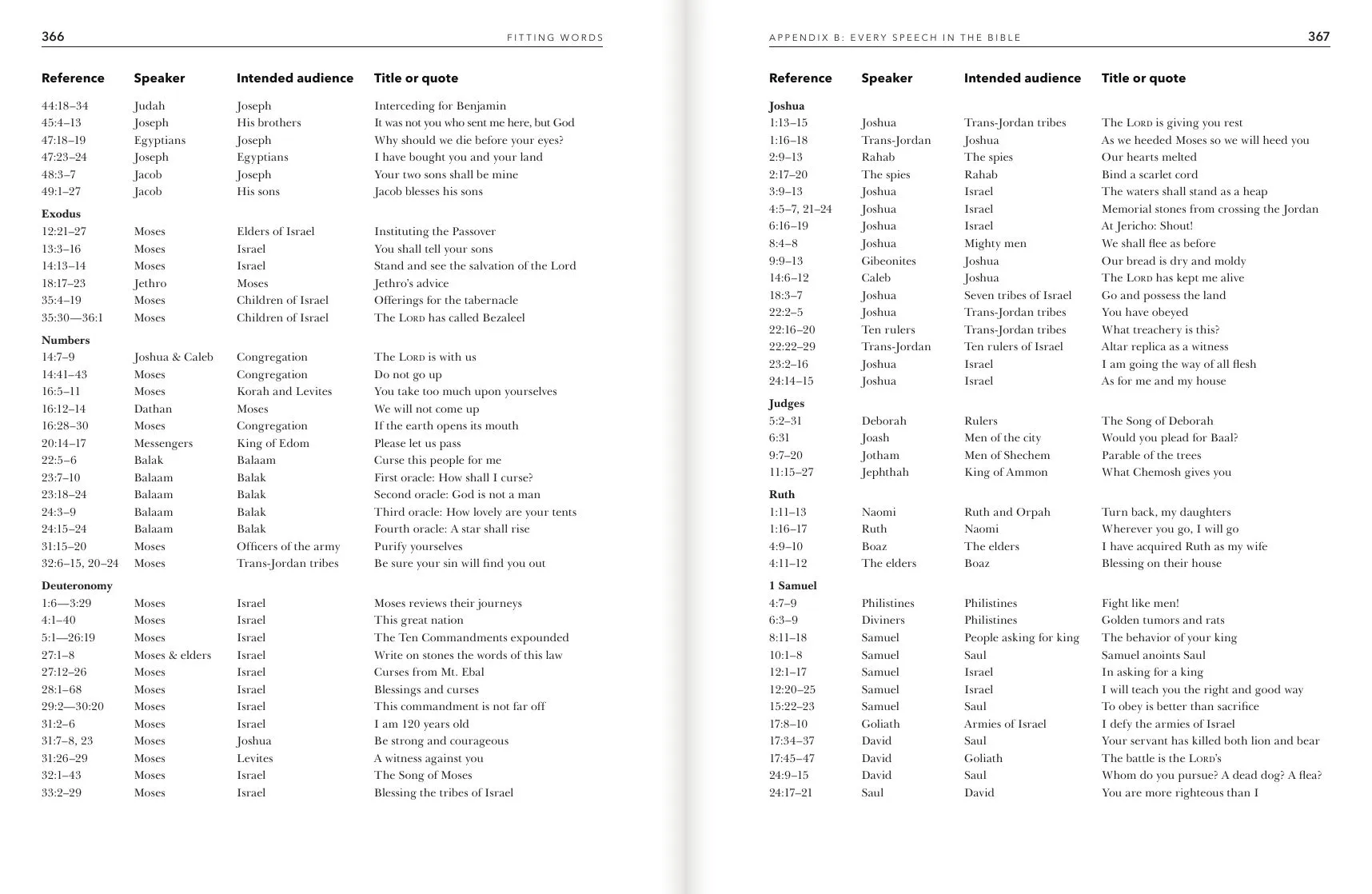
Printed at the back of the book: Pericles’ Funeral Oration, Cicero against Catiline, St. Crispin’s Day, Luther at Worms, Edwards, Patrick Henry, the Declaration of Independence, Gettysburg, Roosevelt, Kennedy, King and Wiesel. Then a chart of every speech in the Bible, Genesis to Revelation.

Practice5 speeches

An emotion speech, a forensic speech, a political speech (or St. Crispin’s Day from memory), a speech of praise, and a final persuasive speech of eight to twelve minutes. “The final evaluation for the course is not a comprehensive exam but a final speech.”

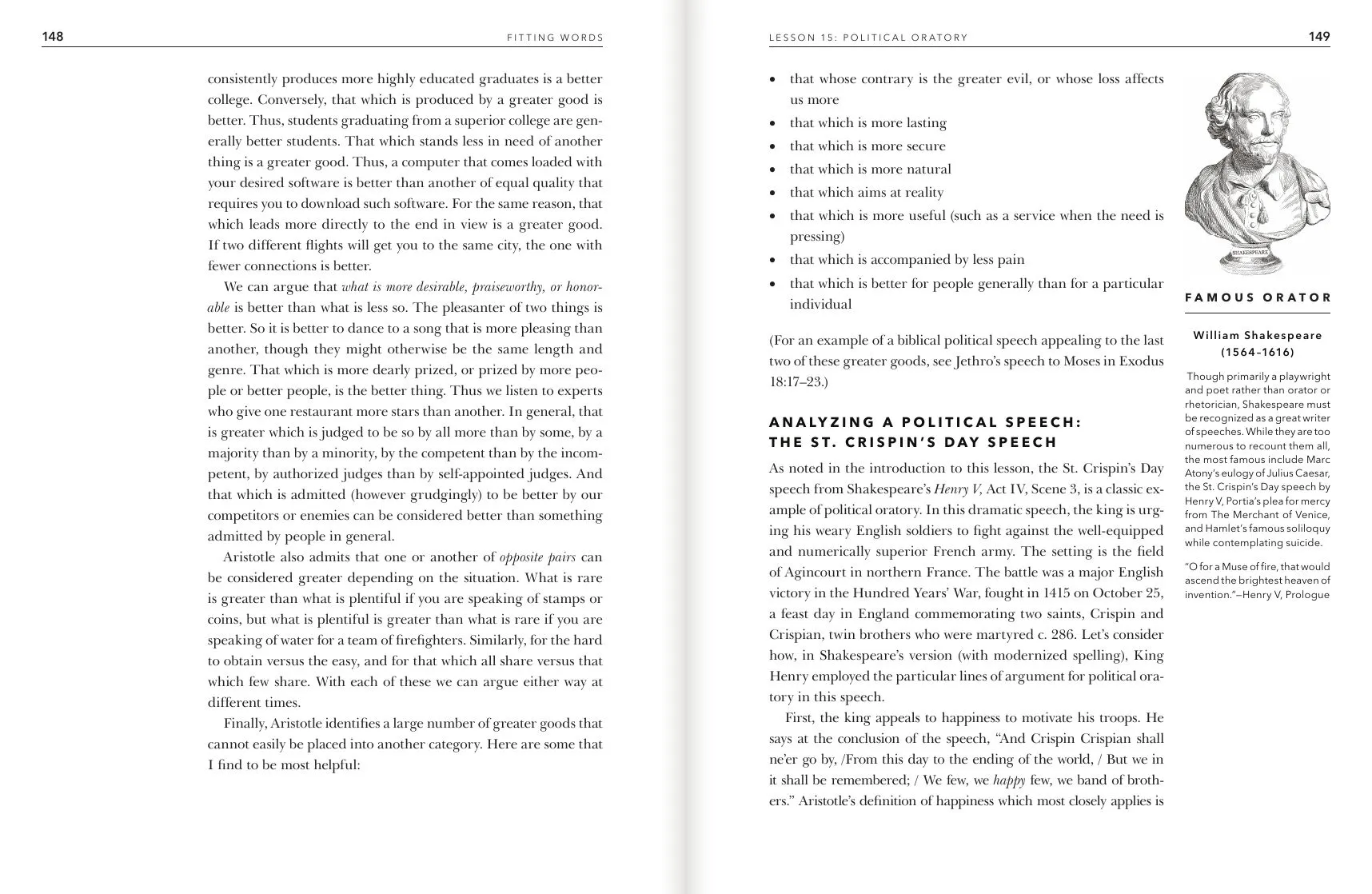
FAMOUS ORATORS

An orator in the margin of every lesson

Statesmen, preachers, poets and saints, each drawn as a marble bust by George Harrell, with a line from one of their speeches. Choose one.

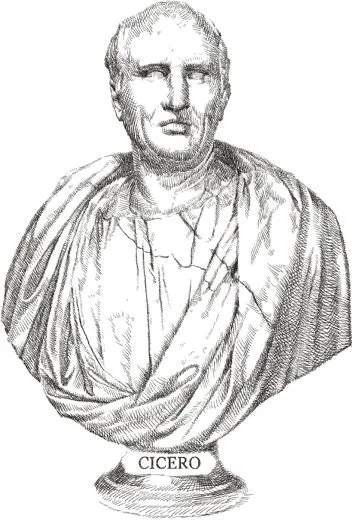
A drawing of a marble bust of Marcus Tullius Cicero
Marcus Tullius Cicero106–43 BCLesson 1“Not to know what happened before you were born is to be a child forever.”Orator ad M. Brutum XXXIV.120
TABLE OF CONTENTS

SEVEN UNITS, THIRTY LESSONS

UNIT 1

Foundations of Rhetoric

  1. 1A Christian View of Rhetoric
  2. 2The Birth of Rhetoric
  3. 3First Excerpt of Phaedrus
  4. 4Second Excerpt of Phaedrus
UNIT 2

Invention and Arrangement

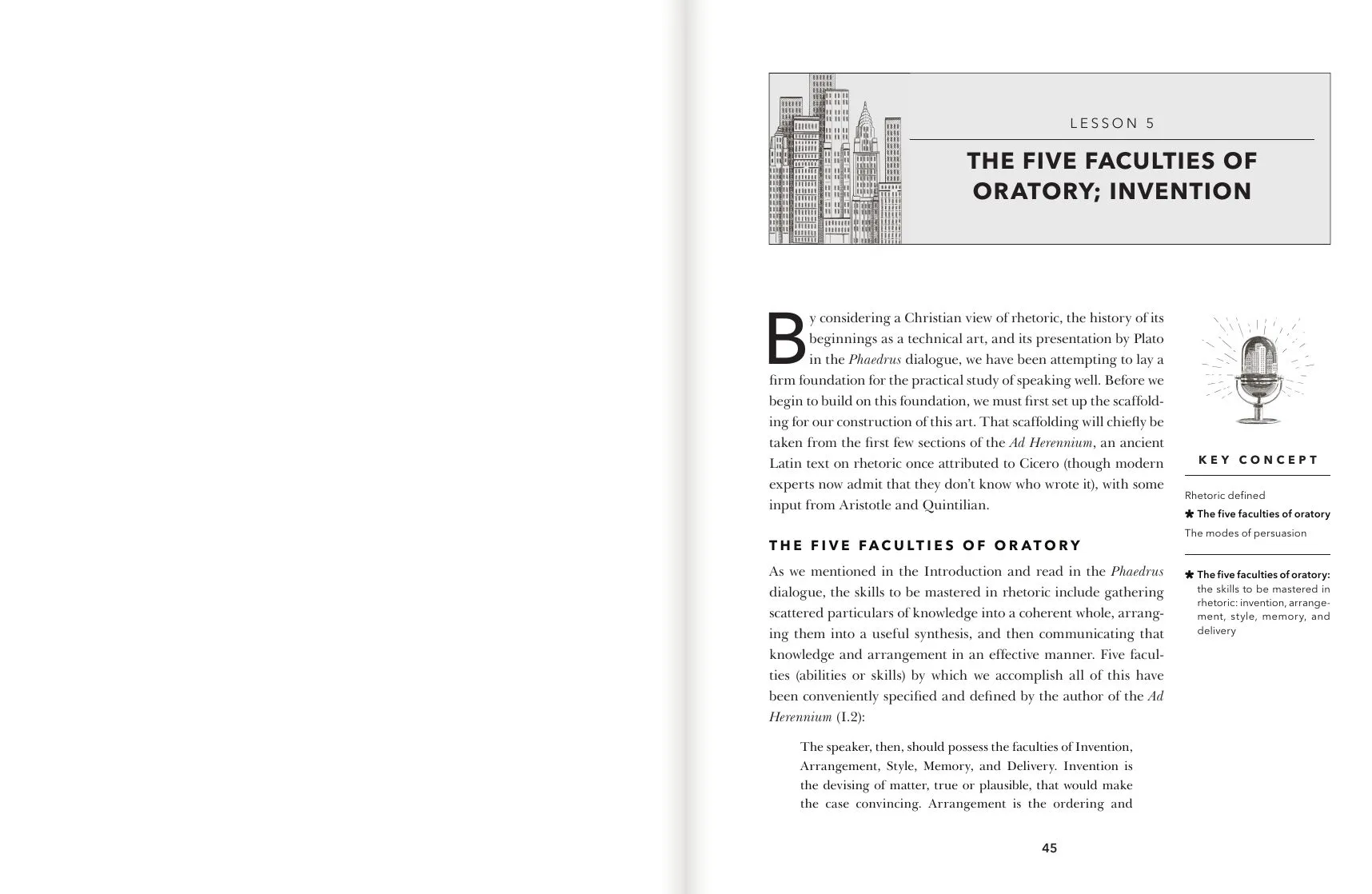
  1. 5The Five Faculties of Oratory; Invention
  2. 6Arrangement: Overview; Introduction
  3. 7Arrangement: Narration and Division
  4. 8Arrangement: Proof and Refutation
  5. 9Arrangement: Conclusion
UNIT 3

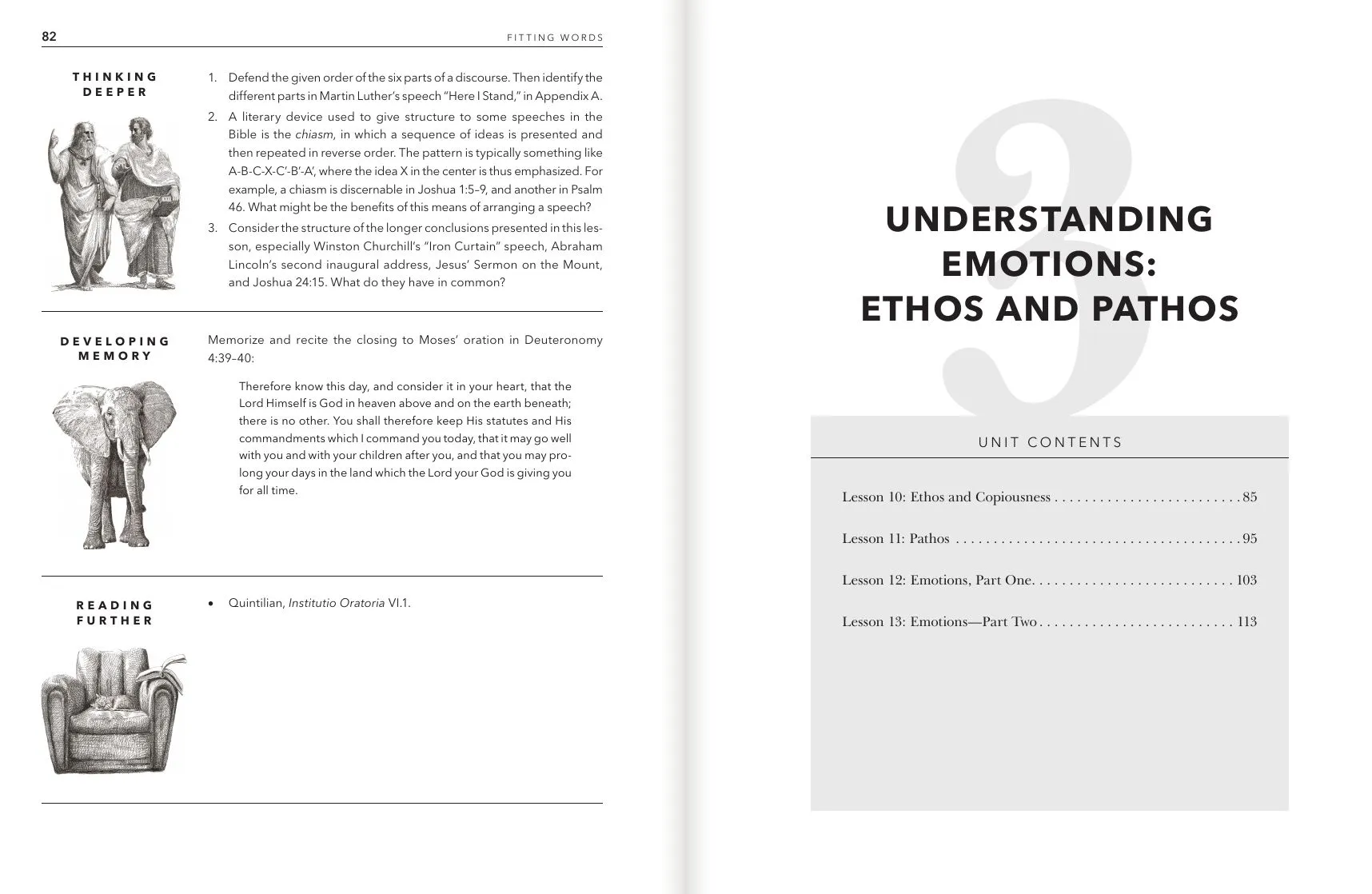
Understanding Emotions: Ethos and Pathos

  1. 10Ethos and Copiousness
  2. 11Pathos
  3. 12Emotions, Part One
  4. 13Emotions, Part Two
UNIT 4

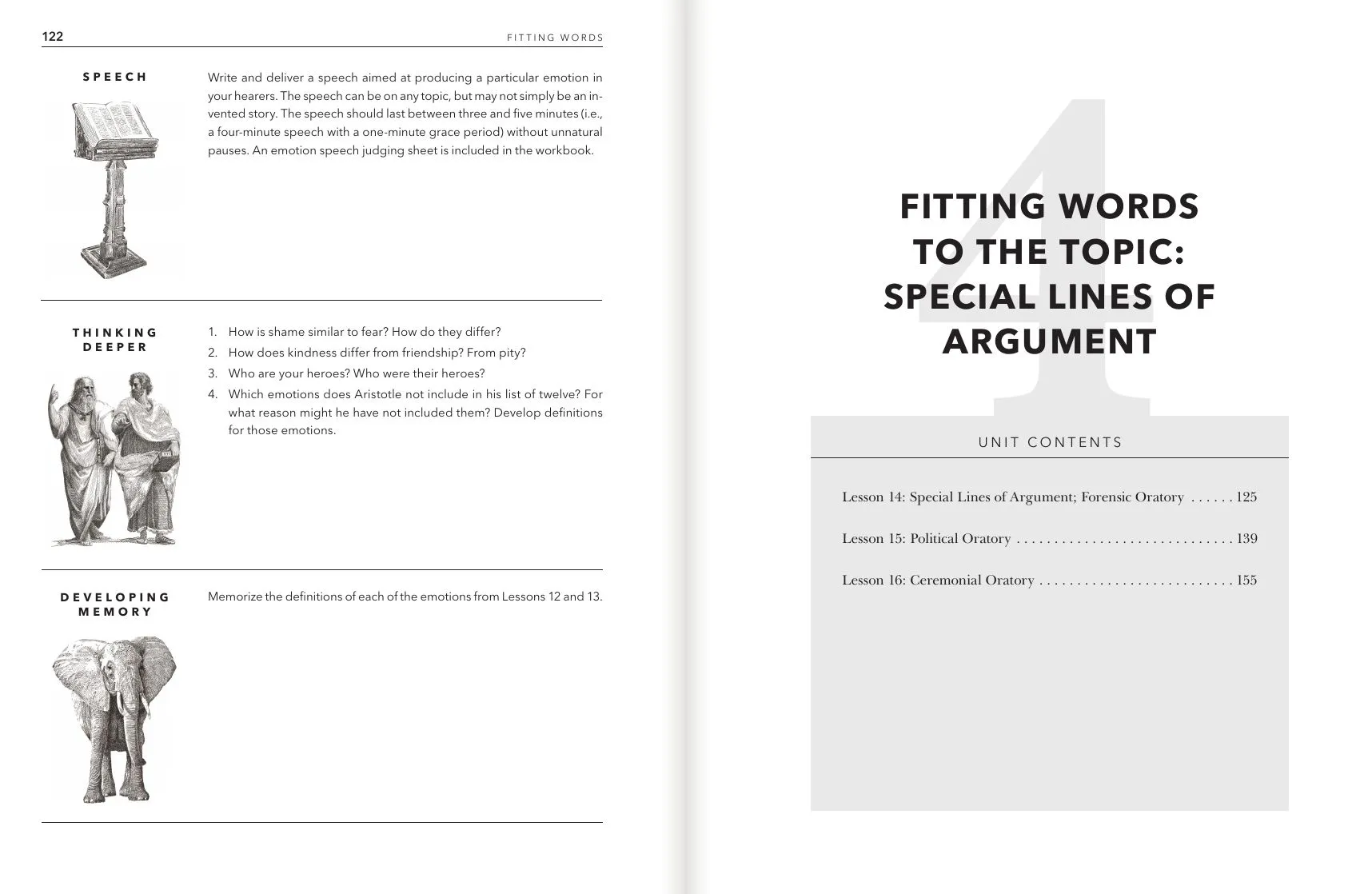
Fitting Words to the Topic: Special Lines of Argument

  1. 14Special Lines of Argument; Forensic Oratory
  2. 15Political Oratory
  3. 16Ceremonial Oratory
UNIT 5

General Lines of Argument

  1. 17Logos: Introduction; Terms and Definitions
  2. 18Statement Types and Their Relationships
  3. 19Statements and Truth
  4. 20Maxims and Their Use
  5. 21Argument by Example
  6. 22Deductive Arguments
  7. 23Refutation of Arguments
  8. 24Informal Fallacies
UNIT 6

Fitting Words to the Audience: Style and Ornament

  1. 25Understanding Your Audience
  2. 26Style: Clarity and Elegance
  3. 27Levels of Style and Figures of Speech
  4. 28Tropes and Allusions
UNIT 7

Memory and Delivery

  1. 29Memory
  2. 30Delivery
AND AT THE BACK
  • Appendix A. Twelve great speeches
  • Appendix B. Every speech in the Bible, with speaker, audience and title
  • Glossary-index of every term taught
  • Works cited, including 37 speeches
LOOK INSIDE

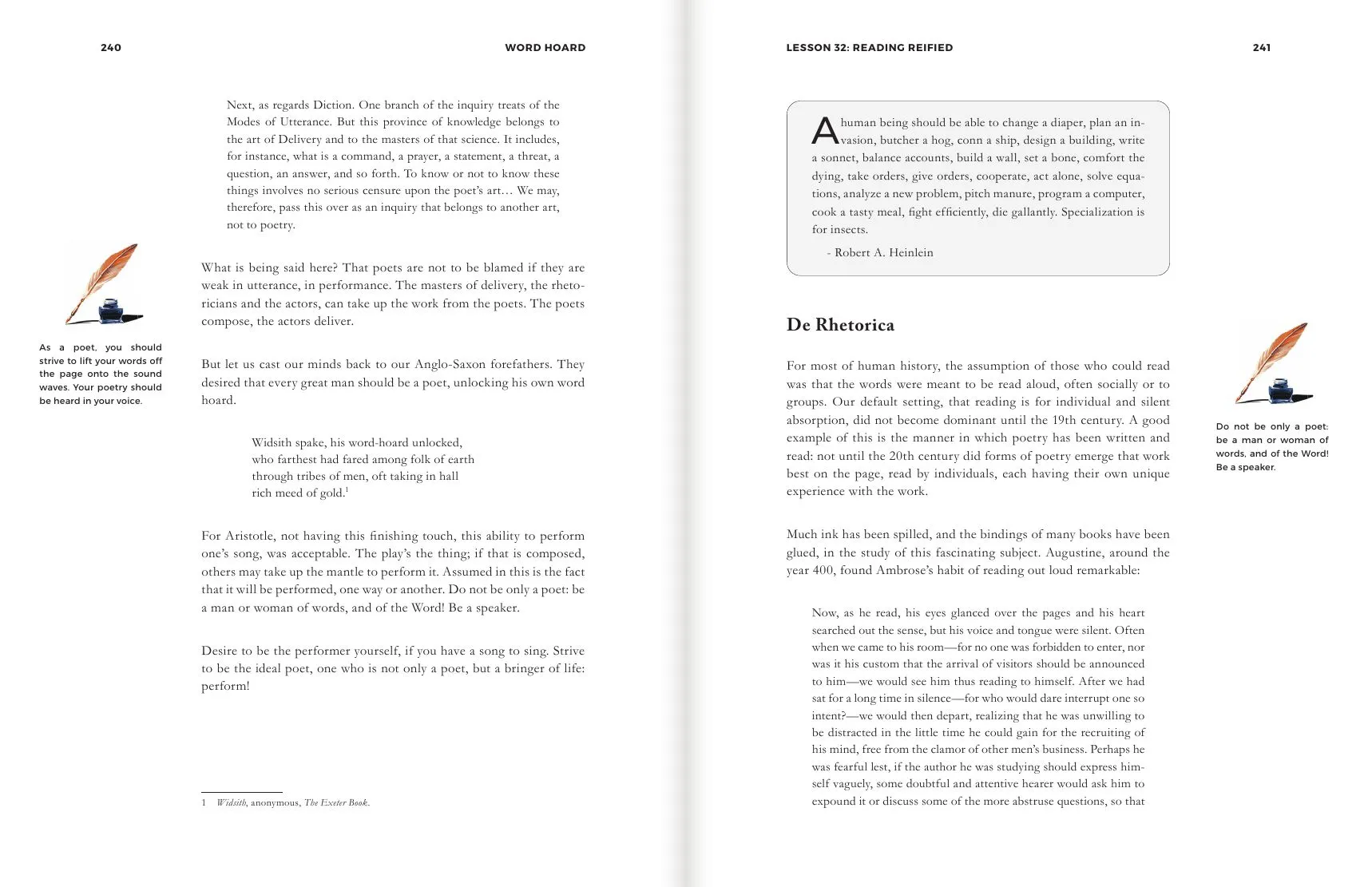
Pages from the textbook

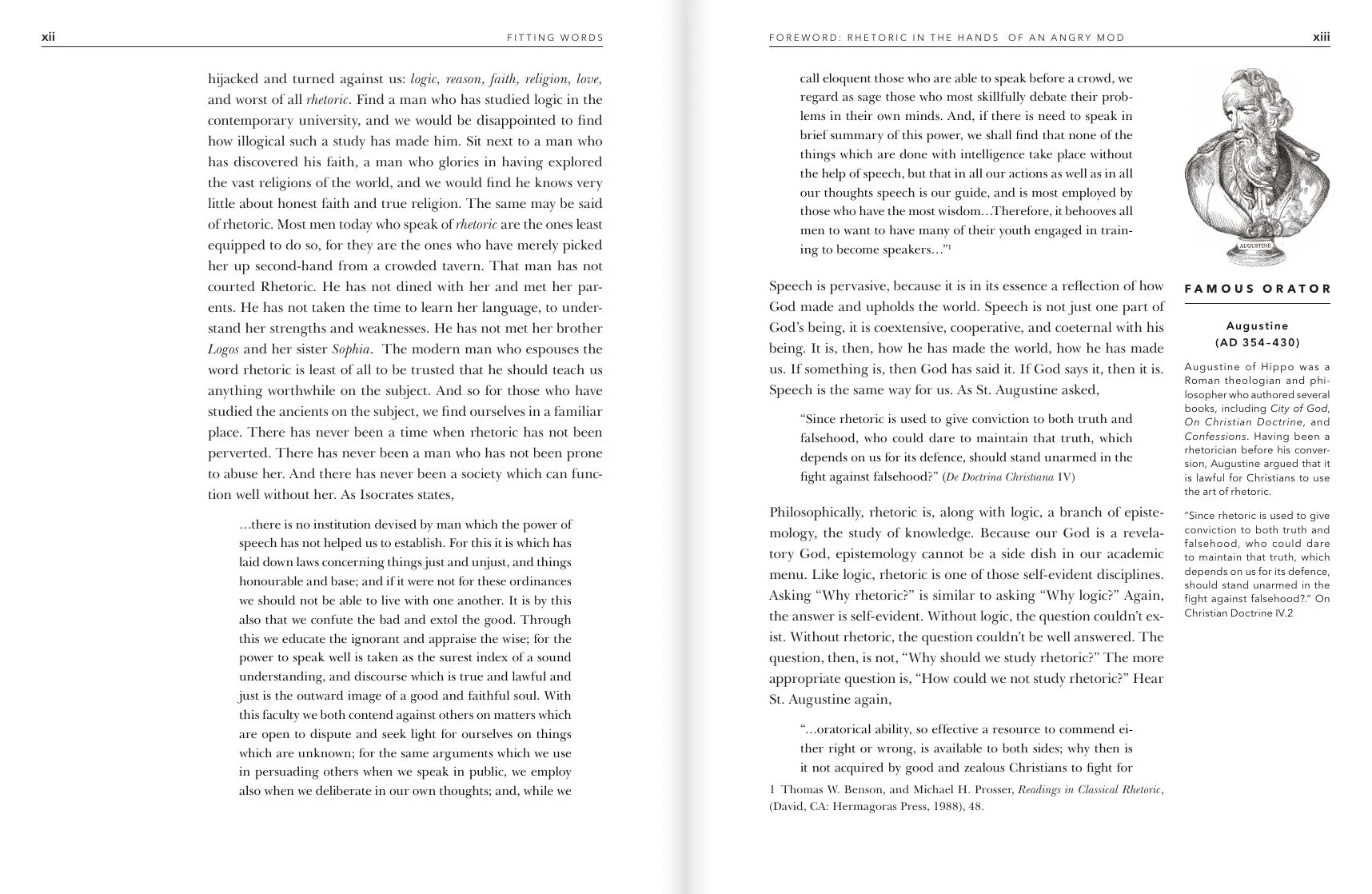
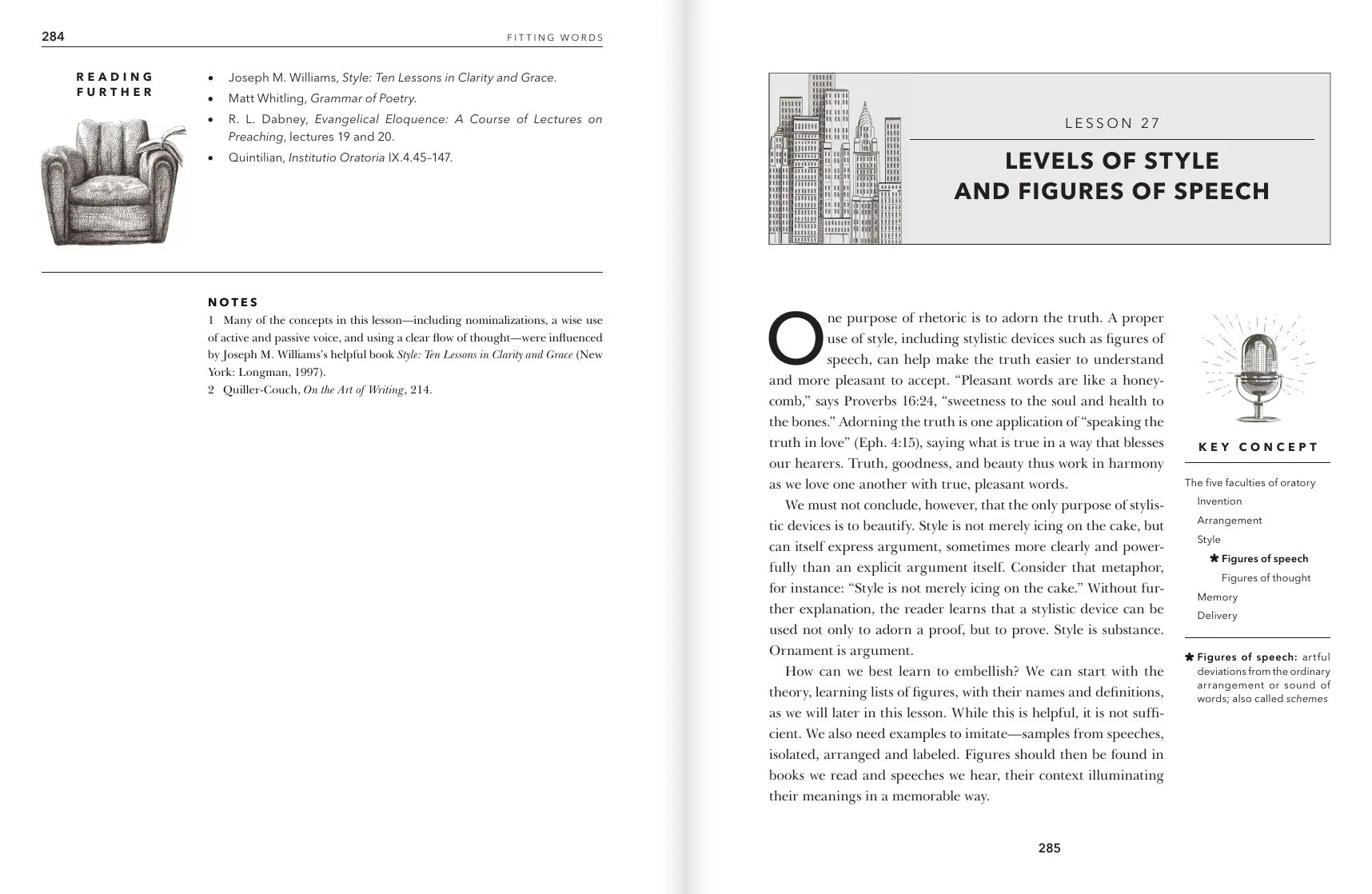
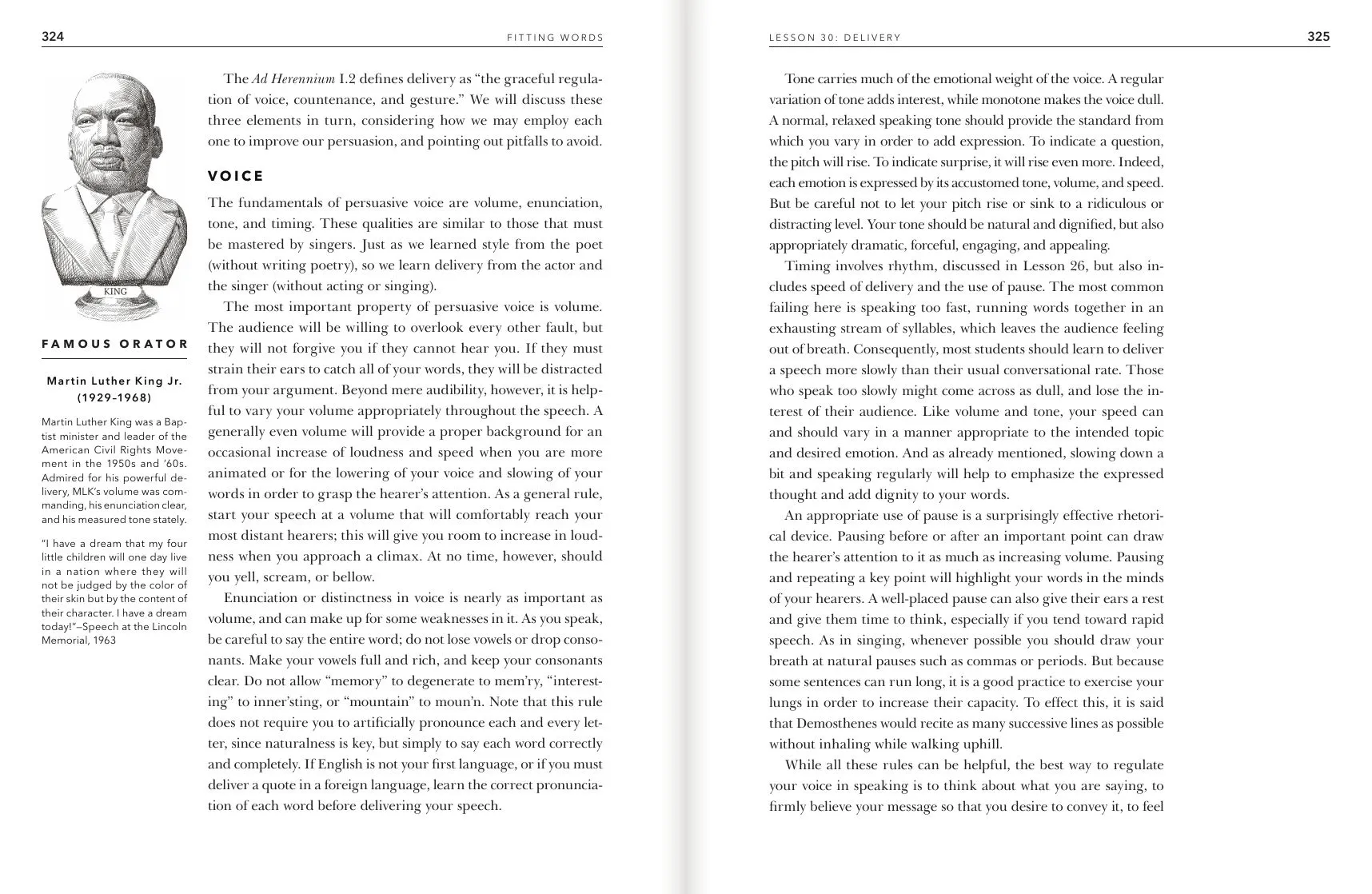
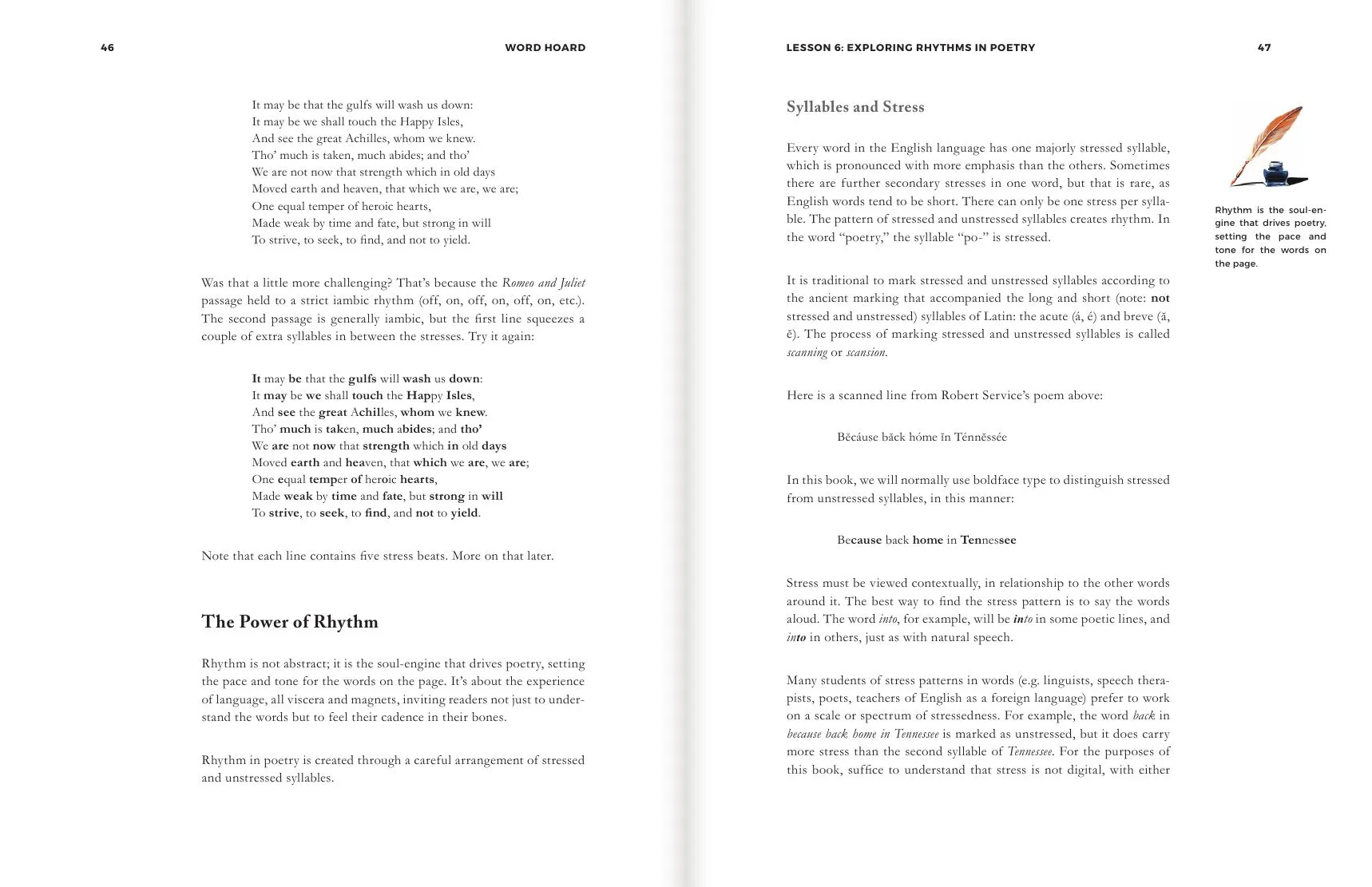
Pages from Fitting Words: Foreword: Rhetoric in the Hands of an Angry Mod, pp. xii–xiii
Foreword: Rhetoric in the Hands of an Angry Modpp. xii–xiii · spread 1 of 9
THE CURRICULUM

Everything for a year of rhetoric

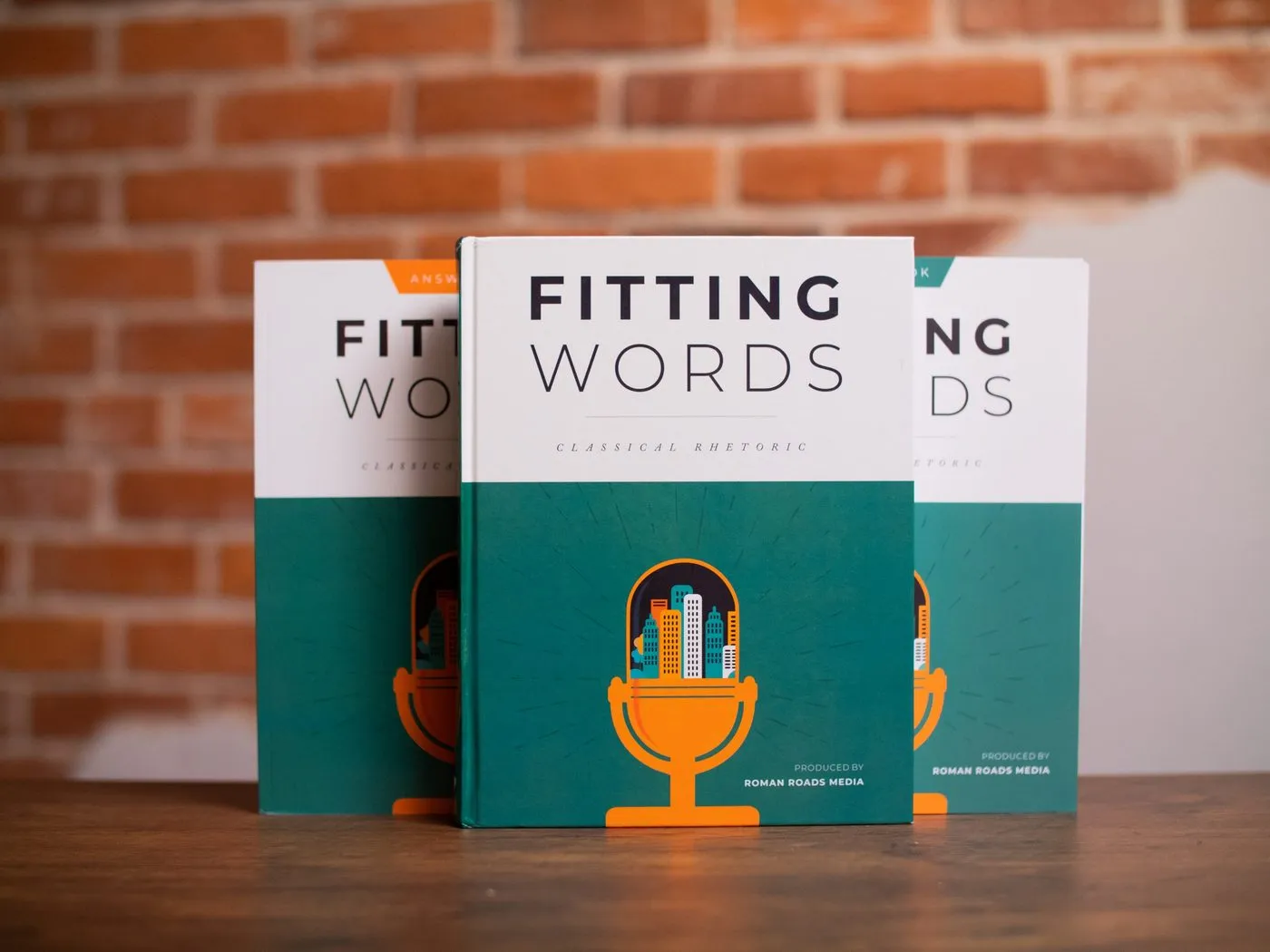
The Fitting Words textbook, workbook and answer key on a table, with an orange microphone
THE COMPLETE SET

Fitting Words Classical Rhetoric

The four books for a year of rhetoric: the hardback textbook, the student workbook, the answer key and the exam pack.

  • Textbook · Workbook · Answer Key · Exam Pack
  • One-year and two-year schedules
  • Speech judging sheets for every speech

Video lessons can be added to the set: streaming, DVD or Blu-ray.
“If you want to climb the mount of classical rhetoric, this text will be the Virgil to your Dante.”

Fitting Words Review

“The greatest compliment I can give of this curriculum is that it could not get into my own children’s hands and heads fast enough.”

Fitting Words Review
THE RHETORIC OF POETRY · GRADES 11–12 + COLLEGE

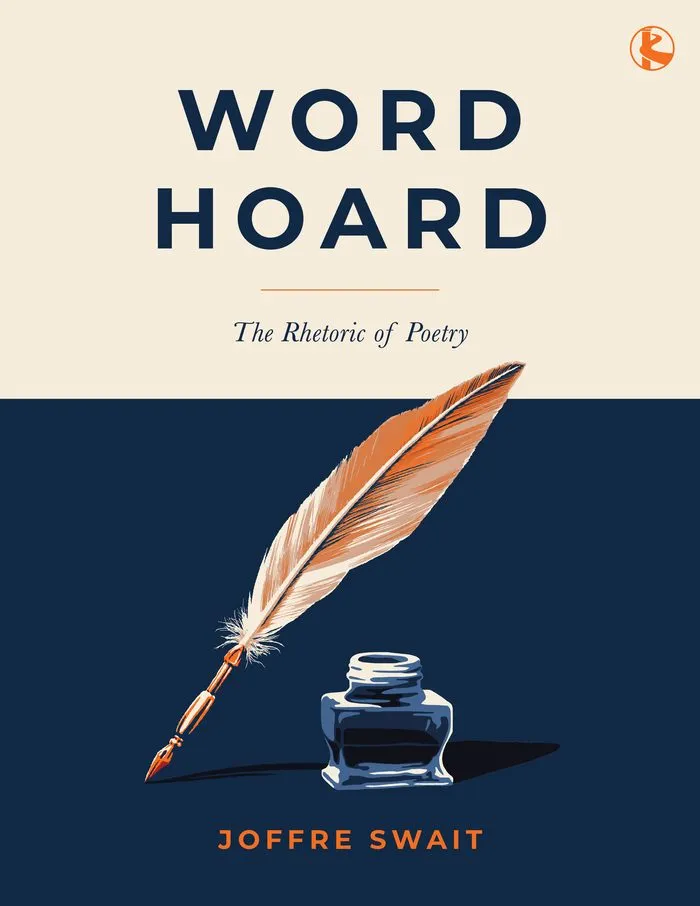
WORDHOARDThe Rhetoric of Poetry

A PRACTICAL GUIDE TO NOBILITY

The capstone of the sequence. Building on Fitting Words and Grammar of Poetry, Word Hoard teaches students to read, hear, write and perform poetry: English “in its most elevated forms,” wielded for truth, goodness and beauty. The poet Joffre Swait calls it “the natural fruit of my life’s work.”

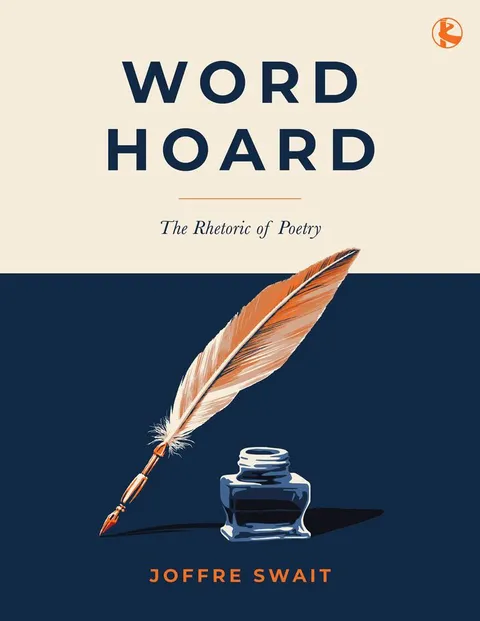
The cover of Word Hoard: The Rhetoric of Poetry, an orange quill and a bottle of ink. See the curriculum.

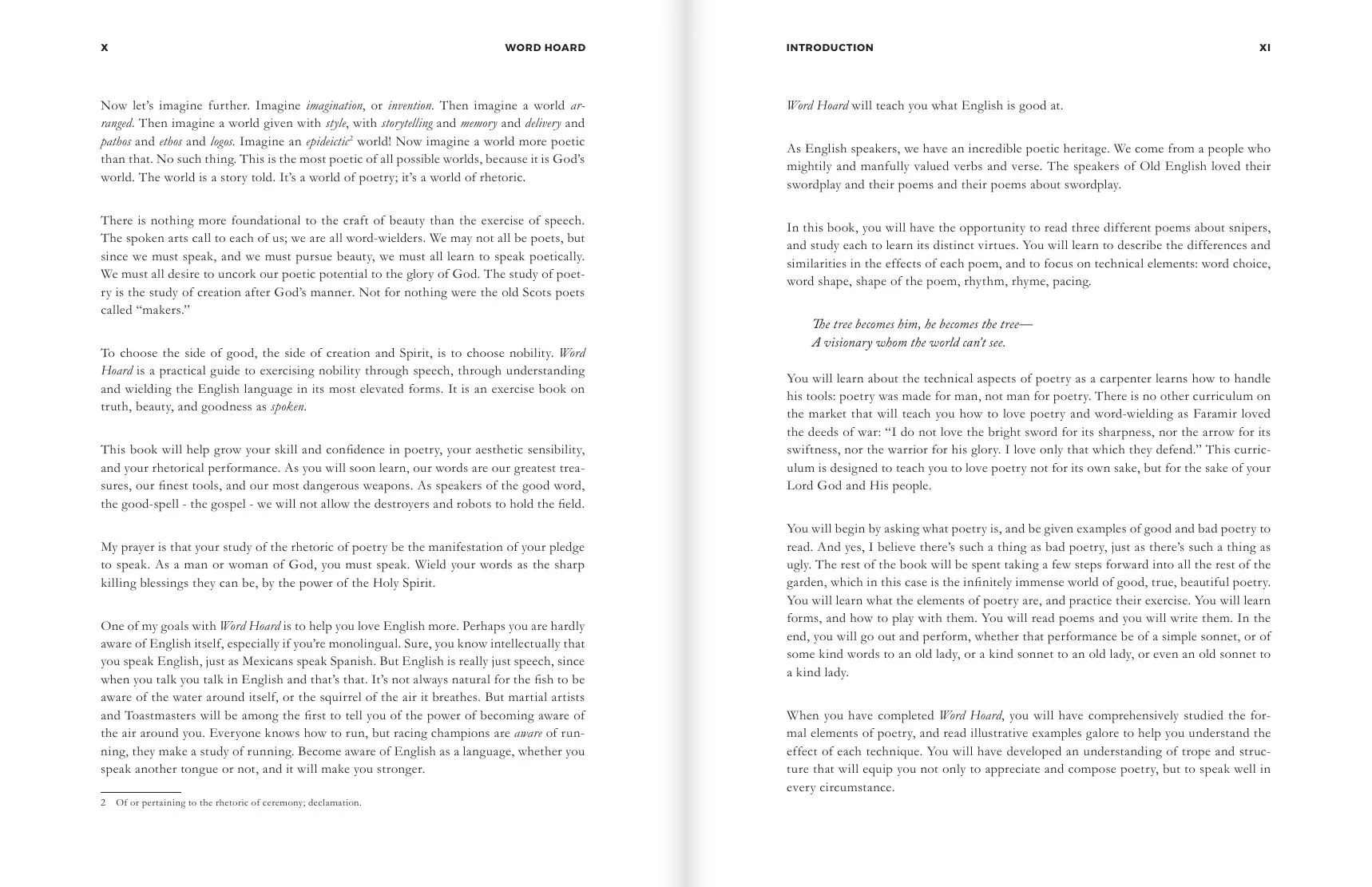
“As you will soon learn, our words are our greatest treasures, our finest tools, and our most dangerous weapons.”

Word Hoard · Introduction

“You will read poems and you will write them. In the end, you will go out and perform.”

READGood poems and bad ones, side by side, to learn the difference. “Examination is good. Dissection is bad.”
HEARRhythm, meter and rhyme, scanned aloud, as well as the alliteration of Old and Middle English.
WRITEBlank verse, terza rima, epigrams, sonnets, villanelles and shaped poems, then poems of your own on death, delight, food, nature, sports and transience.
PERFORMYour own poetry, read aloud to an audience at a public venue.

EIGHT UNITS

Thirty-two lessons, from “What is Poetry?” to “Reading Reified”
UNIT I

Why Study Poetry?

  1. 1What is Poetry?
  2. 2What is Bad Poetry?
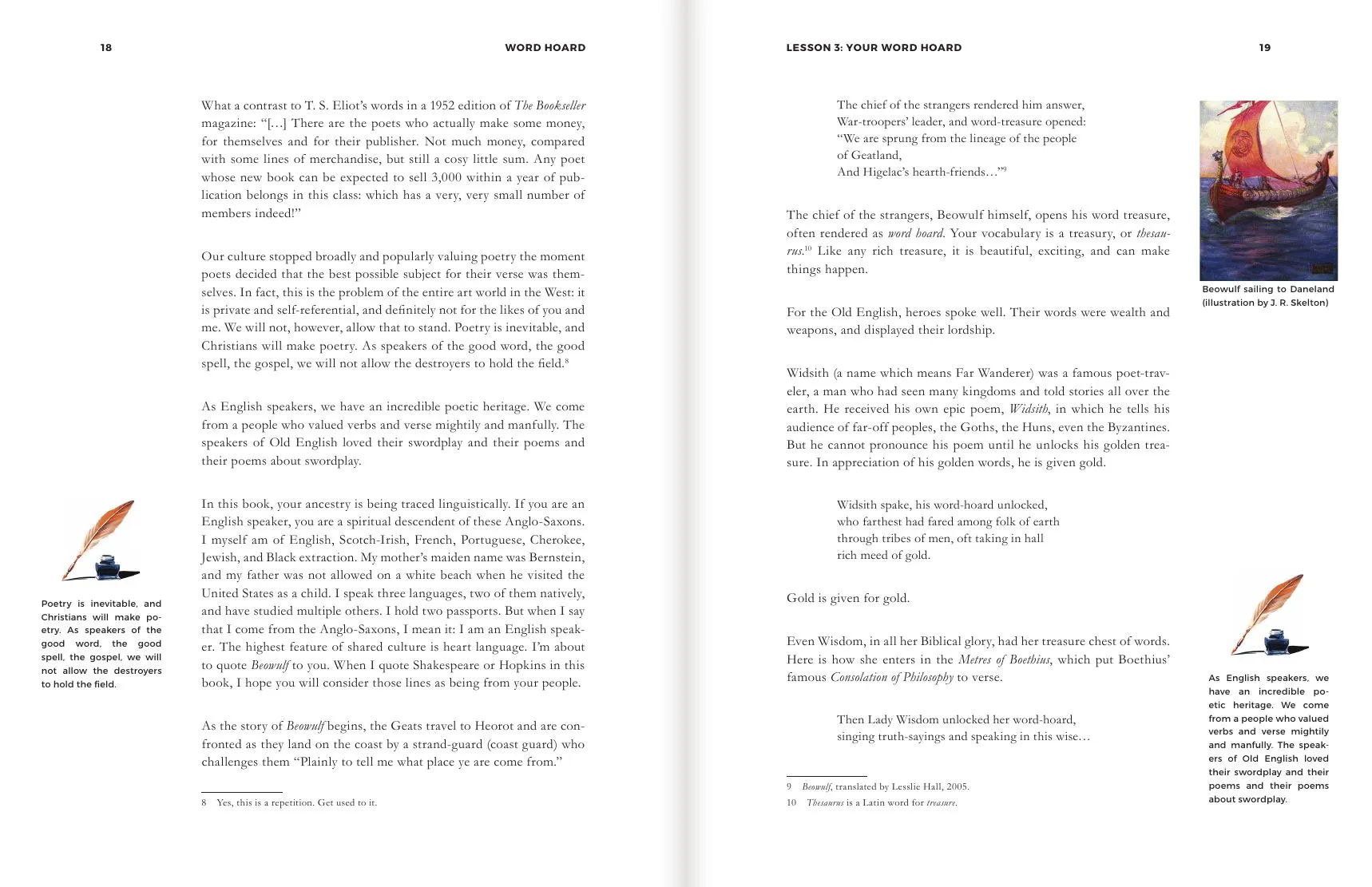
  3. 3Your Word Hoard
UNIT II

Understanding the Poetic Elements

  1. 4Introduction to the Poetic Elements
  2. 5How Poetic Elements Elevate Expression
UNIT III

Rhythm & Meter

  1. 6Exploring Rhythms in Poetry
  2. 7Meter—The Measure of Poetry
  3. 8A Word from Dr. Johnson
  4. 9Rhyme
  5. 10Natural Rhythm
  6. 11Real Meter
UNIT IV

Alliteration & Assonance

  1. 12Old English Poetry
  2. 13Middle English Poetry
  3. 14Alliteration & Assonance Now
UNIT V

Poetic Forms

  1. 15Free Verse
  2. 16Blank Verse & Terza Rima
  3. 17Poetic Aphorisms, Epigrams & Cinquains
  4. 18Sonnets
  5. 19Villanelle
  6. 20aShaped Poetry
  7. 20bJack of All Forms, Master of New Ones
UNIT VI

Some Tropes, Some Styles, Some Memeing, No Synecdoche

  1. 21Figures of Speech
  2. 22aImagery
  3. 22bSimile & Metaphor
  4. 23Repetition & Parallels
  5. 24Onomatopoeia
UNIT VII

Composing

  1. 25What Do I Write?
  2. 26Death
  3. 27Delight
  4. 28Food
  5. 29Nature
  6. 30Sports
  7. 31Transience
UNIT VIII

Performance

  1. 32Reading Reified
An orange quill and a bottle of ink, from the title page of Word Hoard
THE CAPSTONE

Go out and perform

“Your final assignment is to read aloud, to perform, a new poem to an audience at a public venue.”

A coffee shop’s open mic, a writers’ group, an evening with the youth group: the course ends with each student performing a poem they have written themselves. The Teacher’s Guide puts it simply: “This should be something special.”

“…whether that performance be of a simple sonnet, or of some kind words to an old lady, or a kind sonnet to an old lady, or even an old sonnet to a kind lady.”

Word Hoard · Introduction
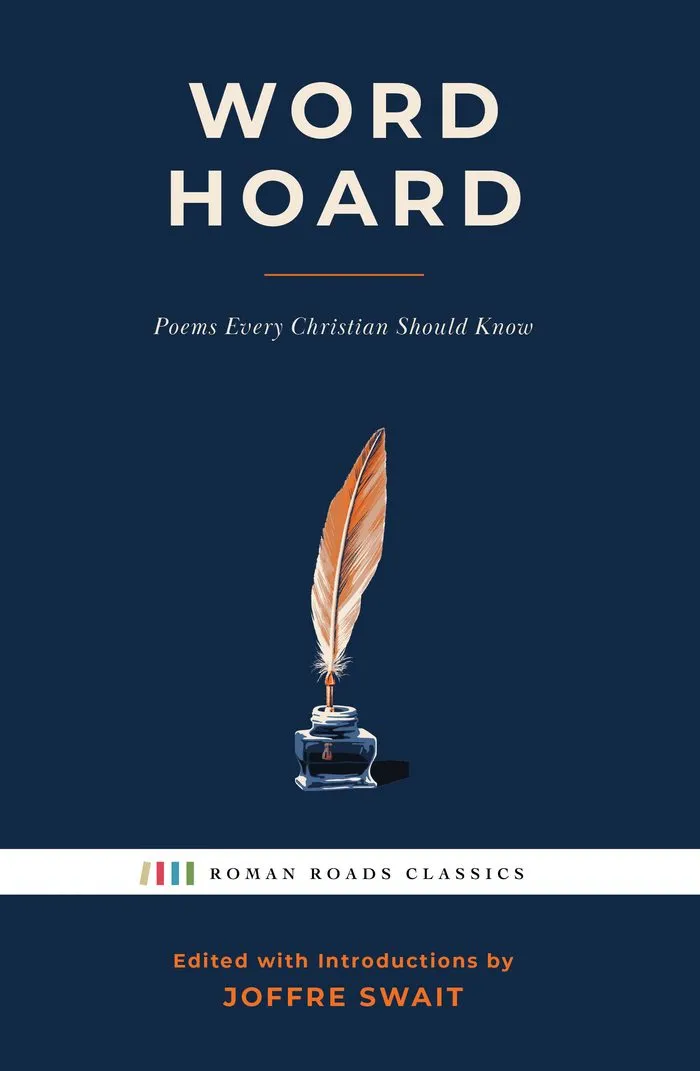
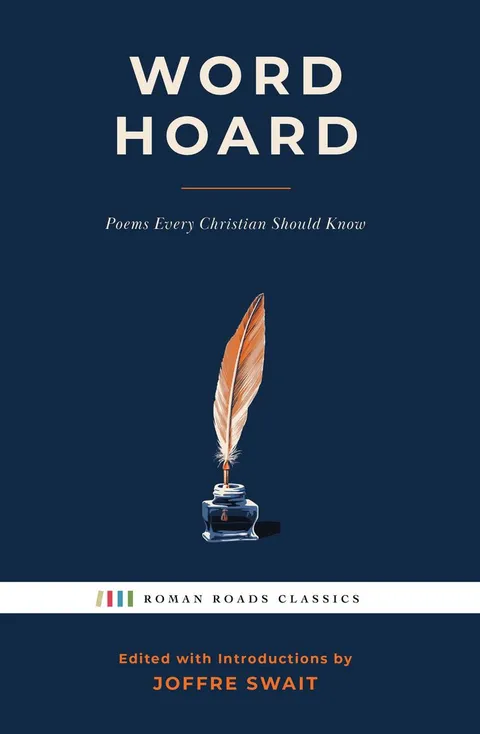
The cover of Word Hoard: An Anthology of Poems Every Christian Should Know, edited with introductions by Joffre Swait
THE COMPANION ANTHOLOGY

WORD HOARDAn Anthology of Poems Every Christian Should Know

“Not a collection of Christian poetry, mind you, but a Christian collection of poetry.”

219poems68poets7centuries, Chaucer’s to Eliot’s

The textbook is a bootcamp; the anthology is meant “to turn poetry from an excursion into a lifestyle.” The poems run in order of the poet’s birth, each century opened by a short introduction, and the Teacher’s Guide sets anthology readings for every week of the year. “Heretics and atheists are included alongside Puritan pastors and Roman Catholic martyrs.”

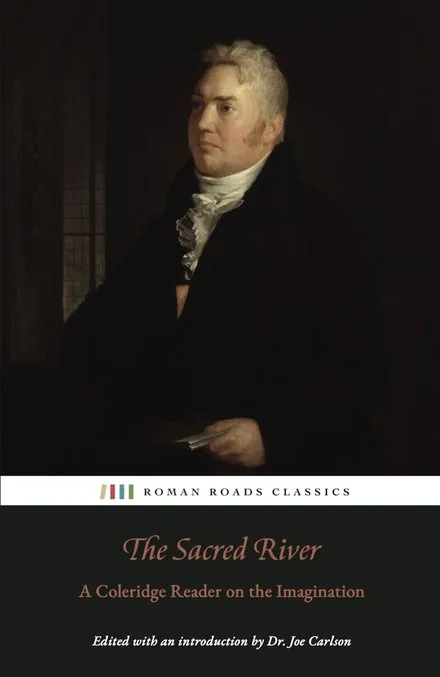
Geoffrey Chaucer · William Dunbar · Walter Raleigh · Edmund Spenser · Philip Sidney · Mary Sidney Herbert · William Shakespeare · Chidiock Tichborne · John Donne · Robert Herrick · George Herbert · John Milton · Anne Bradstreet · Thomas Traherne · Edward Taylor · William Cowper · William Blake · William Wordsworth · Samuel Taylor Coleridge · John Keats · Henry Wadsworth Longfellow · Edgar Allan Poe · Alfred, Lord Tennyson · Matthew Arnold · George MacDonald · Emily Dickinson · Christina Rossetti · Lewis Carroll · Thomas Hardy · Gerard Manley Hopkins · A. E. Housman · Francis Thompson · Rudyard Kipling · W. B. Yeats · G. K. Chesterton · Robert Frost · Carl Sandburg · T. S. Eliot · Wilfred Owen · W. H. Auden · Dylan Thomas · John Gillespie Magee Jr. and 26 more.

“These are poems about love and death and the Church as a hippopotamus. Expect conversations.”

LOOK INSIDE

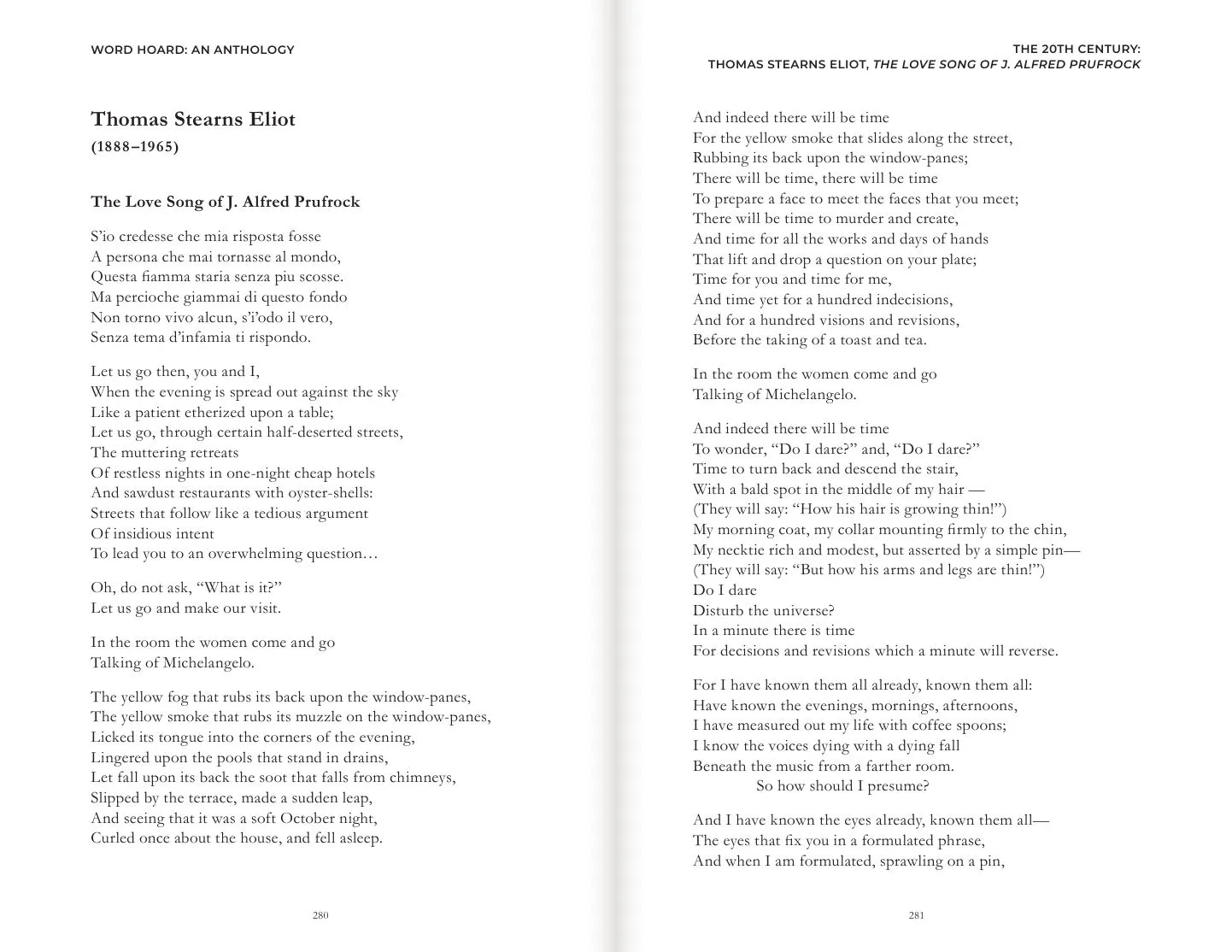
Pages from the textbook and the anthology

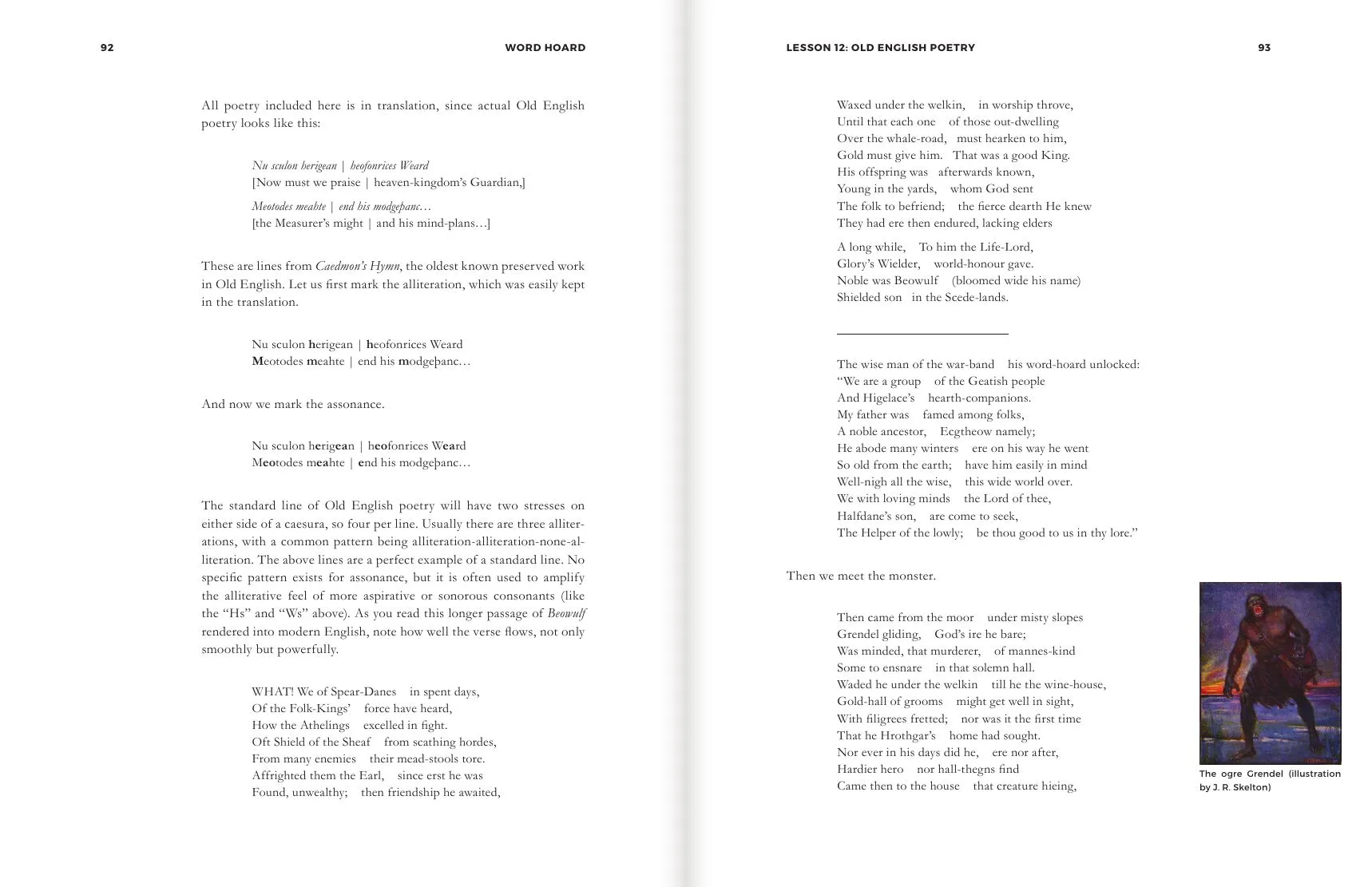
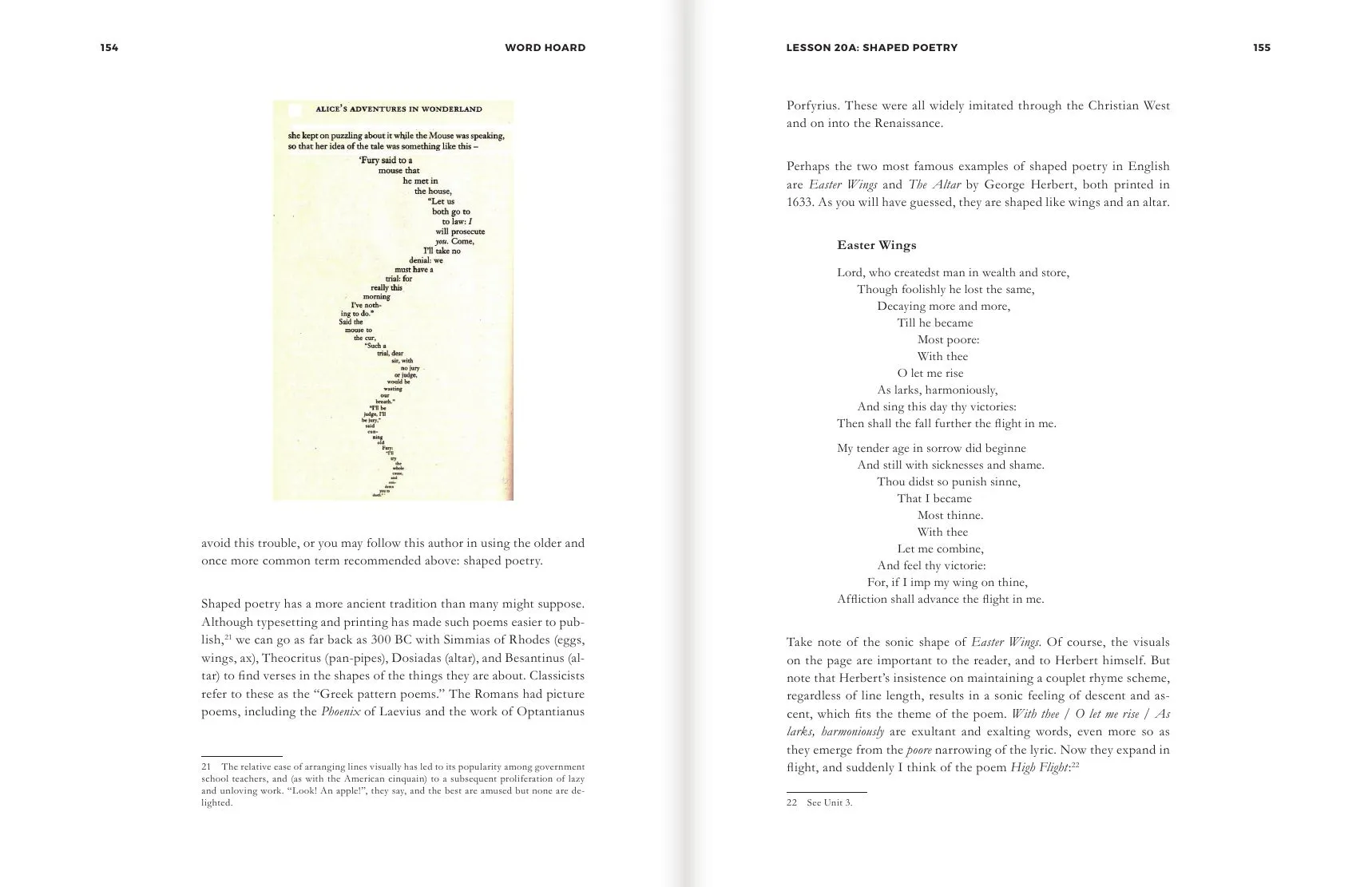
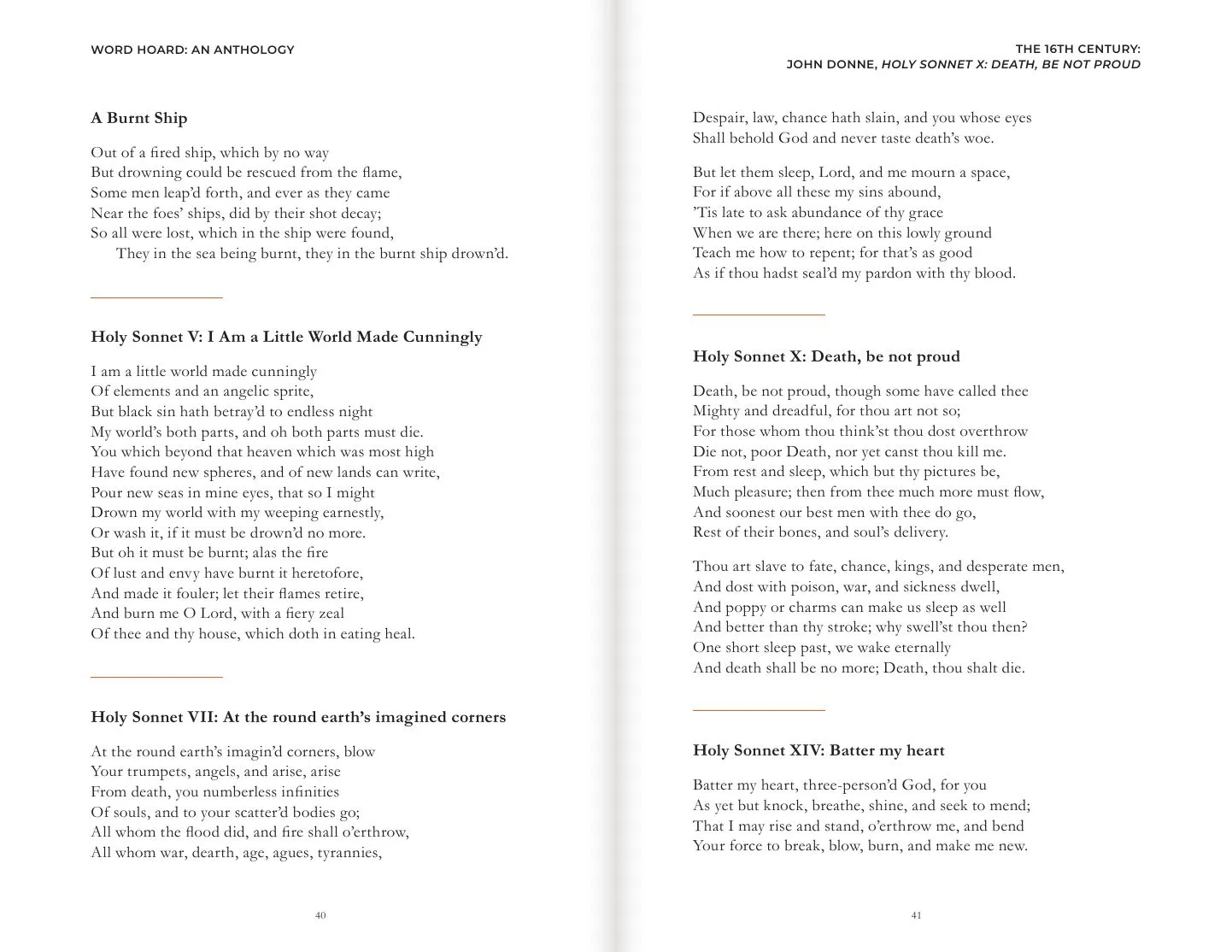
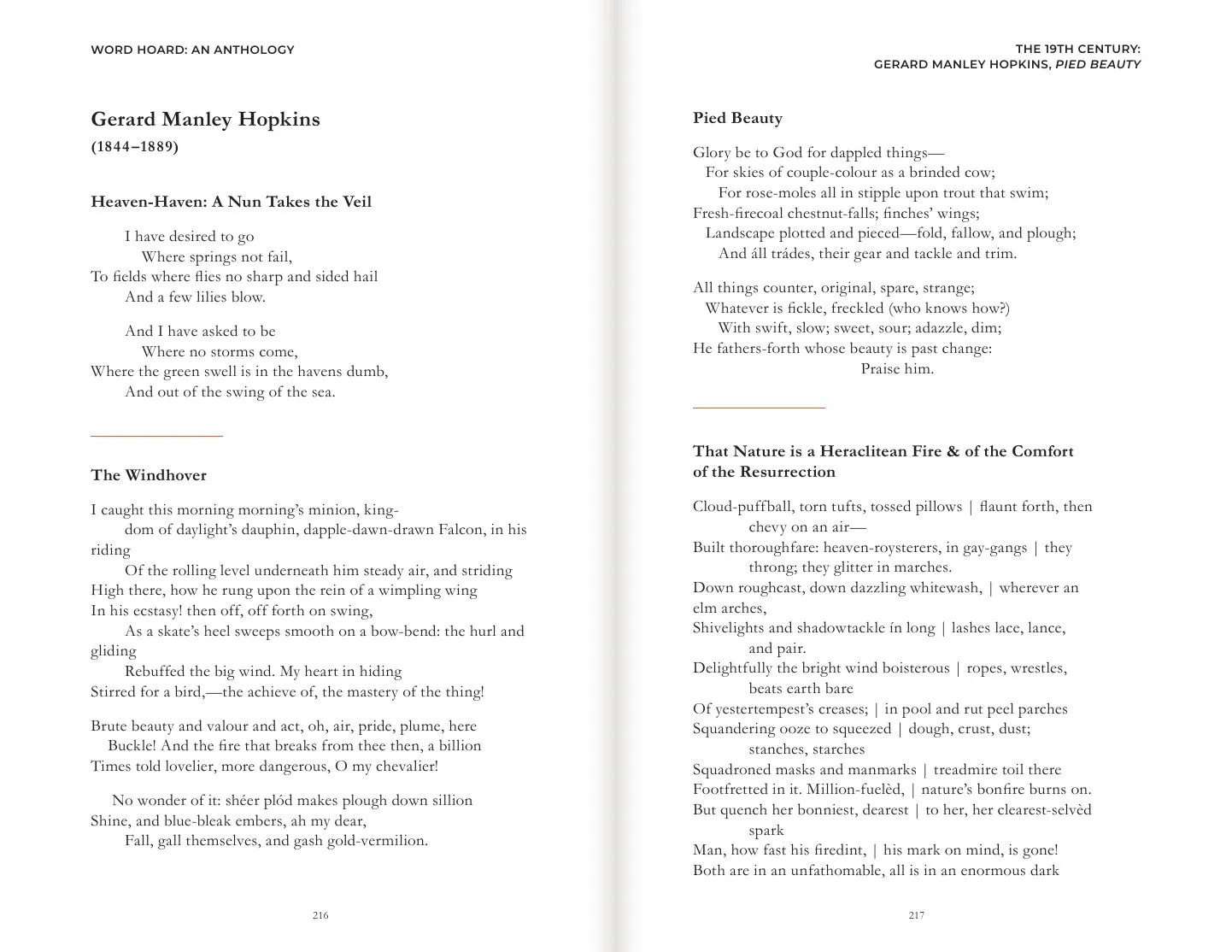
Pages from Word Hoard: Word Hoard: Introduction, pp. x–xi
Word Hoard: Introductionpp. x–xi · spread 1 of 9
THE CURRICULUM

Three books

A full year (32 weeks, four days a week) with weekly anthology readings, or a single semester (16 weeks) focused on composition. Schedules for both are in the Teacher’s Guide.

Student Text$49Word Hoard: The Rhetoric of Poetry, the student text
  • Thirty-two lessons in eight units
  • The poems each lesson needs, printed in the lesson
  • Study questions and writing exercises throughout
  • For upper high school and early college
Get the Student Text
Teacher’s Guide$20Word Hoard: The Rhetoric of Poetry, the teacher’s guide
  • One-year and one-semester schedules
  • Answers for every lesson
  • Four exams, with answer keys
  • Anthology readings, week by week, and the capstone
Get the Teacher’s Guide
The Anthology$28.95Word Hoard: An Anthology of Poems Every Christian Should Know
  • 219 poems by 68 poets
  • Arranged by the poet’s year of birth
  • An introduction to each century
  • Poems every English-speaking Christian should know
Get the Anthology
WORDCRAFT

“Do not be only a poet: be a man or woman of words, and of the Word! Be a speaker.”

Word Hoard · Lesson 32↑ Back to the sequence