CLASSICAL STEM

Calculus for Everyone: Understanding Physics and the Mathematics of Change

By Dr. Mitch Stokes

A complete calculus course for high school and college, and one of the first real steps toward reuniting STEM with the liberal arts.

A vision to restore the broken relationship between the liberal arts and STEM

Calculus for Everyone: Understanding Physics and the Mathematics of Change by Dr. Mitch Stokes teaches calculus. But it also represents one of the first tangible steps in recent years at reunifying STEM (science, technology, engineering and mathematics) with the liberal arts.

The goal is to produce a generation of classically educated students who understand the history of math, and will be better equipped to solve problems like our current crisis in physics.

“Math, philosophy, and science grew up together, and only recently have we tried to separate them.”

Dr. Mitch Stokes · Preface
The cover of Calculus for Everyone by Mitch Stokes. See the curriculum.
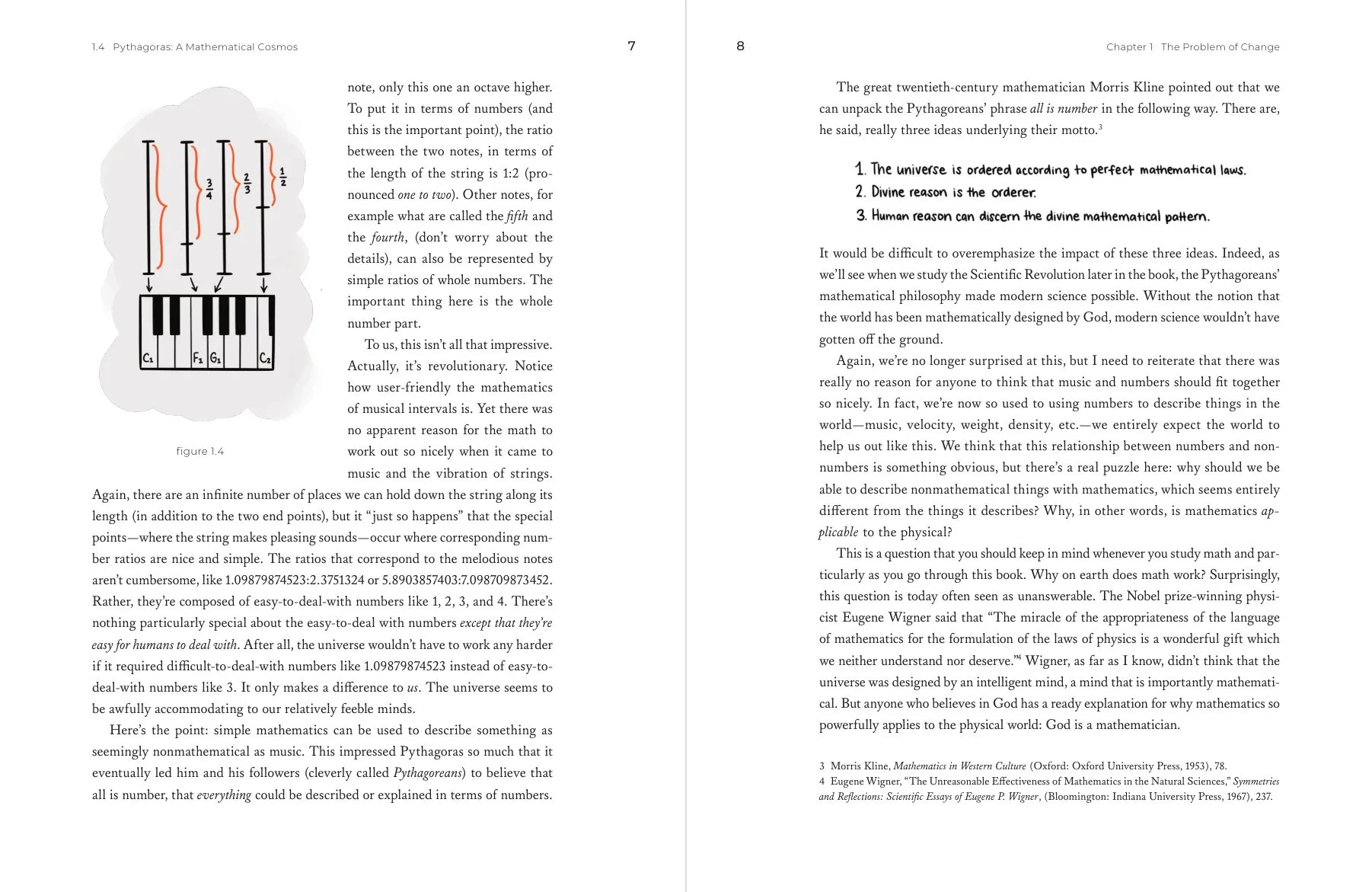
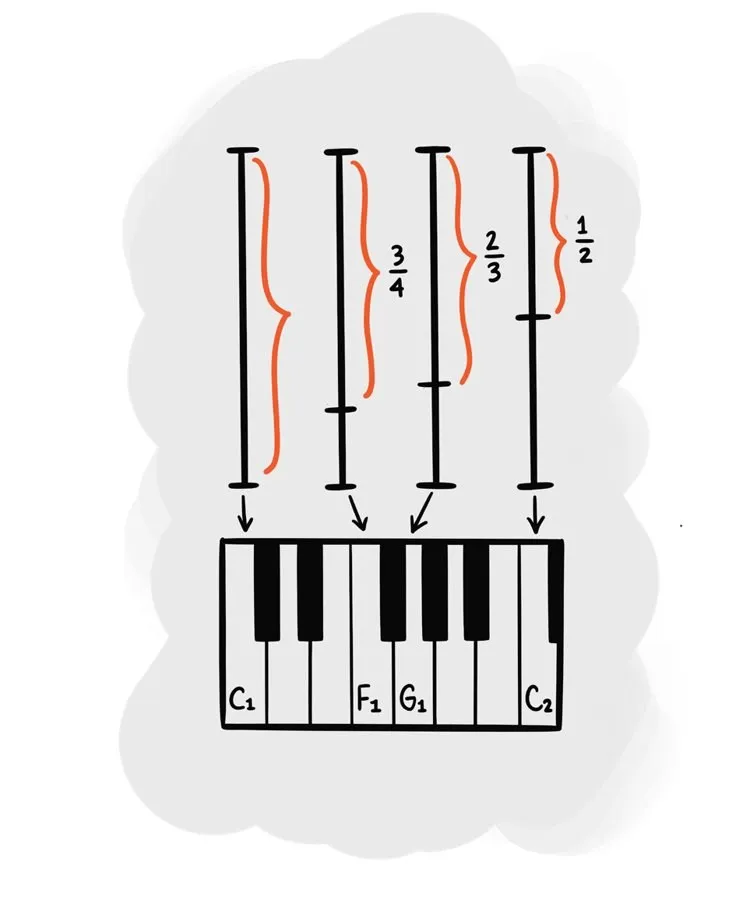
Hand-drawn strings over piano keys, marked one half, two thirds and three quarters.
The liberal arts

Math was always a liberal art

Arithmetic, geometry, astronomy and music: “More than half of the liberal arts (four-sevenths, if we’re doing the math) are Pythagorean mathematics.” Chapter 1
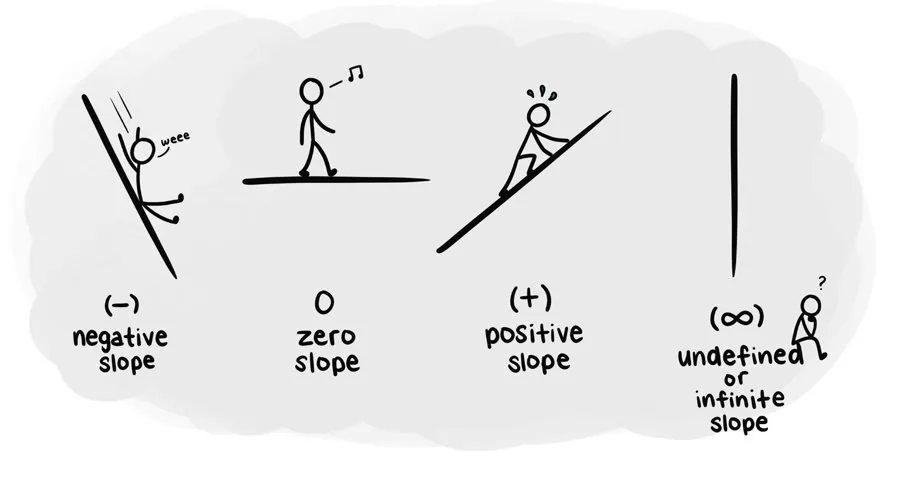
Stick figures sliding down, standing on, climbing and clinging to slopes.
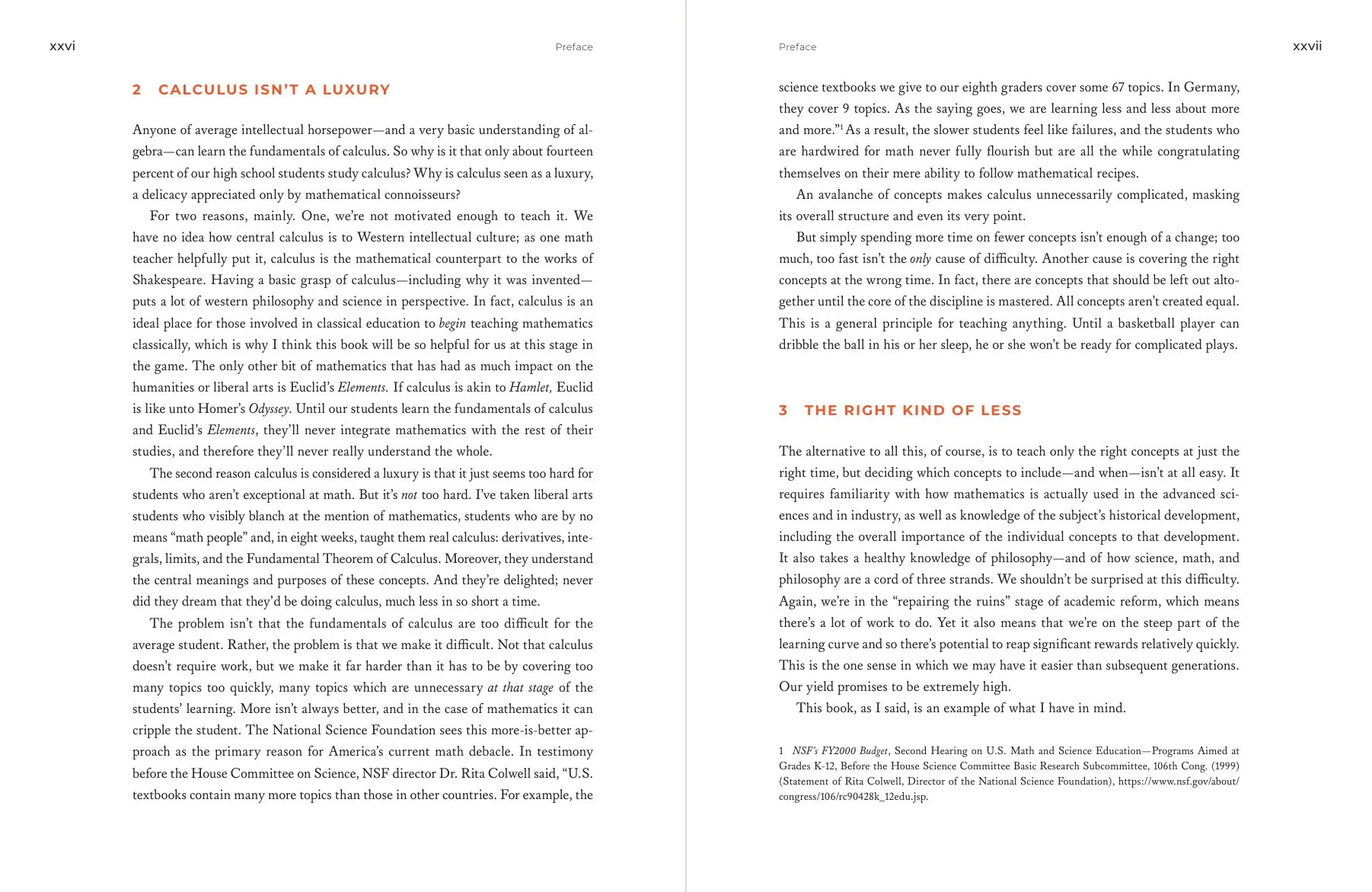
Calculus isn’t a luxury

For every student, not a few

“Anyone of average intellectual horsepower—and a very basic understanding of algebra—can learn the fundamentals of calculus.” Preface
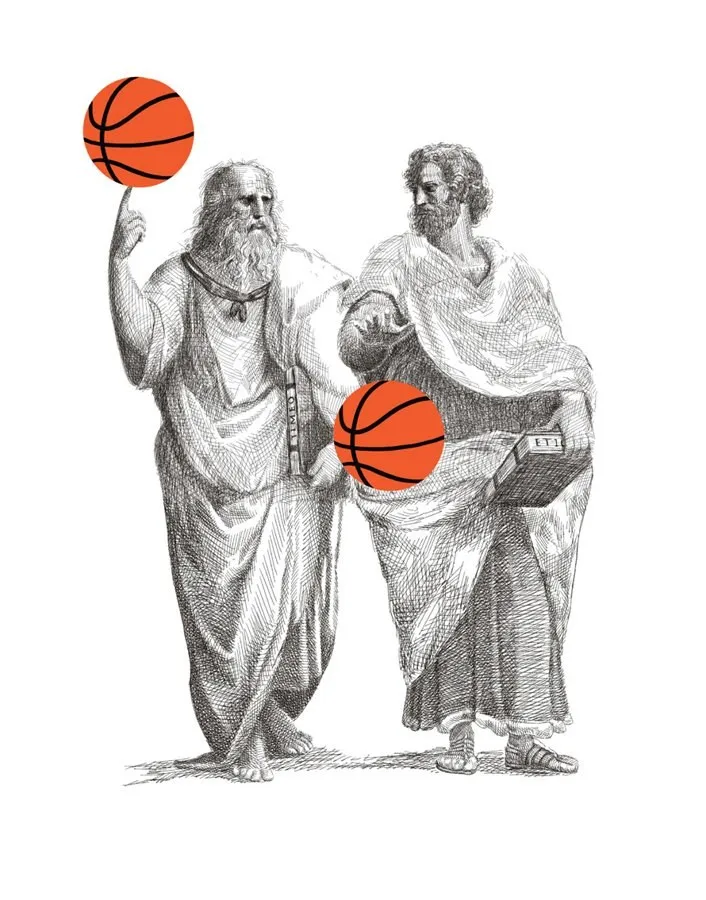
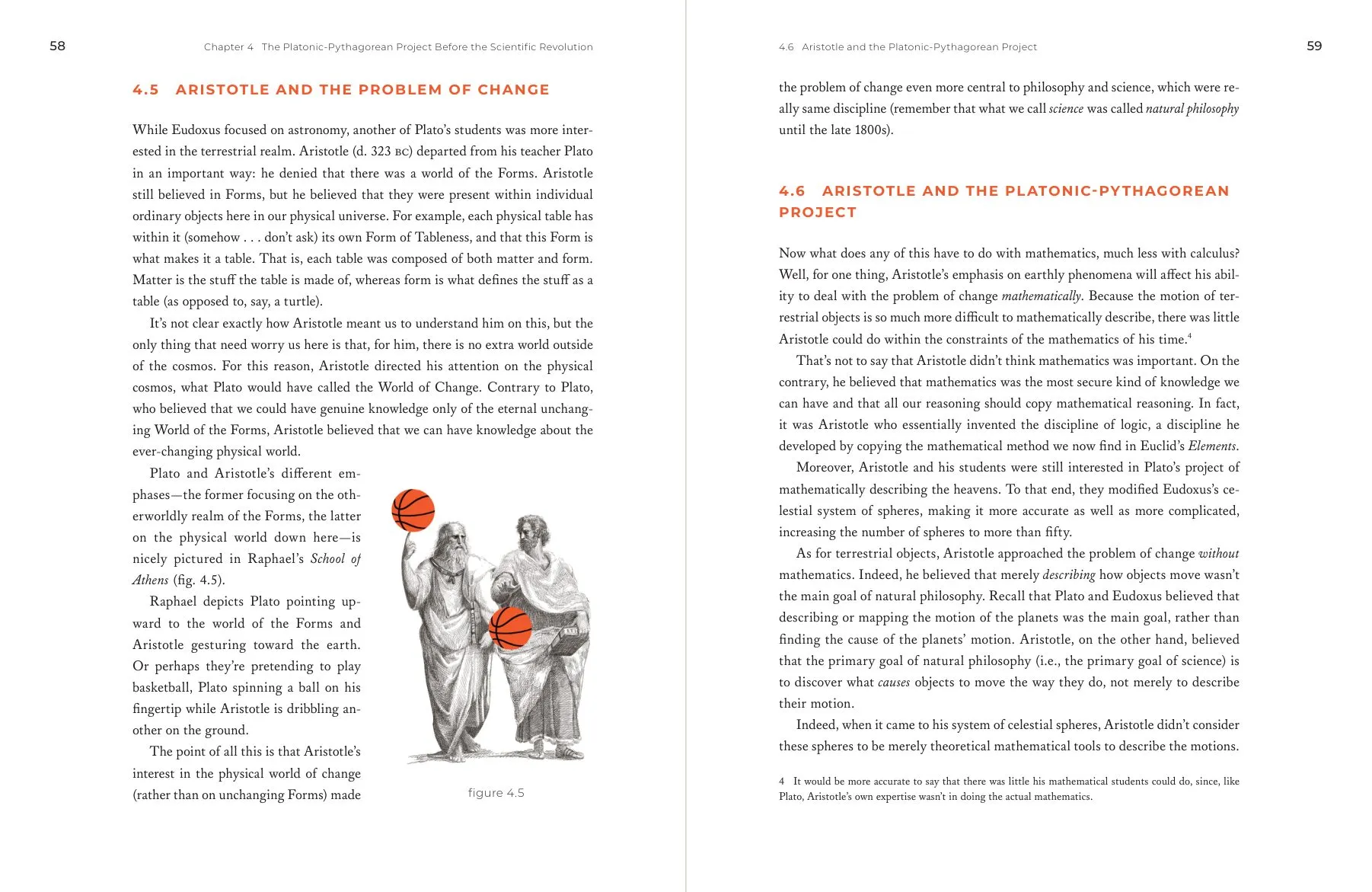
Plato and Aristotle from Raphael’s School of Athens, redrawn with basketballs.
The great conversation

The Hamlet of mathematics

“If calculus is akin to Hamlet, Euclid is like unto Homer’s Odyssey.” Preface

The story calculus tells

Western philosophy began around 600 BC with one question: why do things change? Calculus is the answer two thousand years in the making, so the book teaches it the way it happened.
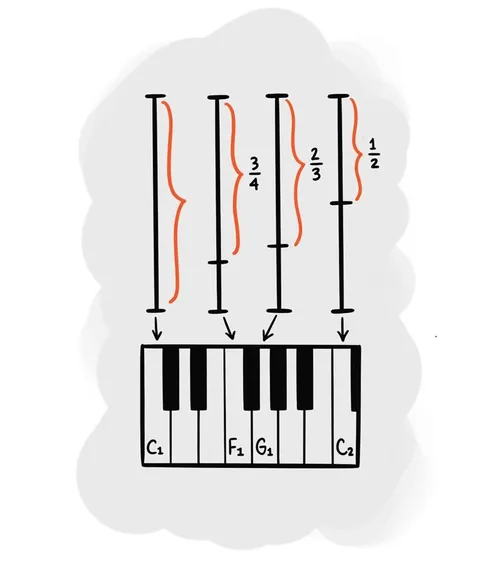
  1. Hand-drawn strings over piano keys.
    c. 530 BC

    Pythagoras

    Plucked strings obey whole-number ratios. All is number.
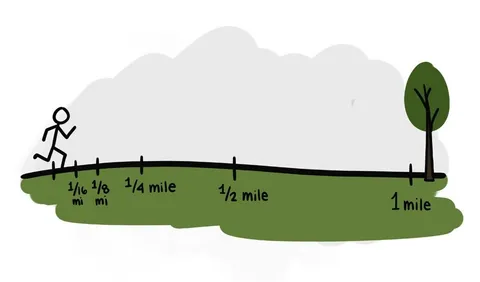
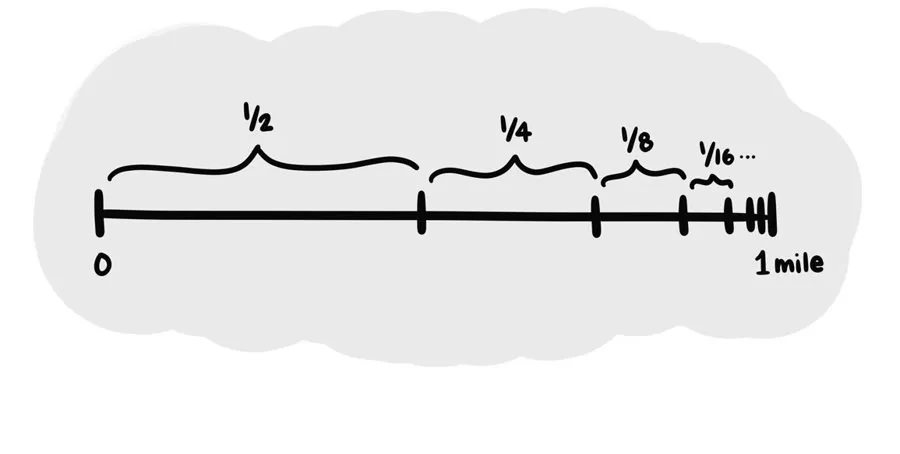
  2. A stick figure running a mile marked in halves.
    c. 450 BC

    Zeno

    Before you run a mile you must run half of it, and half of that… Is motion even possible?
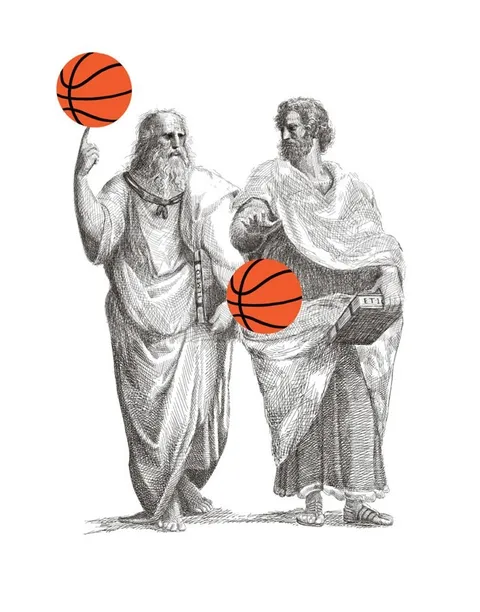
  3. Plato and Aristotle with basketballs.
    4th c. BC

    Plato & Aristotle

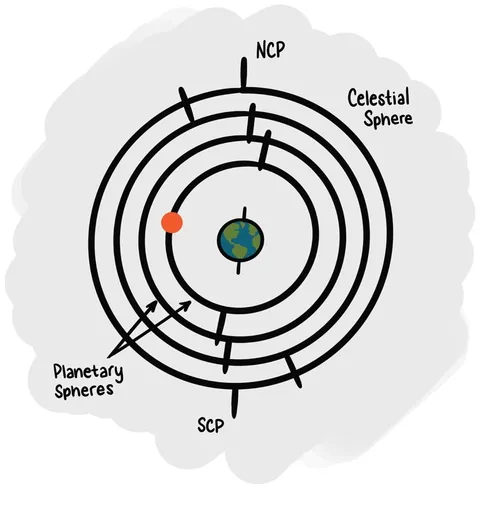
    Plato sets his Academy homework: describe the heavens with mathematics.
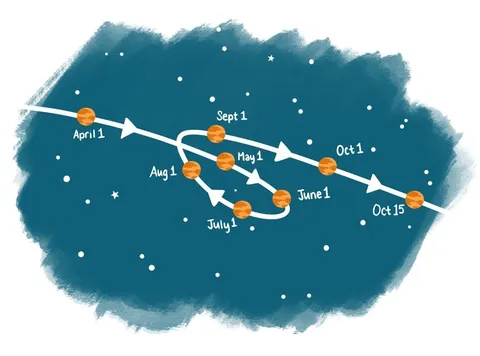
  4. The looping path of Mars against a night sky.
    Eudoxus to Ptolemy

    Circles in the sky

    Mars wanders backwards, and astronomers chase it with perfect circles.

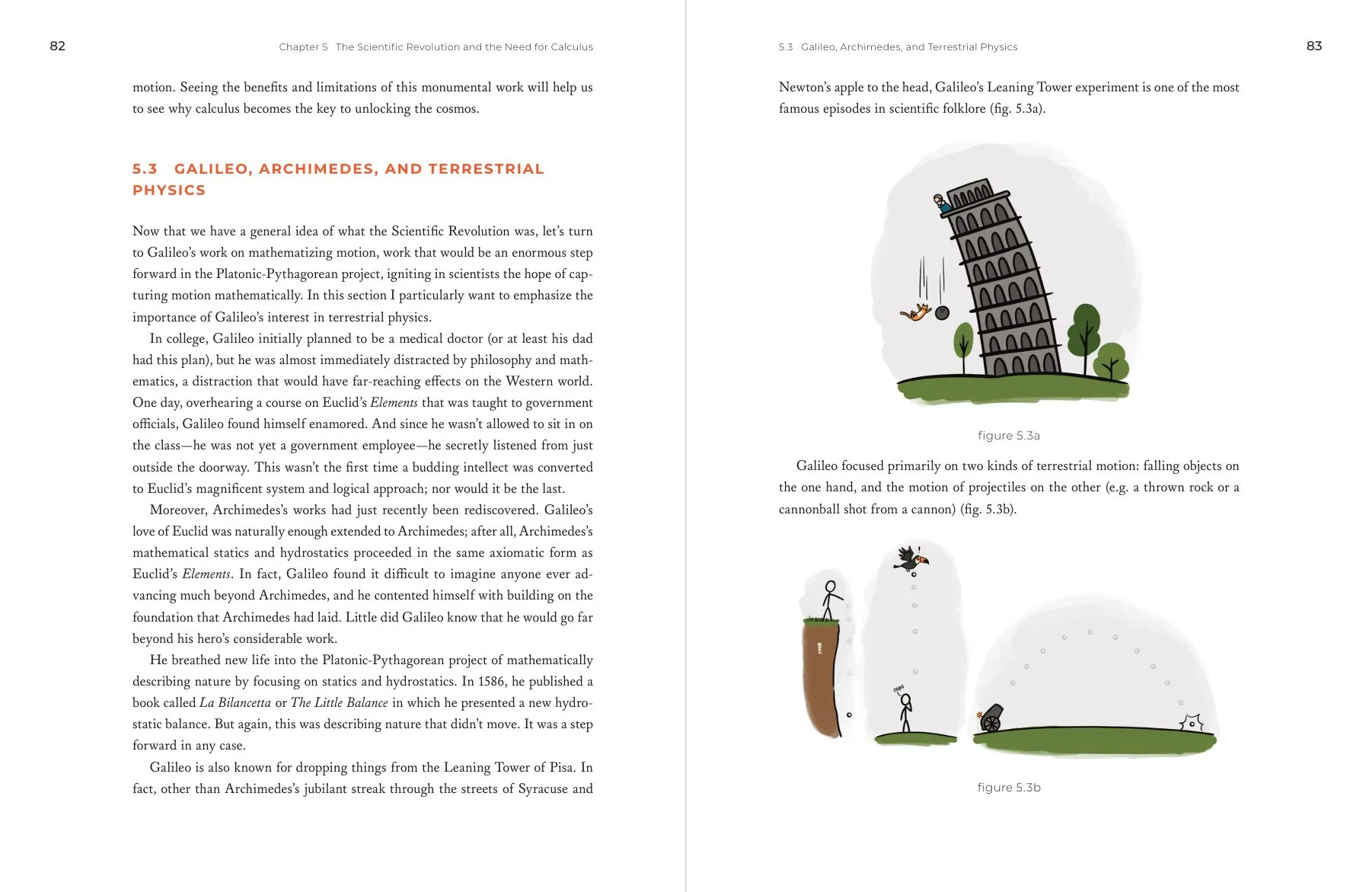
  5. Galileo at the top of the Leaning Tower of Pisa.
    1600s

    Galileo

    The book of nature “is written in mathematical language” (The Assayer).
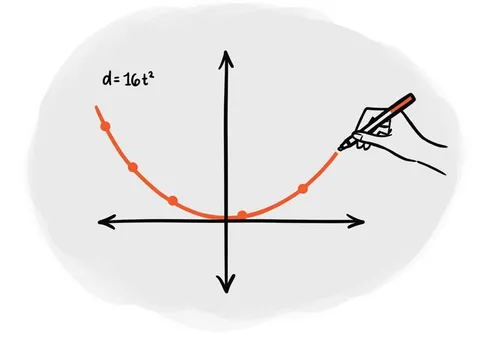
  6. A hand drawing an orange parabola.
    1687

    Newton

    Calculus tames the paradox of speed and unites heaven and earth.

…and then back to Zeno.

Playful pages. Serious math.

Over 600 hand-drawn illustrations by Summer Stokes, who also designed the book’s layout. Every equation is hand-lettered and every key idea circled in orange, like the notebook of a teacher who loves the subject.
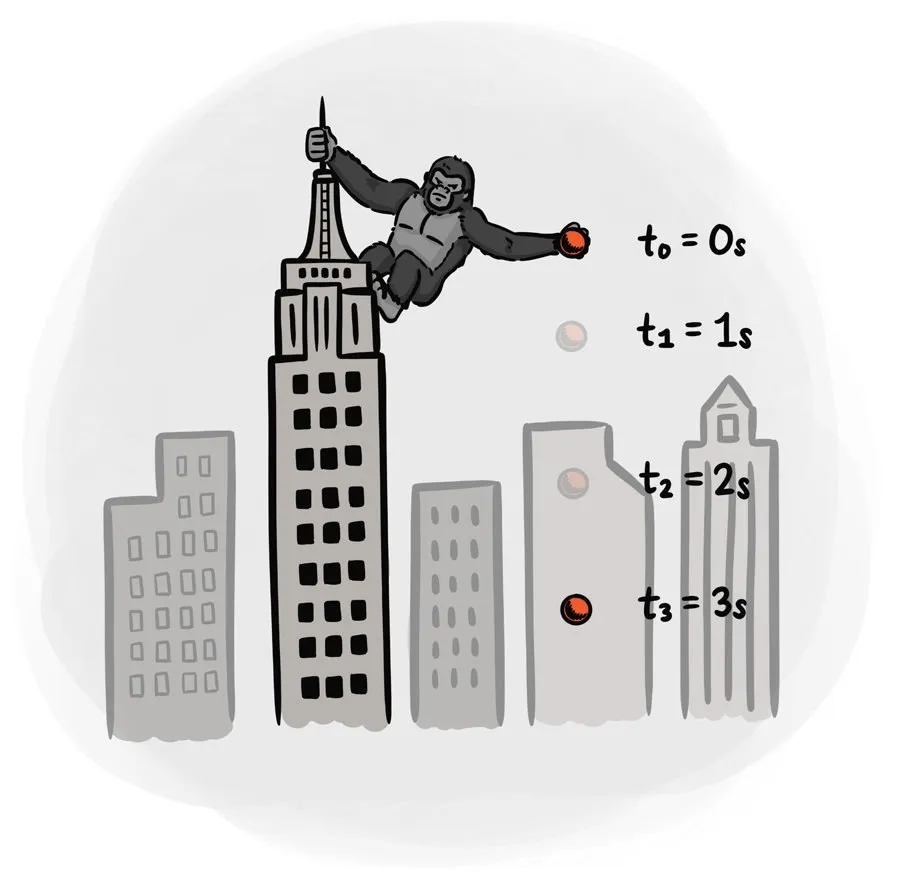
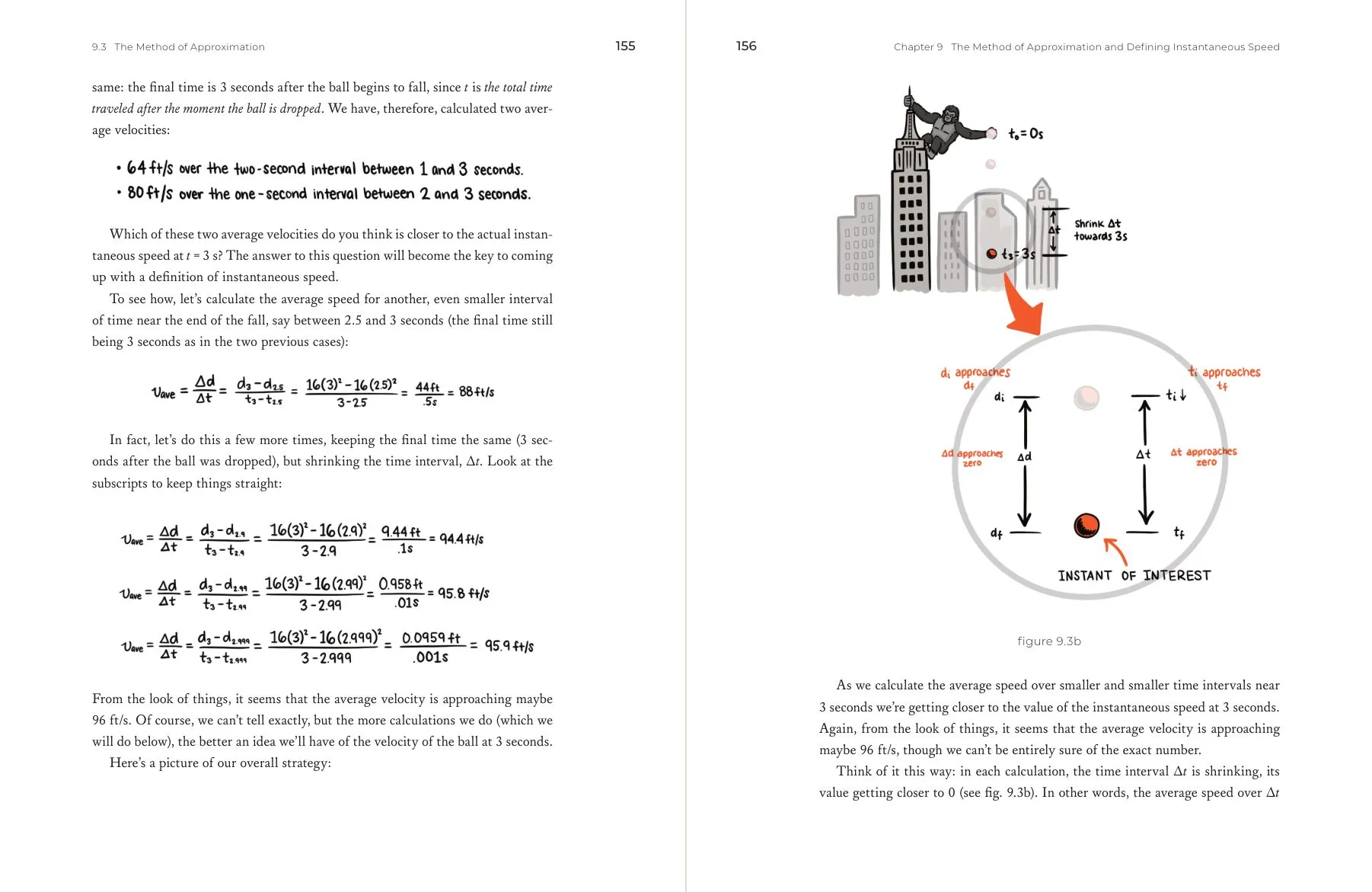
A gorilla atop a skyscraper drops a ball, marked at each second.
“The smaller we make the time interval, the closer the average velocity approximates the instantaneous velocity.”Chapter 9
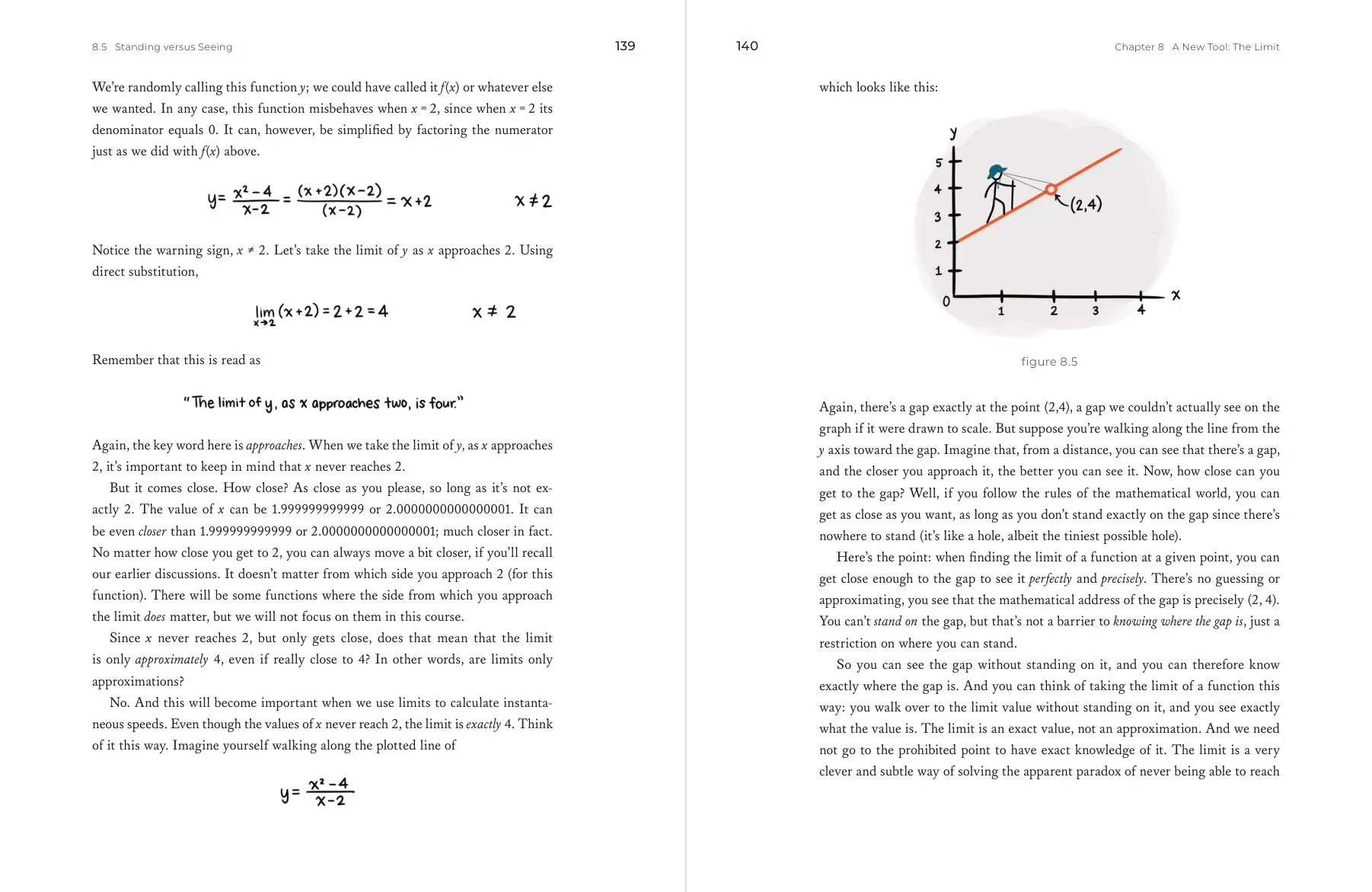
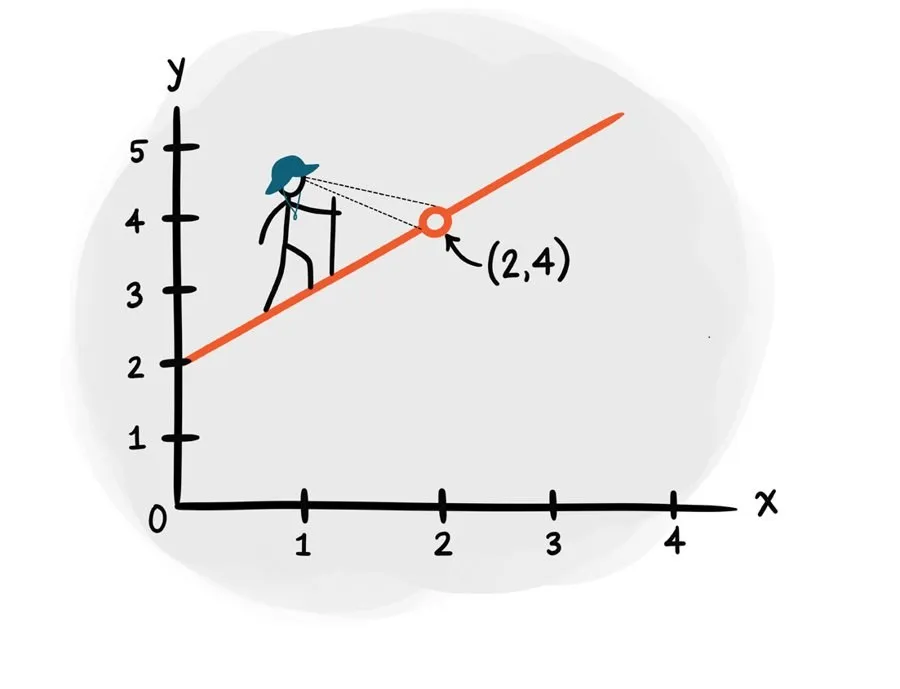
A stick figure walks up a line toward a gap at the point (2, 4).
“You can’t stand on the gap, but that’s not a barrier to knowing where the gap is, just a restriction on where you can stand.”Chapter 8 · The limit
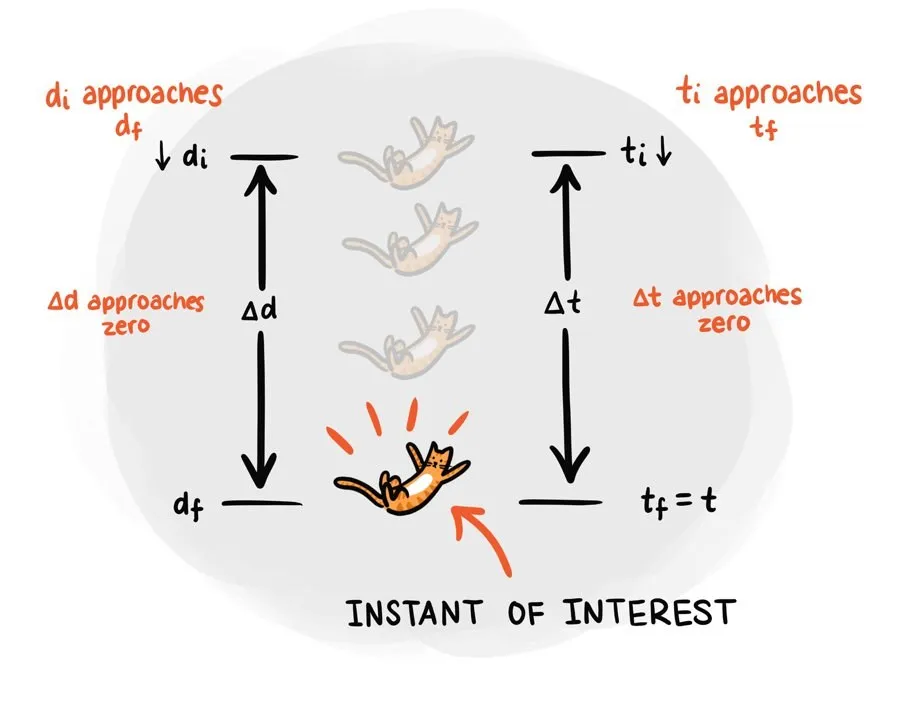
A cat falling, feet first, past the instant of interest.
“…let’s drop a cat.… And don’t worry; cats always land on their feet.”Chapter 11
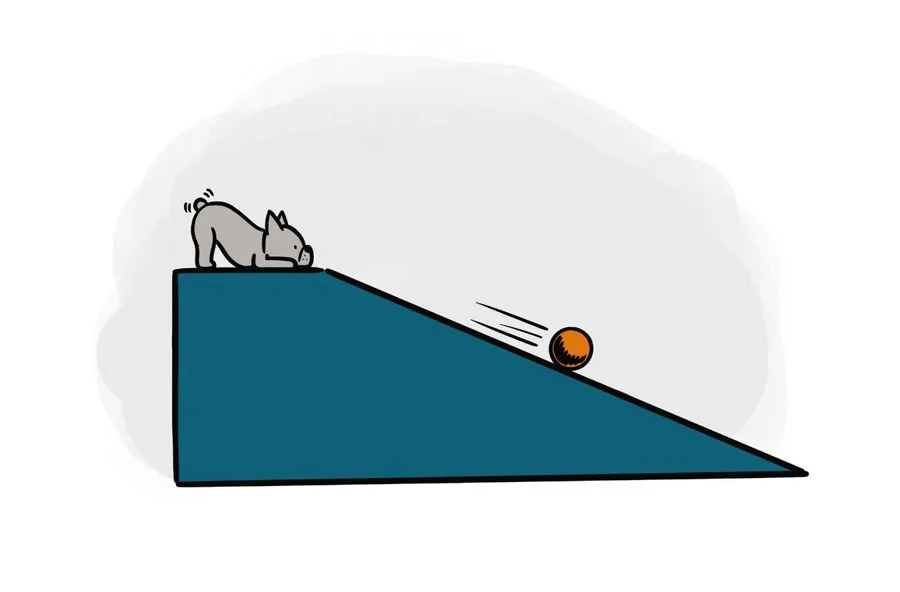
A cat watches a ball roll down a teal ramp.
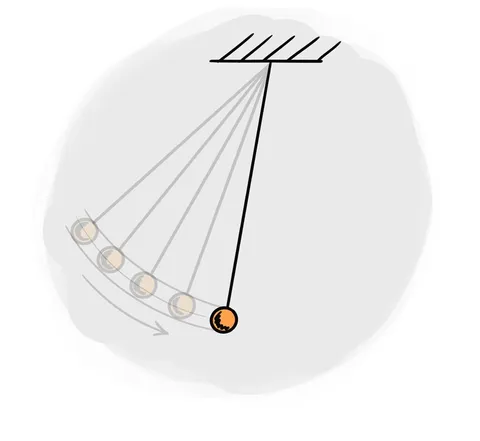
“To slow things down, Galileo rolled very smooth balls down very smooth ramps called inclined planes.”Chapter 5
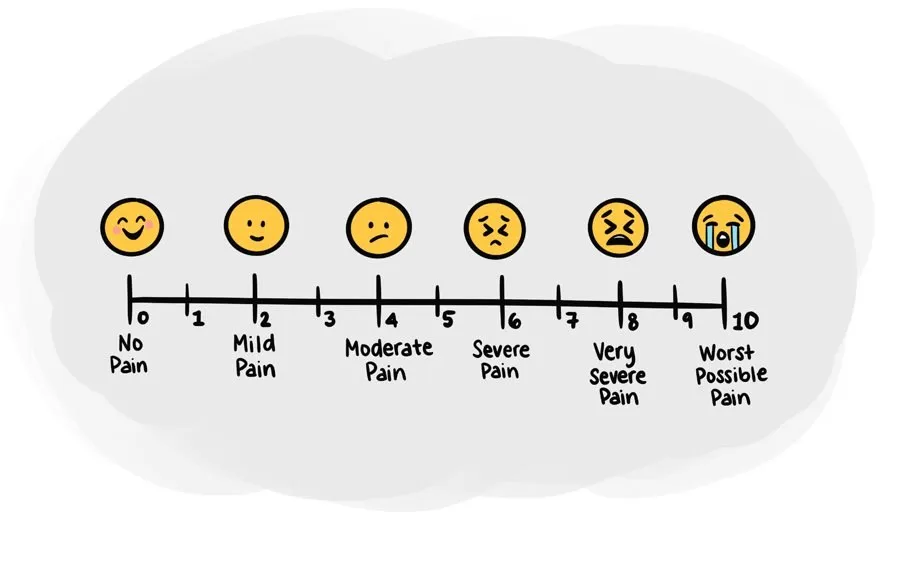
The emergency-room pain scale of faces from zero to ten.
“And what about pain, beauty, love, hunger, thirst, good, and evil? Can we quantify these? Again, probably not.”Chapter 7
Stick figures on negative, zero, positive and vertical slopes.
“…a derivative of a function is the slope of that function.”Chapter 16
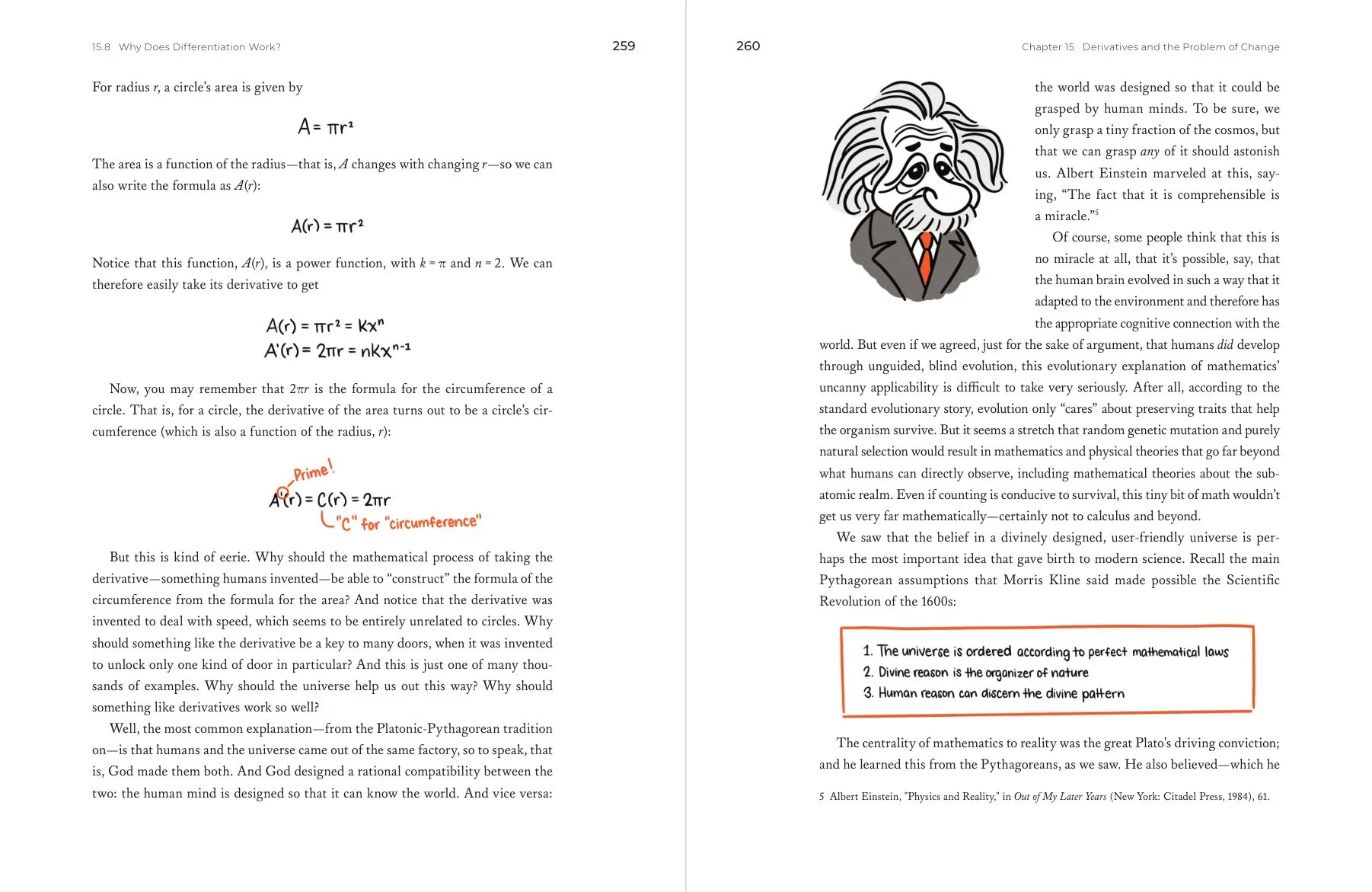
A caricature of Albert Einstein.
“The fact that it is comprehensible is a miracle.”Albert Einstein, quoted in chapter 15
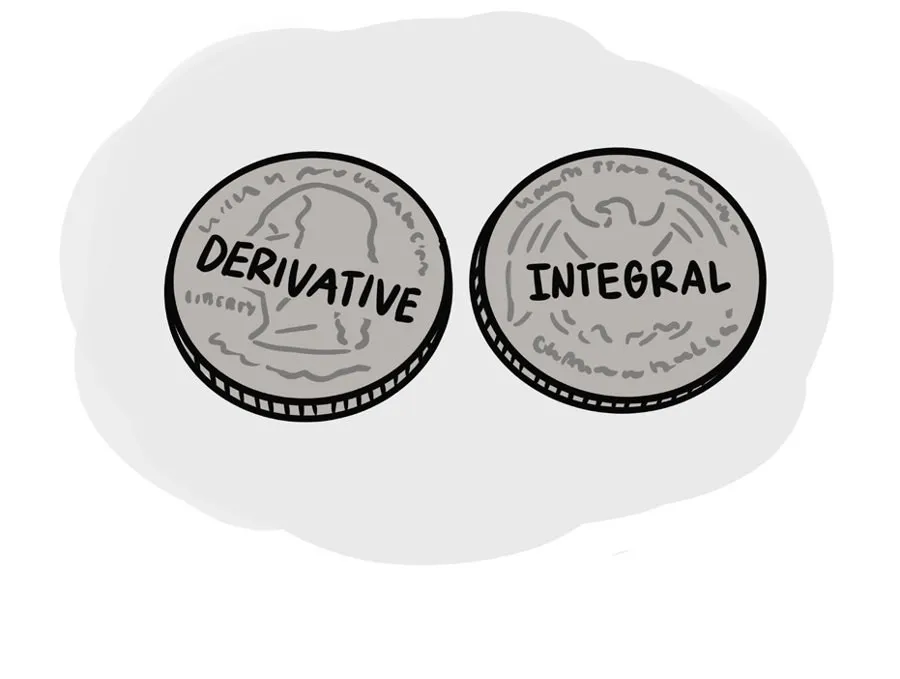
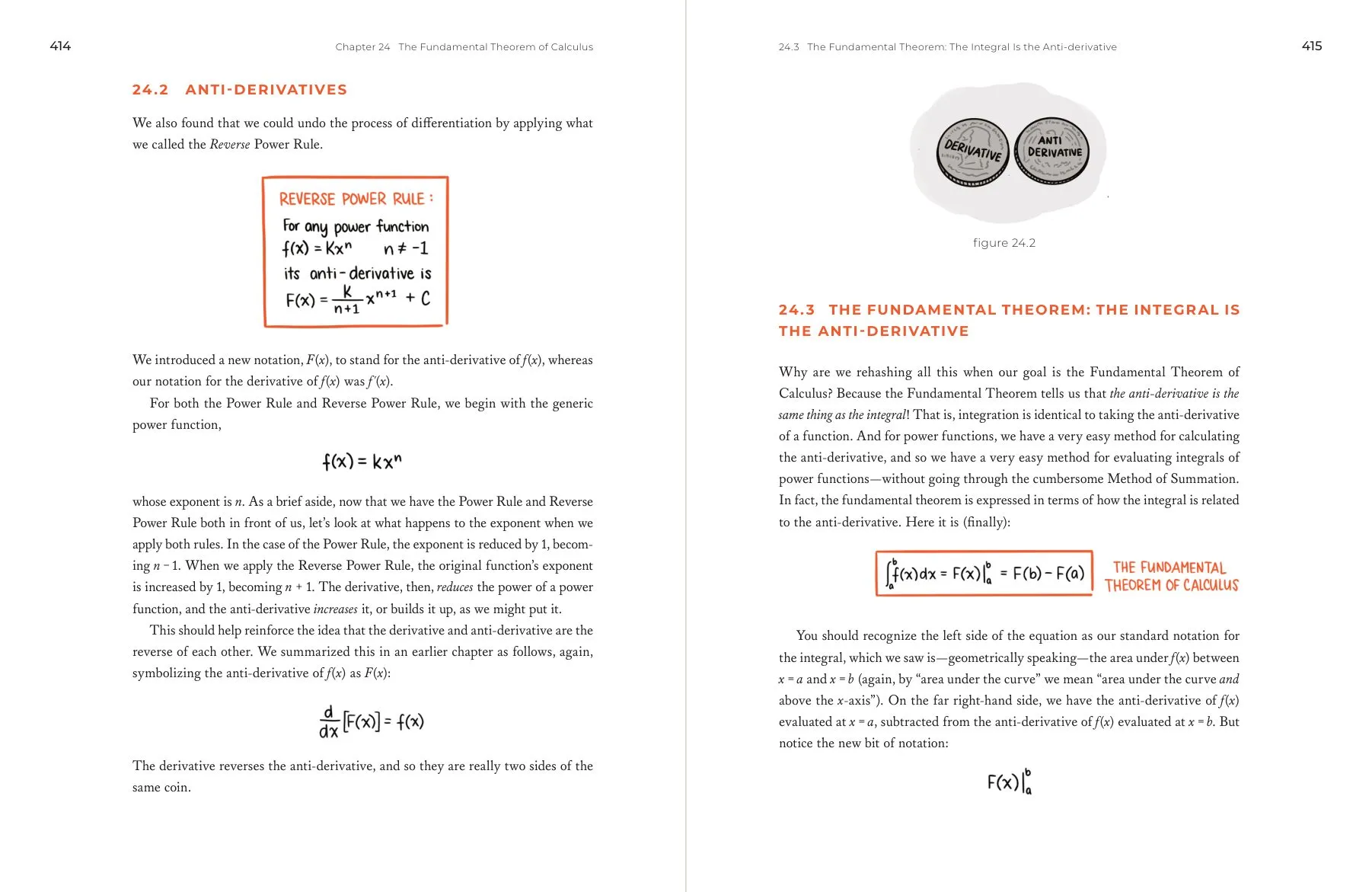
Two coins labelled derivative and integral.
“…the derivative and the integral are two sides of the same coin.”Chapter 24 · The Fundamental Theorem

How it teaches

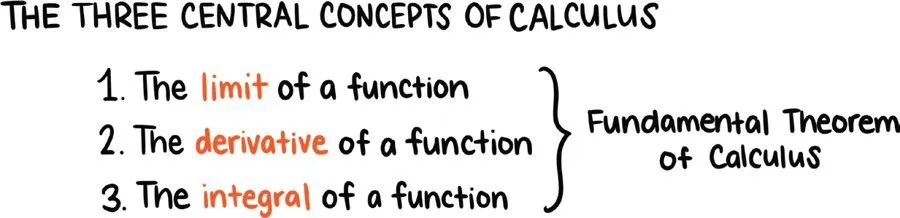
  • Majors on the majors. Limits, derivatives, integrals and the Fundamental Theorem, understood as one whole.
  • Sees the calculus part. Power functions only, so the ideas aren’t buried under tricks for every kind of function.
  • The long way first. The Method of Increments and the Method of Summation come before the shortcuts.
  • Three ways at once. Every idea in numbers, in pictures, and in the physical world of falling objects.
  • Grammar, then practice. Study questions in each chapter, exercises to work, exams in the answer key.
  • Safety first! Students learn the forgotten art of reading a math text, and how to write out every step to fully understand the process, not just the answer.
Hand-lettered: the three central concepts of calculus. 1, the limit of a function. 2, the derivative of a function. 3, the integral of a function. Joined by the Fundamental Theorem of Calculus.

“There is no reason that it should be so powerful or useful, none other than the kindness of God. Mathematics is a gift.”

Chapter 11 · Mathemagical?
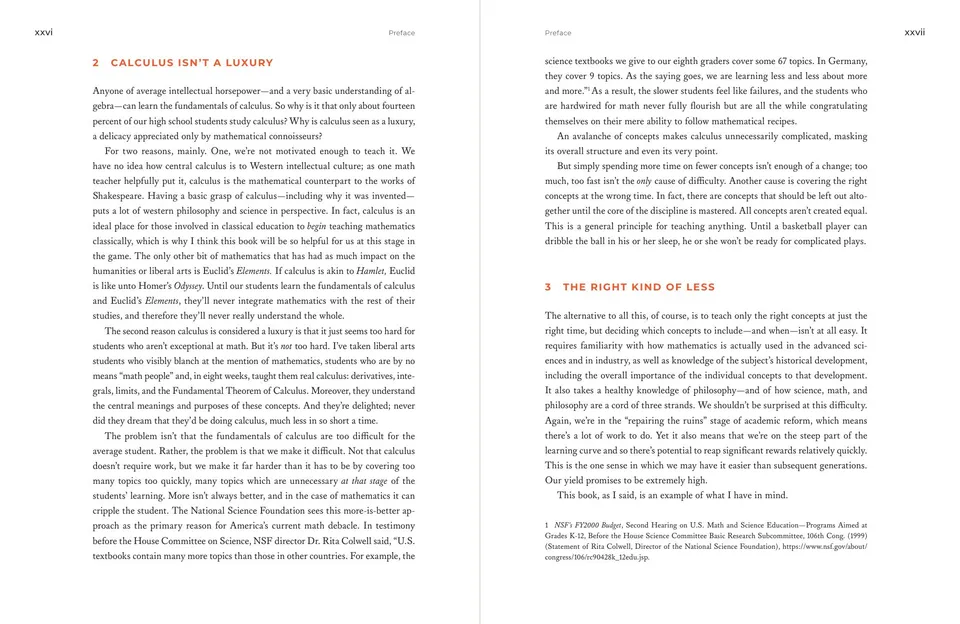
Look inside the book

Calculus isn’t a luxury, Preface, pp. xxvi–xxvii
Calculus isn’t a luxuryPreface, pp. xxvi–xxvii · spread 1 of 10
The full table of contents25 chapters and an epilogue, 490 pages

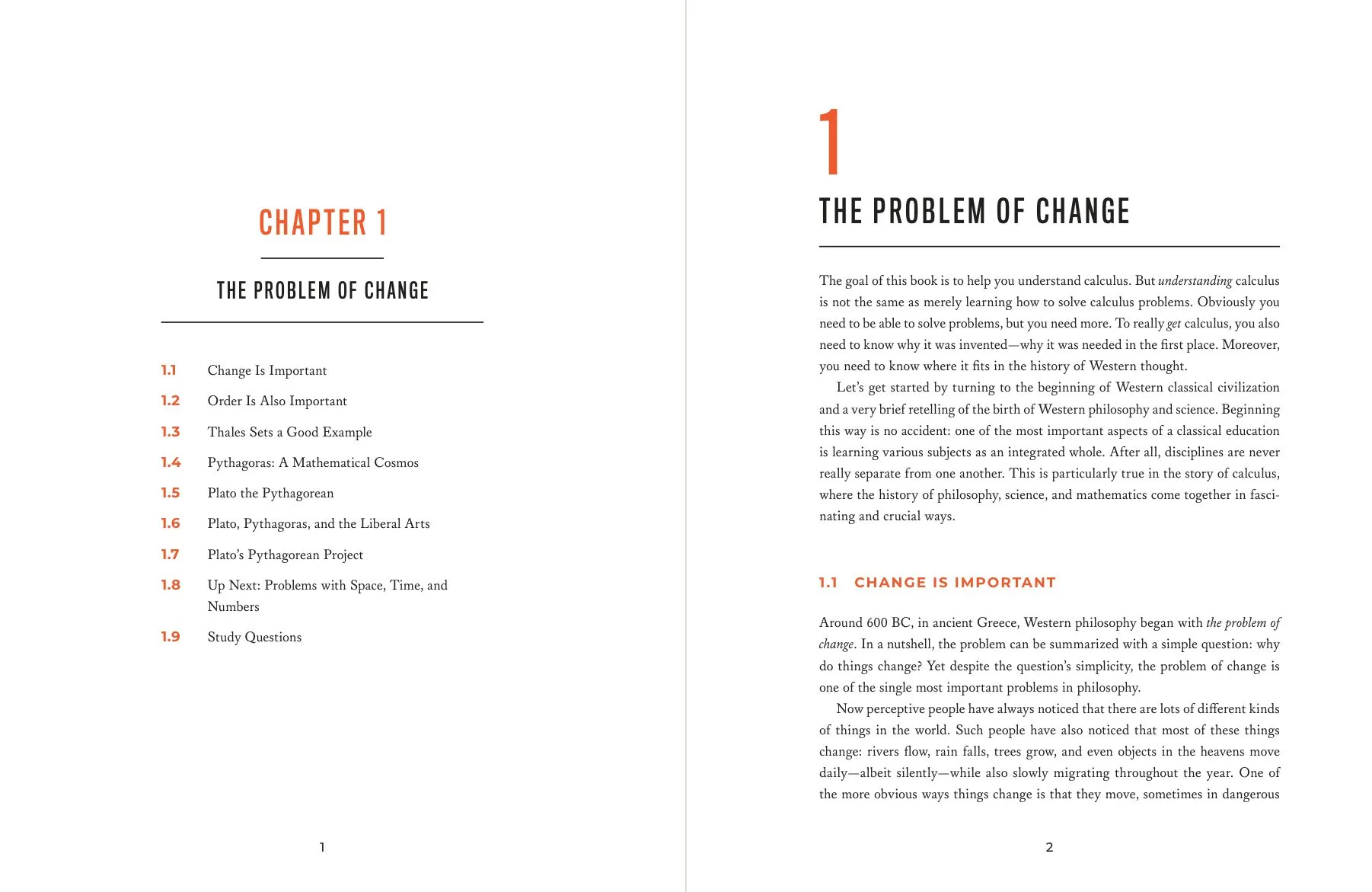
Front matter · Acknowledgments · How to Use This Book · Preface: Mathematics and a Classical Christian Education, Calculus Isn’t a Luxury, The Right Kind of Less

1The Problem of Changep. 1Change Is Important · Order Is Also Important · Thales Sets a Good Example · Pythagoras: A Mathematical Cosmos · Plato the Pythagorean · Plato, Pythagoras, and the Liberal Arts · Plato’s Pythagorean Project
2Space, Time, and Numbersp. 17Zeno’s Paradox: Is Change Even Possible? · Problems with Space · Representing Physical Objects with Mathematical Ones · Problems with Numbers · Quantifying the World: Numbers as Stand-Ins · Problems with Time · The Problem of Motion and User-Friendliness
3The Paradox of Speedp. 37Average Speed versus Instantaneous Speed · An Instant: A Point in Time · Introducing the Delta Notation · Applying the Delta Notation to Speed · Is Our Definition of Speed Coherent?
4The Platonic-Pythagorean Project before the Scientific Revolutionp. 49The Big Picture (So Far) · Eudoxus Is the First to Complete His Homework · Geometry and the Influence of Euclid’s Elements · What about Terrestrial Objects? · Aristotle and the Problem of Change · Aristotle and the Platonic-Pythagorean Project · Aristotle’s Physics · Aristotle’s Physics of Free Fall · Archimedes: Mathematics and Statics
5The Scientific Revolution and the Need for Calculusp. 75What Is the Scientific Revolution? · Copernicanism, Pythagoreanism, and Cosmology · Galileo, Archimedes, and Terrestrial Physics · Free Fall: Galileo versus the Aristotelians · Updating Galileo’s Law · A Way to Calculate Instantaneous Velocity? Alas.
6Newton and Calculusp. 97Newton Unifies the Universe · The Enlightenment · What Is Calculus? · Why Is It Called Calculus?
7The Essential Tools: Variables, Functions, and Graphsp. 111Variables and the Problem of Change · Which Physical Properties Can Numbers Stand For? · Interpreting and Predicting · Functions: Relations between Variables · Graphs: Pictures of Functions · Descartes and Analytic Geometry · Some Conventions Regarding Functions
8A New Tool: The Limitp. 129Approaching a Forbidden Value · Approaching the Limit · Remembering a Function’s History · Same Limit, Different Behavior · Standing versus Seeing
9The Method of Approximation and Defining Instantaneous Speedp. 145The Need for Speed · Free Fall and Average Speed · The Method of Approximation · Defining Instantaneous Speed
10Using the Method of Increments to Calculate Instantaneous Speedp. 163Remember: Dividing by 0 Is Illegal · We Need a Different Formula for Average Velocity · Finding a Formula for Average Velocity · The Big Picture: The Method of Increments · Approaching the Instant from the Opposite Direction
11Using the Method of Increments to Find an Instantaneous Speed Functionp. 179Finding v(t) · Galileo Would Be Proud (or Jealous) · Mathemagical? An Example of Mathematics’ Power · Appreciating v(t)
12The Derivativep. 191Instantaneous Speed and the Derivative · Derivative: The Definition · Rate of Change at an Instant · The Method of Increments in Terms of Rate of Change · Example: Using the Method of Increments to Find the Derivative · Derivatives versus Plain Ol’ Limits · Notation
13Finding More Derivativesp. 209The Derivative for Any Function of the Form y(x) = ax² · An Infinite Number of Calculations · … y(x) = bx · … y(x) = c · … y(x) = ax² + bx + c · The Derivative of a Derivative (of a Derivative)
14Using the Power Rule to Find Derivativesp. 229The Power Rule · Derivatives for a Sum of Power Functions · Other Kinds of Functions
15Derivatives and the Problem of Changep. 241Acceleration: How Fast Speed Changes · Up versus Down: Taking Direction into Account · Dropping an Object · Interpreting Mathematics · Throwing an Object Straight Up · Throwing an Object Straight Down · Free Fall in General · Why Does Differentiation Work?
16Graphs and Slopesp. 267Graphs · Slopes · Start with Δx and Δy · A Changing Slope · The Derivative as Slope
17Slopes and Derivativesp. 281Finding Δy/Δx · The Derivative: The Instantaneous Slope · Slopes and the Method of Increments · What about the Power Rule?
18Slopes and the Problem of Changep. 295Mathematical Pictures versus Physical Pictures · Slopes and Free Fall: d(t) · Slopes and Free Fall: v(t) · Slopes and Free Fall: a(t)
19More Information from Derivatives and Their Graphsp. 307Extracting Information from Derivatives · Slope versus y-Value (Again) · Derivatives of Derivatives
20Looking Closer at Graphs of Free Fallp. 323The Problem of Change · Galileo’s Law of Free Fall · Taking Direction into Account Again · Interpreting the Height, Velocity and Acceleration Functions’ Graphs · Combining All Three Functions on a Single Graph · An Object Thrown Vertically Upward
21The Anti-derivative: Undoing Derivativesp. 347The Reverse Power Rule: A First Approximation · A Problem with the Approximation · The Correct Reverse Power Rule · Some New Notation · Anti-derivatives for a Sum of Power Functions · Anti-derivatives: Not Just for Power Functions · The Problem of Change and Finding C · Notation: Finding Two C’s · Finding C’s from a Graph
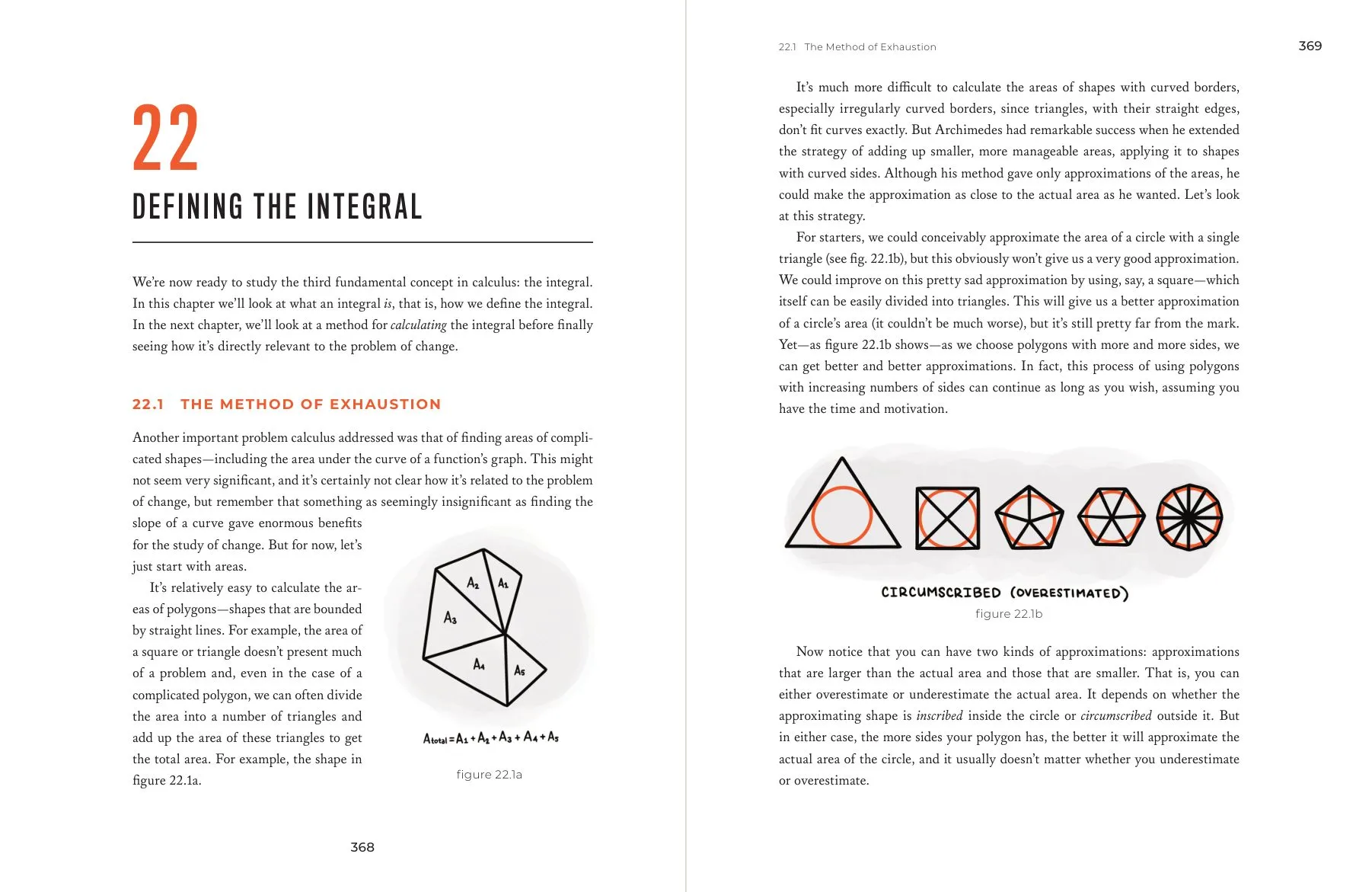
22Defining the Integralp. 367The Method of Exhaustion · Integrals and Area · Area under a Curve: Integrals and Functions · Integrals and Circumscribed Rectangles
23Using the Method of Summation to Calculate Integralsp. 383The Method of Summation · Special Sum Rules · Inscribed Areas · Circumscribed Areas · More (Complicated) Examples: y(x) = x² · The Integral Notation
24The Fundamental Theorem of Calculusp. 411Derivatives and Integrals · Anti-derivatives · The Fundamental Theorem: The Integral Is the Anti-derivative · Derivatives and Integrals (Again) · Indefinite Integrals (versus Definite Integrals) · Integrals and the Problem of Change · Coming to Terms with Calculus: Integrate · Coming to Terms with Calculus: Differentiate
25Interpreting Areasp. 433Interpreting the Area of Acceleration Functions · Interpreting the Area of Velocity Functions · Interpreting the Area of Height Functions
EEpilogue: The Problem of Changep. 447Pythagoreanism Today · (Much) More to Come · But What about Zeno?

The curriculum

Everything a student, parent or teacher needs: the textbook, the answer key with exams and schedules, and Dr. Stokes teaching every chapter on video.

Textbook

490 pages, hardcover, full color, over 600 hand-drawn illustrations.

Algebra 1is the only prerequisite
Grades 9–12and college
16 or 32 weeksone semester or a full year, with schedules for both
One credithigh-school math, or introduction to physics
26 chaptersfrom the problem of change to the Fundamental Theorem
32 video lessonsevery chapter taught by the author
Transcript FAQ

The course earns one high-school math credit or one high-school Introduction to Physics credit.

For schools and co-ops

Group licenses for the video course, and a live online class through Kepler Education. Group pricing · Live class

Corrections

Earlier printings: download the errata sheet. Found a mistake? Tell us.

Chosen by Classical Conversations

The resource for the Challenge IV Research strand, from 2025–26

Part of the Classical Conversations Challenge IV program starting Fall 2025. Students read the history, philosophy and mathematics of change together, the way the classical tradition always meant them to be read.
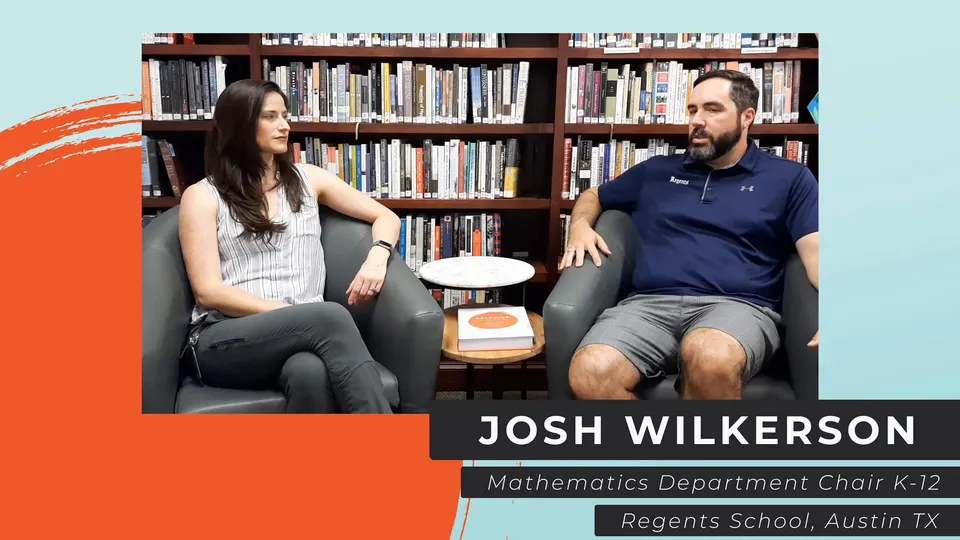
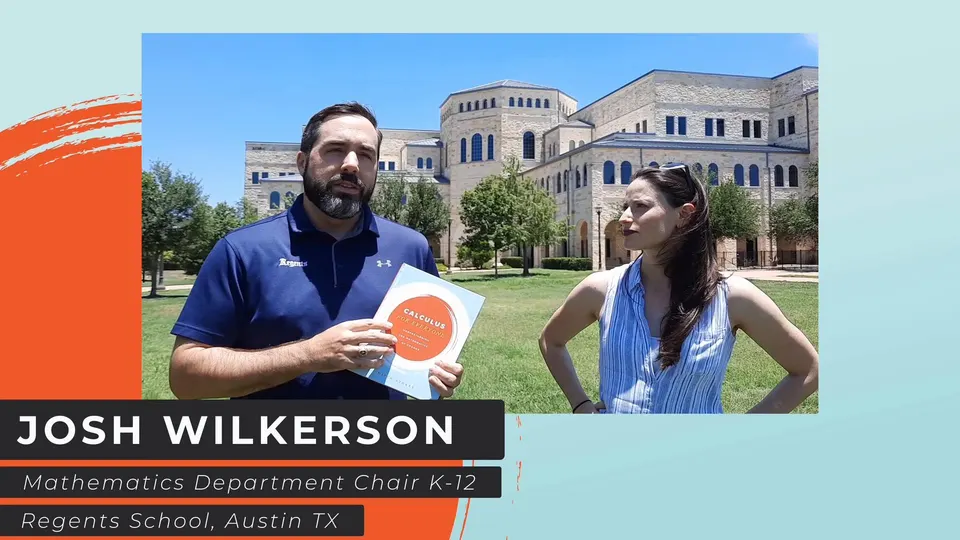
“It doesn’t feel like a math class”

2:51
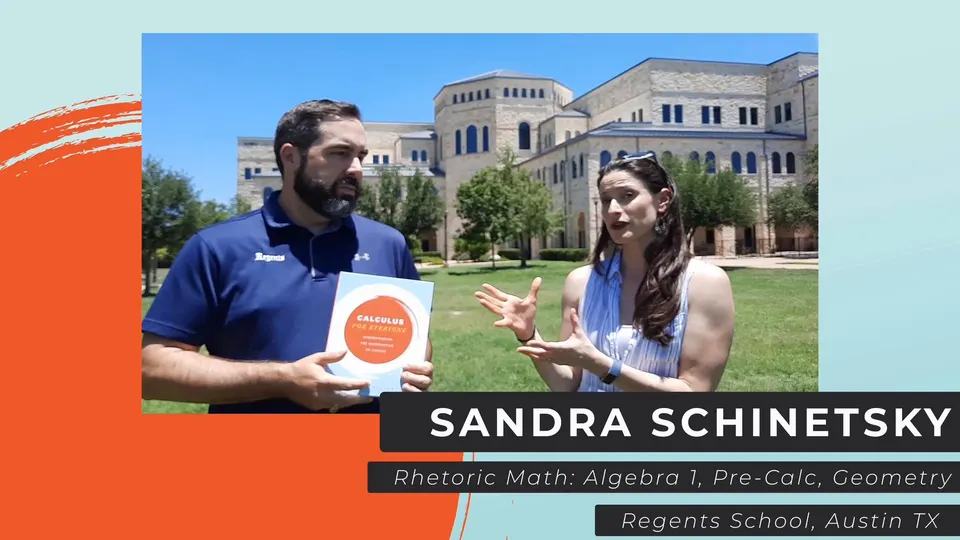
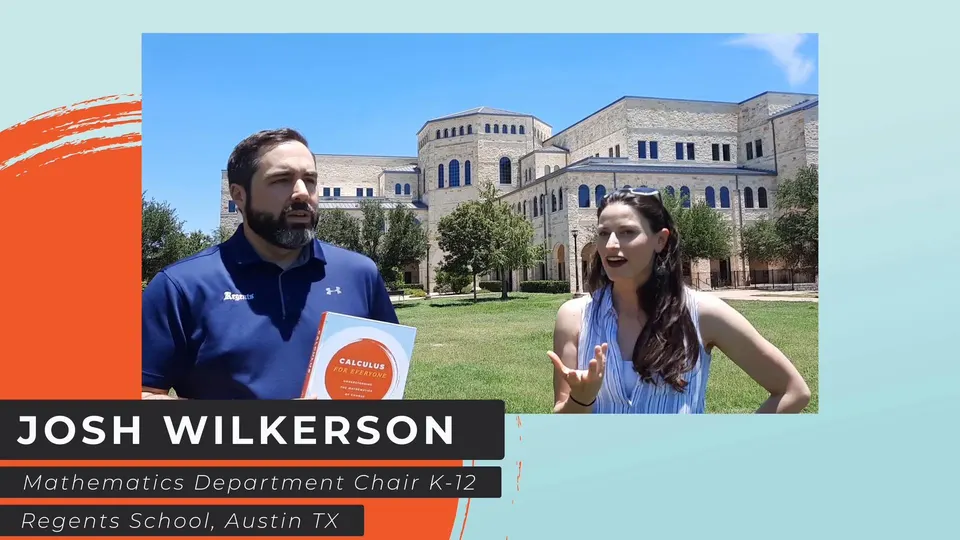
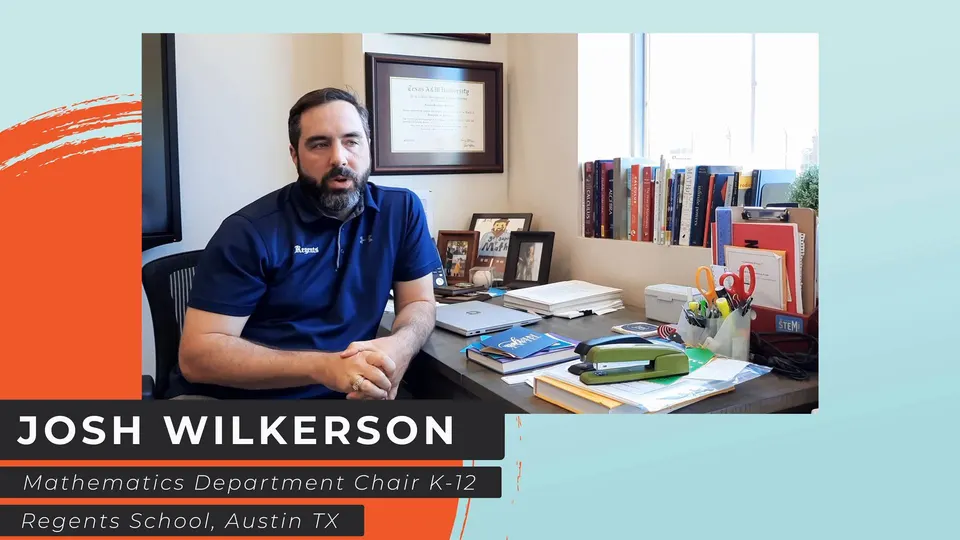
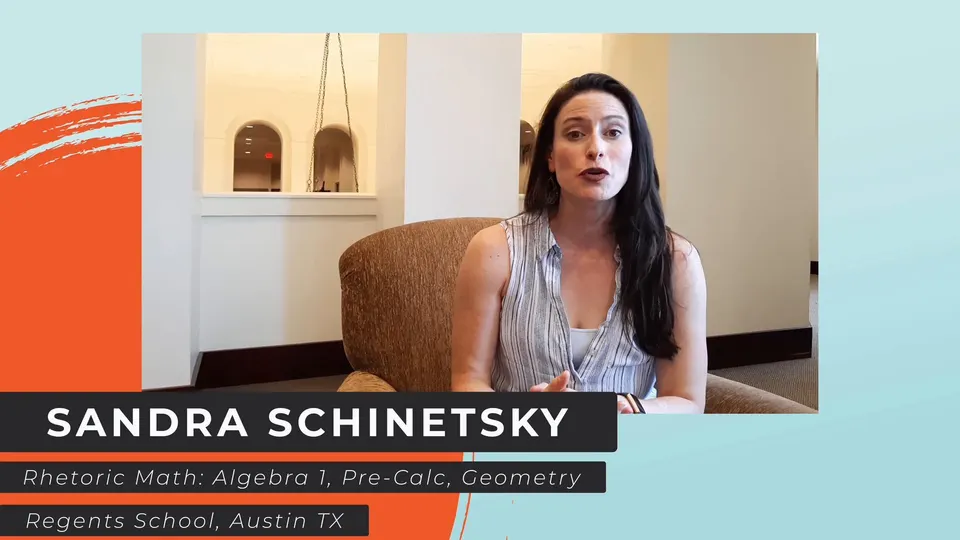
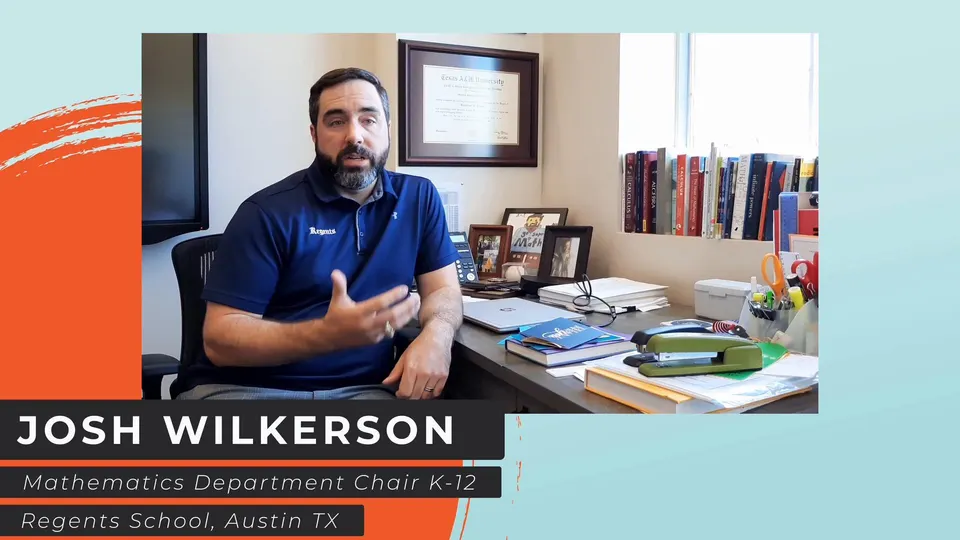
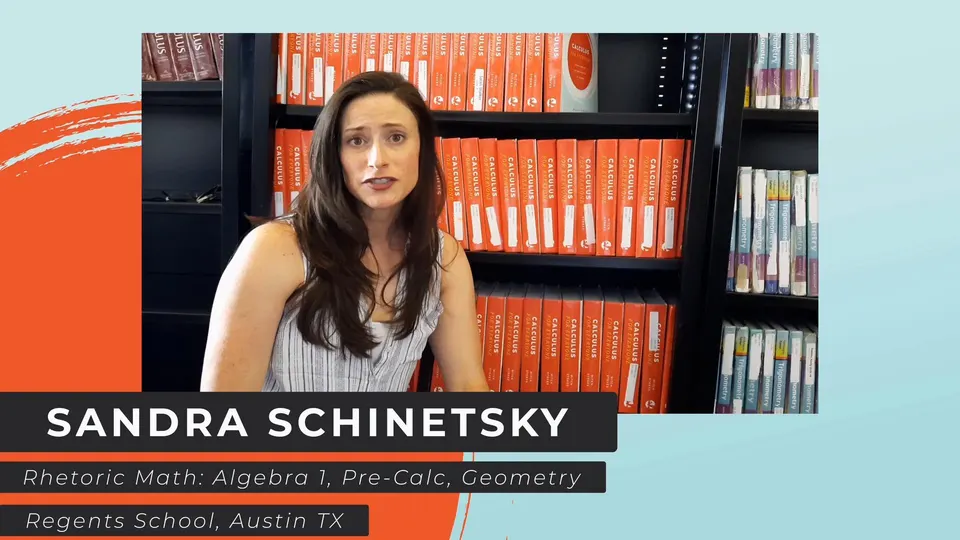
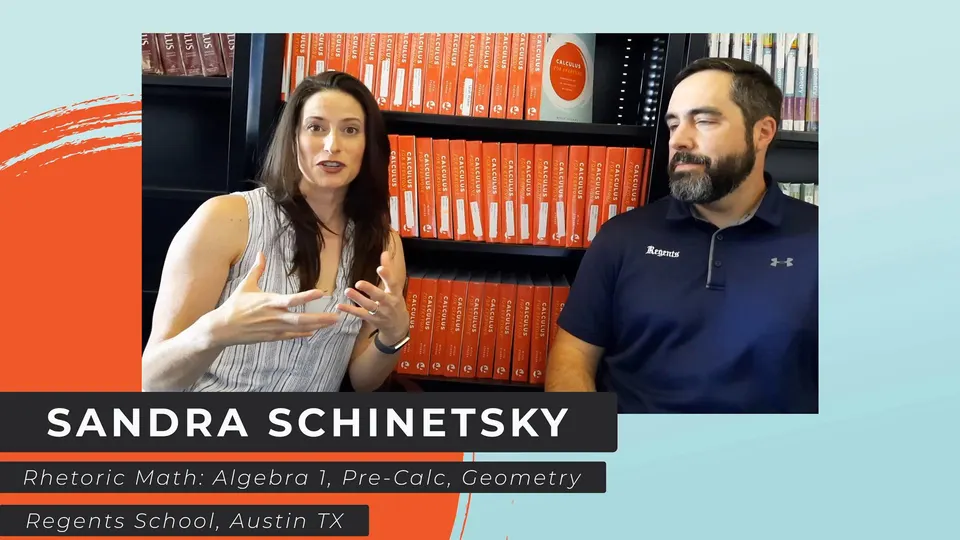
Regents School of Austin · 12 short conversations

A new paradigm for teaching math

Reuben Jansen talks with Josh Wilkerson (Mathematics Department Chair, K–12) and Sandra Schinetsky of Regents School of Austin about teaching with Calculus for Everyone.
An engineer turned philosopher

Dr. Mitch Stokes

“I cannot unsee what I have seen.”

Dr. Mitch Stokes · Acknowledgments

Dr. Mitch Stokes is Senior Fellow of Philosophy and Head of Math, Science & Music at New Saint Andrews College. Before philosophy he was a mechanical engineer, earning five patents in aeroderivative gas-turbine technology. He holds a PhD in philosophy from Notre Dame and an MA in religion from Yale.

He wrote Calculus for Everyone after fifteen years of teaching calculus to liberal-arts students, many with only algebra behind them. His other books include biographies of Isaac Newton and Galileo, A Shot of Faith (to the Head) and How to Be an Atheist.

Illustrated by Summer Stokes, the author’s daughter, who drew every figure and designed the interior. Cover by Rachel Rosales of Orange Peal Design.

Ask Dr. Stokes

Talks at New Saint Andrews

The review we’re proud of

Guilty as charged

“Advertises as a calculus book but drips with religious ideology.”
An Amazon reviewer, 2021

“Well, since Calculus largely came to us through Isaac Newton, whose writings also dripped with religious ideology, their review only further convinces me to use this curriculum.” — Jessica DeWaay Kramasz

Read the whole story
★★★★★
“I can safely say this is the only math textbook I’ve ever actually enjoyed… the illustrations throughout are really helpful.”
Levi · Amazon
★★★★★
“This is absolutely the correct way to teach mathematics.”
Christa J. VanGelder, high-school math teacher · Amazon
★★★★★
“It was so enjoyable to actually understand the concepts before jumping to all the integrations.”
Patty Marr, homeschooling 26 years · Amazon
★★★★★
“35 years later, Mitch Stokes showed me that my professor was wrong. Calculus is for anyone who wants to learn.”
Robert T. · Amazon
★★★★★
“The book that changed my son’s ability to do a high level math course.”
Annie Nardone · Facebook
★★★★★
“I only made it through ninth grade algebra, and I’m still able to track.”
Shawn Schneider, software engineer · Facebook