
Early Moderns: The Enlightenment
The search for certainty
Dr. Mitch Stokes begins his introduction to the Enlightenment of the 18th century with the Greek Pythagoreans and the “problem of change” and traces those issues to the Scientific Revolution. Students learn about the search for certainty that led to skepticism through the works of Galileo, Descartes, Newton, Hume, Kant, and finally Reid, as each philosopher grapples with the nature of knowledge.

13 lectures, eight hours
Each lecture opens with a short review, then summary, commentary and connections across history, art and theology. Watch Lecture 1 free.
- 1Early Moderns Curriculum Trailer3 min
- 2Lesson I Introduction: What is the Enlightenment?Free36 min
- 3The Scientific Revolution: An Overview47 min
- 4Galileo Moves the Earth38 min
- 5The Galileo Affair43 min
- 6Lesson 5 Descartes & Skepticism41 min
- 7Descartes' Search for Certainty38 min
- 8Did Descartes Succeed?27 min
- 9Descartes & the Scientific Revolution38 min
- 10Isaac Newton Takes the Throne45 min
- 11Lesson 10 Hume: Taking Skepticism Seriously43 min
- 12Kant's Answer to Hume49 min
- 13Thomas Reid & Genuine Enlightenment43 min
 Lecture 2 · Lesson I Introduction: What is the Enlightenment? · 36 min · free
Plays here on the page. Every lecture streams and downloads in the Roman Roads app once you own the course.
What your student reads
- GalileoLetters
- DescartesDiscourse on Method
- NewtonPrincipia
- HumeAn Enquiry Concerning Human Understanding
- KantWhat Is Enlightenment?
- ReidAn Inquiry into the Human Mind
Every assigned text is in the Enlightenment Reader (Vol. 15), as a printed book or the eBook that comes with the course. Students are welcome to use other editions of the great books they already own with this course. The video lectures reference Latin or Greek line numbers, which allows a broader use of editions for those who prefer to bring their own.
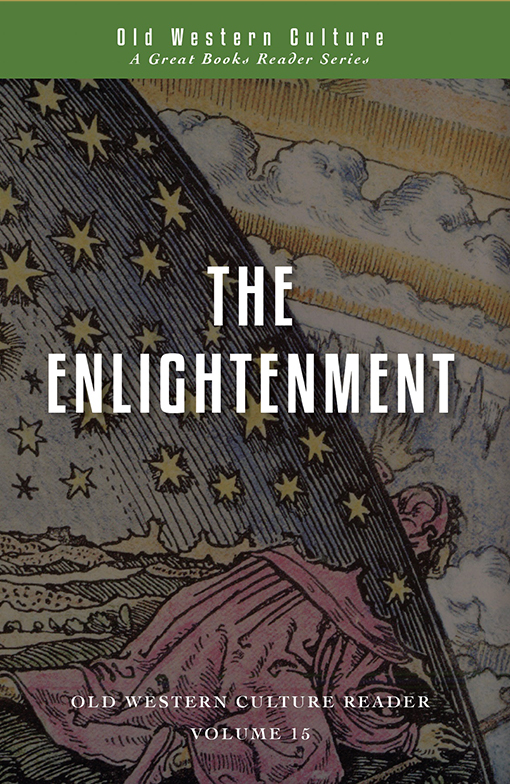
The Enlightenment
320 pages · 6 × 9 in. · paperback $32 · hardback $45 · eBook included with the course
About this Reader
Questions
Is The Enlightenment right for a younger student?
Old Western Culture is intended for mature and discerning students; we recommend it for ages 14 and up. The course deals with mature themes such as paganism, sexual immorality, battle scenes (mostly in the reading) and classical paintings, and is meant to equip your child with a Biblical lens for them. We assume a working knowledge of the Bible and basic Christian doctrine.
How much credit is it?
One unit is half a high-school credit in literature or history; a full year of four units is two credits.
How long does a unit take?
Nine weeks: one lecture a week, with the reading and the questions between. The Honors schedule reads everything; the Essentials schedule reads a shorter selection and still watches every lecture.
Do we need the printed Reader?
No. The Reader eBook is in the app with the course, and the editions already on your shelf work too. We do recommend reading in print, whether that is our Reader, a Roman Roads Classic where one exists, or your own copy; the Reader’s advantage is every assigned text in one volume.
Can a co-op or school use it?
Yes. Students watch at home and discuss in class, or a teacher lectures live. Ask us about group licensing.
Is it a subscription?
No. You buy it once and it is yours for life.
Early Moderns: The Enlightenment
The complete digital course, from $74.75. Add the printed Reader and workbook above.