Litterae
From Digressio Vol. 5Reflections on Reading Aloud
For most of history, reading meant reading aloud. How silent reading arrived, and why good books should still be read slowly and aloud.

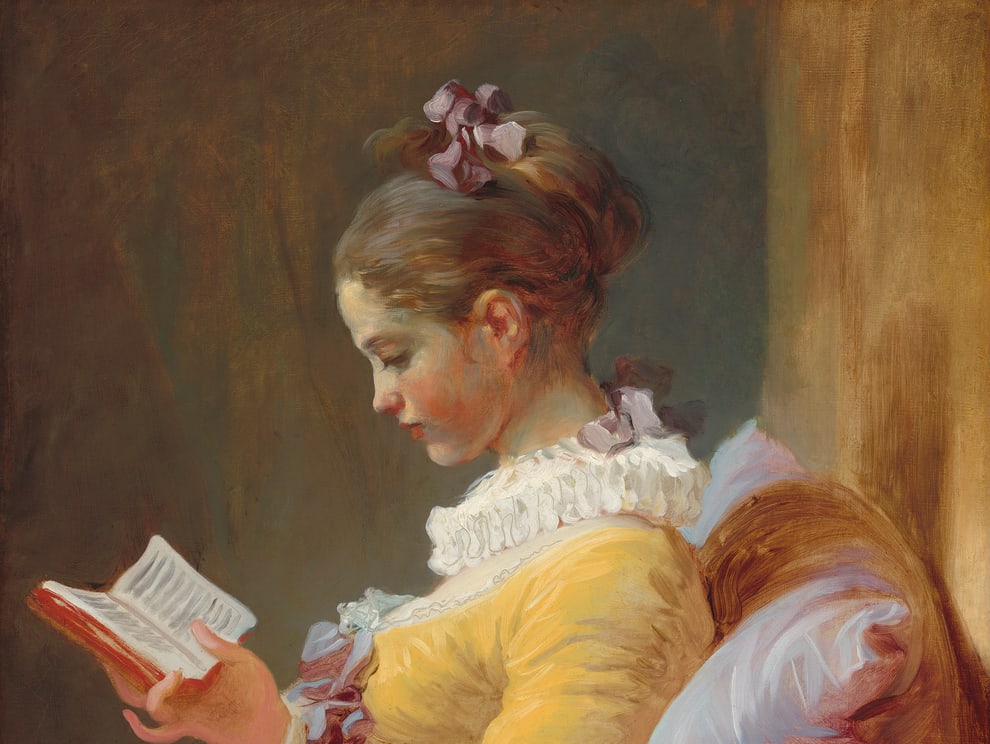
In one of his many delightful letters, the Roman nobleman, lawyer, and governor Pliny the Younger explains rather disconsolately to his correspondent that he had not been able to read lately… because he had a sore throat.
What? we ask. How can a sore throat keep a person from reading? If I had a sore throat I would take it as a wonderful opportunity to read in bed without feeling guilty about all the other things I needed to get done. Was it because the pain was too distracting? No. It’s because reading, in the ancient and medieval worlds, was always done aloud, so a sore throat meant that your main organ of reading—your voice, not your eyes—was incapacitated.
Pliny’s adoptive father, Pliny the Elder, had a slave whose entire job was to read aloud to him while he dressed, bathed, ate, or rode in his litter. There was no time to waste; there were too many books and too little time! But even when he read himself, he read aloud.
Everyone who reads classics is familiar with the story in Augustine’s Confessions of his group of friends sitting in the cathedral in Milan watching in fascination as Ambrose, the great bishop and eloquent preacher, read from the Scriptures at the front of the church… in silence. The young Augustine and his friends wonder to each other at what the reason might be; but the point is that such behavior was most unusual and called for surprised comment.
There are isolated instances in ancient literature of people reading silently—in Euripides’ play Hippolytus, Theseus silently reads a letter in the hand of his dead wife. Plutarch, writing in the early second century AD, says that Alexander the Great, in the fourth century BC, read letters from his mother silently, but his soldiers were astonished at this. Ptolemy, after whom the geocentric theory of the solar system was named, says in the second century AD that on occasion people read silently to keep their thoughts from being distracted by the sound of their own voice—but it is clear that he is describing an odd phenomenon which requires explanation. In the mid-fourth century, Cyril of Jerusalem asks the women in church who are reading (presumably prayers or the psalter) while waiting for the ceremonies to begin to read quietly, so that only their lips move and so that others will not hear what they say. In other words, they were reading aloud—the normal thing—and he had to ask them to read quietly (though not silently).
But as a rule, reading silently did not begin to be anything like common until after the invention of the printing press halfway through the second millennium AD. As in the ancient world, evidence of silent reading shows in the Middle Ages. As often happened, a weary copyist in some monastery in the 8th century adds at the end of a manuscript that “no one knows what efforts are demanded. Three fingers write, two eyes see, one tongue speaks, the whole body labors.” The tongue is as weary as the fingers and eyes. But in the next century, the first regulations requiring silence in the monastic scriptoriums appear. And it’s not hard to imagine why. The Rule of St Benedict does not envision much in the way of academic work in a monastery, but by the ninth century, the copying of manuscripts had become an important aspect of the work of monasteries in Europe where the decay of the old Roman world made the preservation of texts critically necessary. But it’s also not hard to imagine the low rumble of noise in a monastic scriptorium where several—or several dozen—monks are simultaneously muttering aloud to themselves, or being dictated to, as they work. So regulations requiring silence would have helped to preserve the desired monastic peace and silence—and given some rest to weary tongues.
But reading silently really became widespread in the sixteenth and seventeenth centuries. Due to the invention of the printing press in the fifteenth century, printed materials were suddenly available on a massive scale. Before Gutenberg, books were expensive and even the relative few who could afford them only owned a handful at most. Furthermore, until the invention of punctuation and the separation of words in a line of text, all of which happened at various points in the Middle Ages, reading aloud was necessary to make sense of the written lines. So all these changes made reading much easier. The evidence strongly suggests that reading aloud continued to be common well into the eighteenth century, but reading silently was no longer rare. Now we are so used to it that we think—wrongly—that it’s what humans have always done, rather than being a very recent phenomenon.
In a fascinating historical aside, the rise of reading aloud has a curious and close connection with the change in Western society in attitudes toward personal privacy. Again, we think that our attitude is how people have always been, but for most of western history, at least throughout the Middle Ages and until the eighteenth century, there was little privacy in anyone’s life, even in bed. Most people lived in small houses with only one or two rooms and most people slept with others in the same bed, entire families in many cases. Even in the highest circles of society, that of the monarchs, this was the case—a queen’s handmaid in the Middle Ages might climb into bed next to her mistress for warmth just as entire families in the lowest dwelling would sleep together for warmth in winter.
But after the Middle Ages expectations changed regarding individual privacy, and bed curtains began to separate individuals from others in the room. And long after individual bedrooms became more common in middle class Europe and America and this purpose fell away, bed curtains still remained as decorative accoutrements and to preserve warmth in a cold room.
What does this have to do with reading? As bed curtains became more common and individuals found a new personal privacy behind them, they could do something people very rarely ever did before—they could read in bed! For many of us, this is a profound pleasure but one we take for granted. It is another very recent development in our civilization.
But think—if you want privacy while you read in bed, you won’t find it reading aloud because people outside your bed curtains, perhaps sewing or repairing a harness or cooking a stew, will ask you questions about what you’re reading. So you read silently. But when are we in bed? Generally at night when we need light. And until the invention and widespread availability of electricity—something even my own parents did not have until they were in high school in the 1940s in rural western America—if you want to read in bed, you have to use candles or lanterns, and suddenly fire becomes a problem. So in the eighteenth century, there are stories of people dying in bed because they fell asleep while reading with a candle burning which set fire to the bed curtains. Lord Walsingham died in 1831 because of just this, and his wife died jumping from a window to escape the fire. Samuel Johnson, the famous eighteenth-century author, dictionary composer, and contemporary of Gibbon, Adam Smith, and the Founding Fathers in America, read in bed so much that all of his wigs were burned back to the fabric mesh that held the hair, and his servant had to stand ready with a new wig to put on his master’s head every time Johnson left his house.
One of the most famous opera singers in the eighteenth century, Caterina Gabrielli, about whom delightful and often hilarious stories are told, was once summoned to Sicily by the Viceroy to sing for several engagements. At her first engagement she didn’t show up. Servants were sent to find out why and she was discovered reading in bed behind the curtains, so engrossed in her book that she’d forgotten her engagement. She apologized graciously but refused to put down her book and leave her bed. Our hearts are warmed toward her.
Along with everything else that was changing in this new Enlightenment age, this individualistic attitude was part of a move away from the Christian world that had been building for fifteen hundred years.
Wes Callihan
Moralists in the eighteenth century warned that reading in bed was dangerous—fires, remember? But what they really worried about was moral degeneration. After all, what good could come from isolating oneself from the world and reading a novel? Shocking! We roll our eyes. But these moralists were onto something—though only dimly, they grasped that a sea change was occurring in culture, from a more communal to a more individualistic attitude about human life and fulfillment. Along with everything else that was changing in this new Enlightenment age—a rise in materialist thought, a new reliance not on revelation but on reason because of the obvious power of the new sciences, the growing attack on Christianity via Deism, etc.—this individualistic attitude was part of a move away from the Christian world that had been building for fifteen hundred years, a Christian world which understood human good to be bound up in community with others.
This is not to say that reading silently, or privately, is anti-Christian. The history and philosophical relation of reading to the structure of civilization is infinitely more complex than that. But it is to suggest that there are vastly important issues hidden behind seemingly insignificant historical details, and worthwhile questions to ponder which are raised by innocuous and charming historical anecdotes.
What, for example, are the implications of reading aloud when reading good books versus reading silently? When you read aloud, three entrances of knowledge are in use—the eyes, the ears, and the mouth. When your tongue, palate, throat, and lungs are shaped by the words you say, even as they are the ones doing the shaping, your whole person is being shaped by what you read, because you are more than a mind. King David may have meant more literally than we think his command to “taste and see that the Lord is good.” It is gnosticism to say that our bodies don’t matter when it comes to reading or thinking, just as it is gnosticism to say that they don’t matter in prayer or worship. Is reading silently gnosticism? It depends on the situation, the person, and the habit. I will say that reading aloud is better than reading silently.
Great books, poetry, anything into which time and energy has been poured by the author, these should always be read slowly, leisurely, lovingly, and aloud, as much as possible.
Wes Callihan
Are there times when eating quickly is justified? Yes—if the food you’re consuming isn’t worth much. No one eats Doritos slowly, savoring each bite (at least no one I know). They’re not worth eating slowly. But no one in his right mind would hastily devour a Thanksgiving meal his mother had lovingly been preparing for days. That would be rude in the extreme to his mother, and he would get far less of the nutrition available. In the same way, some reading material should be devoured quickly—and silently, because you can read faster when reading silently—because it’s not worth anything more; news, blogs, etc., are the kind of Doritos reading that should be taken in quickly. But great books, poetry, anything into which time and energy has been poured by the author, these should always be read slowly, leisurely, lovingly, and aloud, as much as possible, in order to be charitable to the author and to receive as much of the nutrition as he put into the work. Remember that he was almost certainly muttering aloud as he wrote, and our reading should be no faster than the human pace at which he wrote, and we should hear what he heard as he spoke while he wrote. Aristotle said that letters are the signs of sounds. They are not meant to replace sounds.
An old Latin adage goes like this: verba volant, scripta manent. This is most commonly translated something like, “words fly away, but written things remain.” The idea is that spoken words are ephemeral, but in writing there is permanence, a useful concept in law and politics, perhaps. But there is another way to understand this adage—written things remain fixed, fossilized, inert, lifeless. But when they are read, when they are spoken, they come to life and take wing and soar.