
Greeks: Drama and Lyric
The Greek playwrights and poets
The Greeks: Drama and Lyric covers the beginning of drama and some of the earliest comedies and tragedies known to the Western world. This course includes lectures on the three primary tragedians from the Ancient Greek world by Sophocles, Aeschylus, and Euripides and also one of the most famous writers of Greek comedy, Aristophanes. The course also offers an introduction to Greek lyric poetry from the same era, including passages by Pindar, Sappho, and Quintus of Smyrna. A lecture on the minor epic poetry of Hesiod is also included as a complement to part Greeks: The Epics.

Twelve lectures, five hours
Each lecture opens with a short review, then summary, commentary and connections across history, art and theology. Watch Lecture 1 free.
- 1Lesson 1 Background: The Development of TheaterFree24 min
- 2The Period, the Poets, and the Presentation29 min
- 3Aeschylus’ Oresteia: Agamemnon25 min
- 4The Libation Bearers and The Eumenides14 min
- 5Sophocles’ Oedipus the King32 min
- 6Sophocles’ Oedipus at Colonus and Antigone25 min
- 7Euripides’ Medea and The Trojan Women34 min
- 8Aristophanes’ The Frogs and The Clouds22 min
- 9Lyric Poetry: Sappho, Pindar, and Theocritus37 min
- 10Lyric Poetry: Hesiod23 min
- 11Lesser Epics: Quintus of Smyrna’s The Fall of Troy28 min
- 12Lesser Epics: Apollonius of Rhodes’ The Argonautica34 min
 Lecture 1 · Lesson 1 Background: The Development of Theater · 24 min · free
Plays here on the page. Every lecture streams and downloads in the Roman Roads app once you own the course.

What your student reads
- AeschylusThe Oresteia
- SophoclesOedipus the King, Oedipus at Colonus
- EuripidesMedea, The Trojan Women
- AristophanesThe Frogs, The Clouds
- Sappho, Pindar, Theocrituslyric poems
- HesiodWorks and Days
- Quintus of SmyrnaThe Fall of Troy
- Apollonius of RhodesThe Argonautica
Every assigned text is in the Drama and Lyric Reader (Vol. 2), as a printed book or the eBook that comes with the course. Students are welcome to use other editions of the great books they already own with this course. The video lectures reference Latin or Greek line numbers, which allows a broader use of editions for those who prefer to bring their own.

Drama and Lyric
702 pages · 6 × 9 in. · paperback $32 · hardback $45 · eBook included with the course
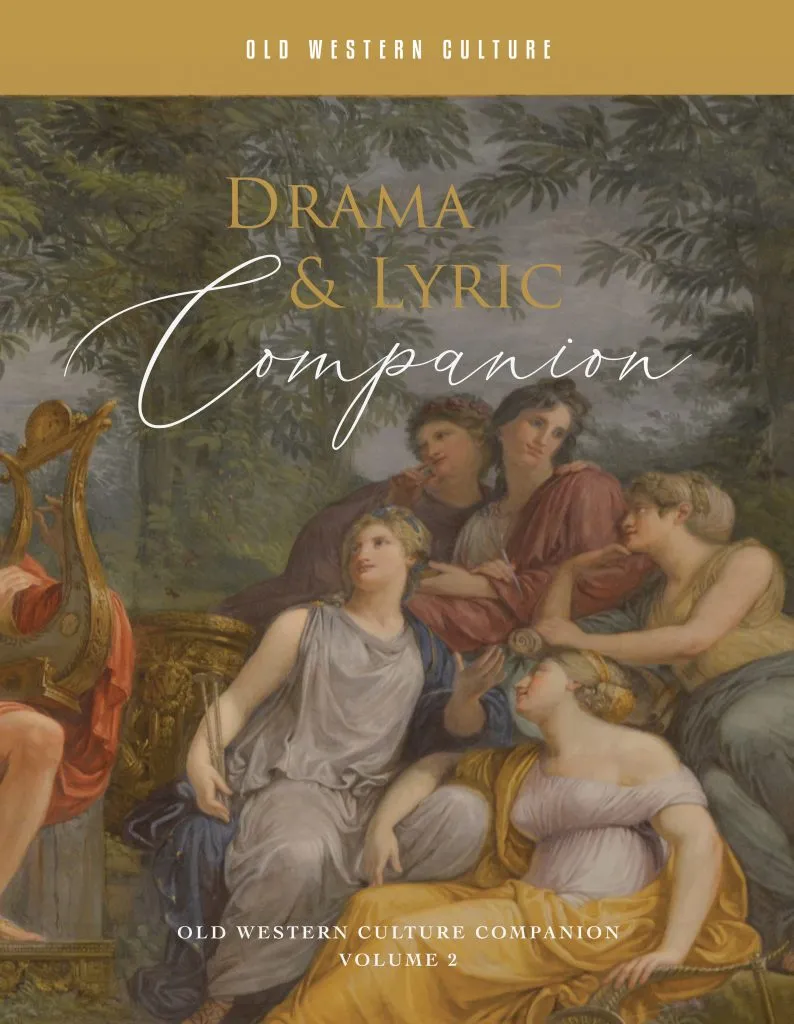
About this ReaderDrama and Lyric Companion
One printed, full-color volume for this unit: the Honors and Essentials schedules day by day, Grammar, Logic, Rhetoric and Discussion questions for every lesson, commonplace starters, and Digressios on the art, music, maps and stories behind the books. It adds no busywork; it is a companion to the books, not a textbook.
Use it beside the Workbook or in its place. $39.
Questions
Is Drama and Lyric right for a younger student?
Old Western Culture is intended for mature and discerning students; we recommend it for ages 14 and up. The course deals with mature themes such as paganism, sexual immorality, battle scenes (mostly in the reading) and classical paintings, and is meant to equip your child with a Biblical lens for them. We assume a working knowledge of the Bible and basic Christian doctrine.
How much credit is it?
One unit is half a high-school credit in literature or history; a full year of four units is two credits.
How long does a unit take?
Nine weeks: one lecture a week, with the reading and the questions between. The Honors schedule reads everything; the Essentials schedule reads a shorter selection and still watches every lecture.
Do we need the printed Reader?
No. The Reader eBook is in the app with the course, and the editions already on your shelf work too. We do recommend reading in print, whether that is our Reader, a Roman Roads Classic where one exists, or your own copy; the Reader’s advantage is every assigned text in one volume.
Workbook or Companion?
Both work with the lectures. The Workbook (PDF included with the main curriculum; printed edition available as add-on) holds the questions for every lecture and reading with an answer key. The Companion is the fuller book: schedules, more questions at four levels, and the Digressios. Use it beside the workbook or in its place.
Can a co-op or school use it?
Yes. Students watch at home and discuss in class, or a teacher lectures live from the Companion. Ask us about group licensing.
Is it a subscription?
No. You buy it once and it is yours for life.
Greeks: Drama and Lyric
The complete digital course, from $74.75. Add the printed Reader and the Companion above.