Poetica
From Digressio Vol. 5Why We Need Epic Poetry
What an epic is, the four marks of the genre, and why a people needs its epic poets.

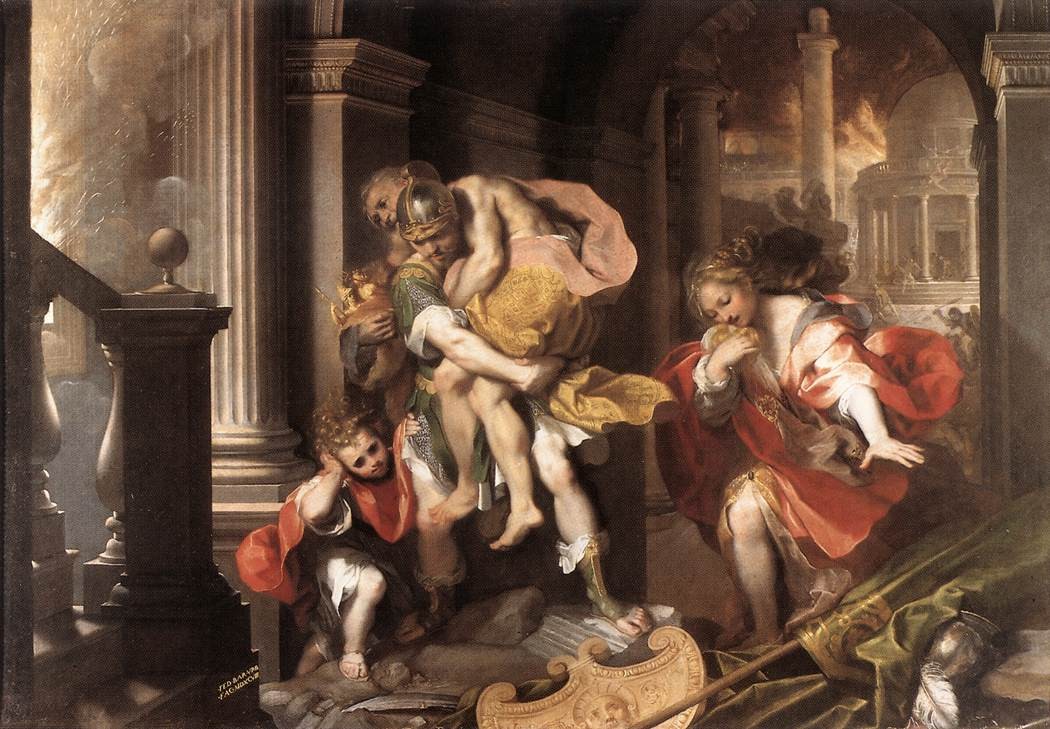
Many have referred to Milton’s Paradise Lost as the last great epic poem, and this is probably true. While more recent prose works could certainly be considered part of the epic genre (Moby Dick, The Brothers Karamazov, The Lord of the Rings), the seeds of epic poetry have seemingly lain dormant for nearly half a millennium. But what is an epic? With regard to poetry specifically, what are the characteristics that determine which poems are in and which are out? Put another way, why do we speak of Homer, Vergil, Dante, and Milton in the same breath, while other great poets and poems stand to the side? Culturally, we have lost a palette for excellence in poetry. We have dieted on sugar cubes for decades, and as a result have no taste for real food. But a culture will not survive on such fare. They need substance, something for teeth to sink into. They need heroes who do not wear capes or fight for DEI, but actually build cities, establish empires, and protect their homes and homeland from the sons of Belial. What we need is a reintroduction to the epics. Consider this a preface.1
Every culture has a myth. What do I mean? Every people group has some “tribal myth that unites” them as a people:
The mythic awareness that results permeates the society, not as an occult power granted to the few but, rather, as a heightening of the natural state of sentient beings aware of existence as having meaning. It produces a network of symbols, a web wherein insights are captured, a matrix where intuition can dwell; from it, we might say, extends a kind of lightning rod to attract the divine [inspiration]. The high arts, science, philosophy, prophecy are particularly attentive to this medium and are responsible for discerning and bringing to the community whatever extrasensory messages are granted them. The poet in particular has the task of listening to the gods, the angels, the presences that are outside the self, outside the community’s paradigm, as the supernatural agencies go about their seemingly random selection of events to be crowned with significance. The gods’ choices define and beckon a people; the epic poet as conscious artist lets society know its identity and its mission.
The epic poet is the messenger, the self-conscious emissary from above, the conduit through which the transcendent imposes itself onto a complacent people.
Dr. Joe Carlson
This is the role of the epic poet. Using the pre-existing web of symbols, insights, and intuitions, the poet tells society who it is and why it is. But more than a glorified junior high pep rally, the epic poet situates this prophetic word within the relationship between the people and its gods (or, for the Christian poets like Milton, the Triune God of Scripture). The epic poet is the messenger, the self-conscious emissary from above, the conduit through which the transcendent imposes itself onto a complacent people. The epic poem itself serves as a tangible and unavoidable artifact that continually confronts a people with their own mythic history. I hasten to add that mythic history is not a contradiction in terms, nor does the first term qualify the second out of its connotations of literal truth. Mythic, in the sense I am speaking of here, has to do with the culture shaping power of story. The story of Adam and Eve in the Garden in Genesis 1–3 is literal history. It happened in time and space. If Eve had a smartphone, she could have taken a selfie with the dragon in front of the tree of the Knowledge of Good and Evil. It is literally true. But it is also a mythic story in that it has powerfully and indelibly shaped our society in significant ways. The true and historic activity of the Garden, as recorded in Genesis, has produced a bevy of symbols and images that continue to shape human culture, nearly 6000 years later. It is this mythic quality of historical stories that brings a heightened awareness of the meaning embedded in literally everything we see and do. That the historical stories of Scripture—the Garden, the Exodus, the Promised Land, the Cross, the Upper Room—have an enduring mythic power does not deny their historicity. Nor does their historicity deny their mythic power. The two states can (and do) exist simultaneously.
I spend time hammering this home because in our modern era we are under the impression that something true in nature and history must be devoid of a cultural, and even spiritual power. Myths necessarily refer to something like a fairy tale or other imaginatively made-up stories. Thus, stories either really happened or they are myths. But this is a false dichotomy. True stories attain the status of myth (without forfeiting their historical nature) when they take on enduring influence and culture-shaping power, as we see with Paradise Lost and Paradise Regained. It is also true that non-historical stories can attain the same status. That the Iliad, Odyssey, Aeneid, and Divine Comedy have become mythic in their enduring power to shape culture is unarguable. However, this is because each of these poems is anchored in something historical and human (the Trojan War, the conquest of Italy, the political unrest of the late Duecento). As such, each touches on what is universally true about human nature. The main characters in each of these poems (Achilles, Odysseus, Aeneas, Dante-pilgrim) are identifiably human (however larger-than-life their contexts make them). And in this way they still communicate something true, even if the pilgrim never actually scaled a mountain full of spirits in the South Pacific.
This idea of the mythic is the necessary foundation for all epics, though it is not unique to the epic genre. Rather, poetry in general, including imaginative literature, “is the vehicle for giving form to the myth, bringing into consciousness, where it may be contemplated and known. Unlike folktales or legends, a literary work of art produces in mimetic form the wholeness of a people’s unconscious sense of themselves, providing an image of humanity in action in a world constituted by value.” That said,
the epic in particular, in its story of a hero’s conquest of disorder and establishment of a cosmos, has a close relationship with the mythic. But rather than being myth, epic is the literary genre that gives tangible form to this vital seed of a community’s life, that not only portrays a world in the making but, by looking toward final things, brings about a new order and fulfills the implicit mythic promise.2
Thus, the epic genre can be broadly defined by its “function of cosmopoesis, its making of a cosmos wherein the other genres find their place and within which human life may be envisioned in its varied dimensions” (10). Put simply, the epic cosmos is an imaginative landscape that mimetically (by imitation) encompasses everything there is, including that which we cannot see. It cannot be defined logically, nor itemized in any way. It must be intuited, through the matrix of symbol and allusion that permeates the world. This is cosmopoesis, the act of speaking a complete cosmos into existence. Importantly, this happens at the level of cultural memory: “The poetic cosmos… comes into being from the act of bringing the myth into consciousness—from shaping the past into memory…” (16). Cultural memory is necessarily curated by our poets, and our epic poets specifically. They take past events and rework them into relevant culture-building tales that speak directly to the human condition. Through images and stories, symbols and songs, the epic poet formalizes a culture’s founding history, keeping the past always present. The result of a culture-wide acceptance of the epic is a mutually agreed upon identity (the poet telling them who they are) and purpose (the poet telling them why they are). This is what the epic poem does, grounded in its mythic power.
With this as an introduction, what are the specific qualities of the epic genre? Four key distinctions have been identified:
A primary feature of the epic cosmos is its penetration of the veil separating material and immaterial existence, allowing an intimate relation between gods and men and a resultant metaphysical extension of space. A second feature is its eschatological expansion of time, and, third, its restoration of equilibrium between masculine and feminine forces. The final feature, one that is no doubt paramount in its importance, is the epic’s sense of motion, its linking of human action to a divine destiny, toward which it senses history moves. (11)
More than simply the presence of gods in the narrative, the epic genre takes for granted and normalizes the penetration of the divine into the human realm. The epic landscape by definition includes the transcendent and spiritual realms. In crafting a story, the epic poet consciously identifies himself as a link between the human and the divine, calling on the Muses for inspiration and guidance in telling the story. But more than that, the story itself centers on man’s communication and interaction with the divine. Thus Achilles petitions Zeus via his goddess-mother; Odysseus regains Ithaka with the help of Athena; Aeneas achieves Italy, guided and protected by Venus; and Dante-pilgrim escapes the dark wood with help from Virgil and Beatrice. In Paradise Lost, the divine element of the story takes on an even closer immediacy, as Milton imagines the conversations of both the demons in Pandeamonium and the Father and Son in Heaven. Adam and Eve are likewise guided (or misguided) by celestial (or infernal) beings. And in Paradise Regained, the main characters are Satan and Jesus; thus, the epic landscape naturally makes room for the transcendent realities of angels, demons, gods, and the God of gods.
The inclusion of the transcendent naturally means an inclusive view of time as well. Just as we pass into ethereal realms, so too we journey into eternal regions outside of time. Tragedy focuses on a single and completed action; comedy the restoration of a particular thing that has been broken; lyric the interior response to a particular image or moment. But the epic landscape, in addition to its vertical expansiveness (including the supernatural and divine), expands horizontally as well. “Epic poets have a larger view of temporality than other poets. They see the Alpha and Omega, the entire scheme of things, though they are constrained to speak of this beginning and end in terms of the human society they know” (15). The epic poem is, therefore, shaped by a certain timelessness. Characters enter regions that are not bound by time, which communicates a universality to the reader, giving us the impression that if we were in those regions, we would behold the same events. This serves to strengthen the bond between the hero and the culture he is founding.
The third quality identified is the restoration and re-harmonization of opposites within a culture. Societies are born out of the civilizing force of human dominion and endeavor. This presupposes, in the mythic sense, a chaos out of which order is brought, the formlessness and void of Genesis 1:2. The contrasting masculine and feminine forces referred to above symbolize those elements that seemingly contradict each other and need to be brought into harmony for worlds to be built. The epic genre captures this through different means, but most often through characters that represent and embody the opposing forces that need to be reconciled: Zeus/Hera, Neptune/Athena, Jupiter/Juno, Virgil/Beatrice, Adam/Eve, masculine force/feminine wisdom. The epic holds these equal and opposite forces in balance, which again is the only way for civilisation to be built: “The epic assumes that the sacred marriage of the two equal and complementary powers is possible and that in that wedding the whole world is renewed” (22). In this vision of harmony, the epic poem provides a window into something real and necessary for those living in times when that balance has been disturbed. Thus, the epic not only provides a vision of the past, but hope for the future as well.
This is the prophetic mantle of an epic poet. He is moved by the inspiration of a higher will, called to inspire his readers with what can be in the here and now through a clear picture of what will be at the end of all things.
Dr. Joe Carlson
Which brings us to the fourth quality of the epic genre: eschatological redemption. The epic poem is oriented toward the “culmination of history,” precisely because the “total action [of the epic] is by far greater than the deeds of the hero” (22–23). The hero represents something much larger than himself, something universal and universally true. The epic puts forward a moral cosmos, a deep and permeating sense of true and false, good and bad, beautiful and ugly. “The epic cosmos, in itself, implies a force, an energy that impels a people forward. Though such a movement is portrayed through the actions of one person, it affects the life of all, expressing an elemental will within a people, unrecognized among them without the hero’s urgency, his pressing outward against the forces pressing inward…” (23). This, again, is how the epic poet tells a people who they are and why they are. Through the agency of the hero and the heroic action, the people of a culture are awakened to their own identity and purpose, and are filled with a desire to accomplish great things. The mimetic action inspires them, raises their spirits, and gives them a vision of what is possible. But more than that, the epic casts a vision of what will be, inevitably, in the culmination of all things. Obviously, there is a difference between the Pagan and Christian epics with regard to this eschatological vision. For the Pagan, a cyclical pattern of war and peace is only resolved in the laying down of individual wrath, the restoration of the city, the establishment of an empire. For the Christian, it is the Beatific Vision and the victory of Christ over the chief representative of sin and death. But in either case, a vision of future redemption is cast, made possible through virtuous loyalty to a people’s fundamental identity and purpose. This is the prophetic mantle of an epic poet. He is moved by the inspiration of a higher will, called to inspire his readers with what can be in the here and now through a clear picture of what will be at the end of all things.
All this together gives the epic genre of poetry an ability to “norm” a people. It is “the mode from which civilisation emerges, the originary poesis that enlarges its people’s scope, enabling them to enter history. It makes conscious the major symbols of society, shaping its sense of purpose, its forms and standards” (25–26). It looks back to teach us to treasure those worthy elements of our inheritance and to prepare us to take part in our own individual world-building callings. For if the epic teaches us anything, it is that we exist in that same poetic world and are called to heroically strive against the obstacles in our way, to overcome through virtue and faith, and embrace the dominion to which we are called.
- In what follows I will largely be using Louise Cowen’s insightful definition of the epic as it appears in her introduction to The Epic Cosmos. All in-text references are to: The Epic Cosmos, ed. Larry Allum (Dallas, TX: The Dallas Institute Publications, 2014). ↩︎
- Louise Cowen, “Myth in the Modern World.” ↩︎