Table of Contents
American Romanticism
- The Legend of Sleepy Hollow, by Washington Irving
- The Fall of the House of Usher, by Edgar Allan Poe
- Bartleby, the Scrivener, by Herman Melville
Realism/Naturalism:
- The Celebrated Jumping Frog of Calaveras County, by Mark Twain
- The Luck of Roaring Camp, by Bret Harte
- An Occurrence at Owl Creek Bridge, by Ambrose Bierce
- The Blue Hotel, by Stephen Crane
- To Build a Fire, by Jack London
Modernism/Experimentation
- The Gift of the Magi, by O. Henry
- Paul’s Case, by Willa Cather
- Bernice Bobs Her Hair, by F. Scott Fitzgerald
- Hills Like White Elephants, by Ernest Hemingway
- A Rose for Emily, by William Faulkner
By reading this book, you are engaging in a battle for American culture.
Dramatic? Maybe. Exaggeration? I don’t believe so. As America grows and develops, there is debate over what we consider representative of true American history. Who are her leaders? Who are the great men who contributed to the westward expansion? What should we think about them? The same is true for America’s classic literature. Who are the representatives of American literature? What should our children’s children read as “classic” American literature?
Anyone who presents a collection of American literature is presenting a certain narrative. The question you must ask as a reader is this: What does the presenter praise and censure? Particularly for a set of literature labeled “classic,” what is the rubric the editor follows to determine what a “classic” American short story is? By calling this a collection of classic American short stories, I am identifying an American ideal as my rubric; these stories have not only literary merit, but are ethically and spiritually valuable, and are therefore worth preserving as representatives of American literature. It is humbling to be part of this project, and also a bit nervewracking. But the battle for American literature is a battle worth fighting.
Consider, for example, the following description for a short story collection of 19th century American short stories—released this year—edited by John Stauffer, the Professor of English and of African and African American Studies at Harvard University:
Diverse, wide-ranging, and unprecedented in its scope, this new two-volume anthology gathers more than 100 stories by 51 writers to track the development of the American short story from Charles Brockden Brown’s haunting gothic tales to the Gilded Age masterpieces of Henry James.
The collection presents generous selections of all the genre’s essential voices: Irving, Hawthorne, Poe, Melville, Twain, James, Jewett, Chopin, Wharton, Crane, and Dunbar.
Also included are such stories as Francis Parkman’s “The Scalp-Hunter,” a riveting frontier drama drawn from the author’s travels in New England’s wilderness; two sketches from James McCune Smith’s “Heads of the Colored People” series, which lampoon the racist pseudoscience of phrenology; Lucretia P. Hale’s feminist fantasy “The Queen of the Red Chessman”; Fitz-James O’Brien’s “The Lost Room” and “What Was It?,” powerful tales of decadent horror; Rebecca Harding Davis’s “Life in the Iron-Mills,” a gripping work about the poverty of industrial workers… and Alice Dunbar-Nelson’s “The Stones of the Village,” a story of racial passing written in 1900 but unpublished in the author’s lifetime.
The marketing material declares that the collection will “redefine the great American literary form.” In an interview about the collection, Stauffer states that O’Brien’s works are not only decadent horror, but “highly charged homoerotic tales.”
What does this tell us about Stauffer’s narrative of the American short story? What does this particular collection set out to do, and which stories does it highlight? There are certain buzzwords which are meant to catch the eye of the modern reader— “diverse,” “feminist fantasy,” “racist” and “racial,” “homoerotic tales.” In Stauffer’s defense, the collection does not set out to be a tailored collection of classics, and does contain the genre’s “essential voices”—but an anthology still falls prey to the economy of space, and the presenter must have some rubric for inclusion and exclusion.
There is a desire, when reprinting or collecting the classics, to present something new, or “unprecedented,” or “undiscovered.” This is often a marketing ploy used to sell more copies. In the hustle and bustle of the current moment, the modern reader is presented with nearly endless choices of things to read; what will make your collection stand out? It must be new and shiny, something never-before-seen. Or so it would seem.
I must be honest with you; I have no desire to “rediscover” anything with this collection, or present a cutting edge revisionist history of any of these classic works. I will not “redefine the great American literary form,” for I believe it is already defined, and I hold as suspect those who set out to do so. Rather, I prefer to take you through a museum of stories that already exist—stories that have been curated over many years, printed and reprinted in various collections, studied by students of American literature for generations. And, as with any museum piece, they can and should be curated, presented, and admired with respect
American literature represents a significant cultural heritage, and I believe it is worth guarding jealously. Therefore, I warmly invite you to read these stories, be shaped by them, laugh and cringe and shudder as you read, disagree or concur with what they present. But know they are worth reading and passing on through the generations.
From the introduction by Nathan Miller
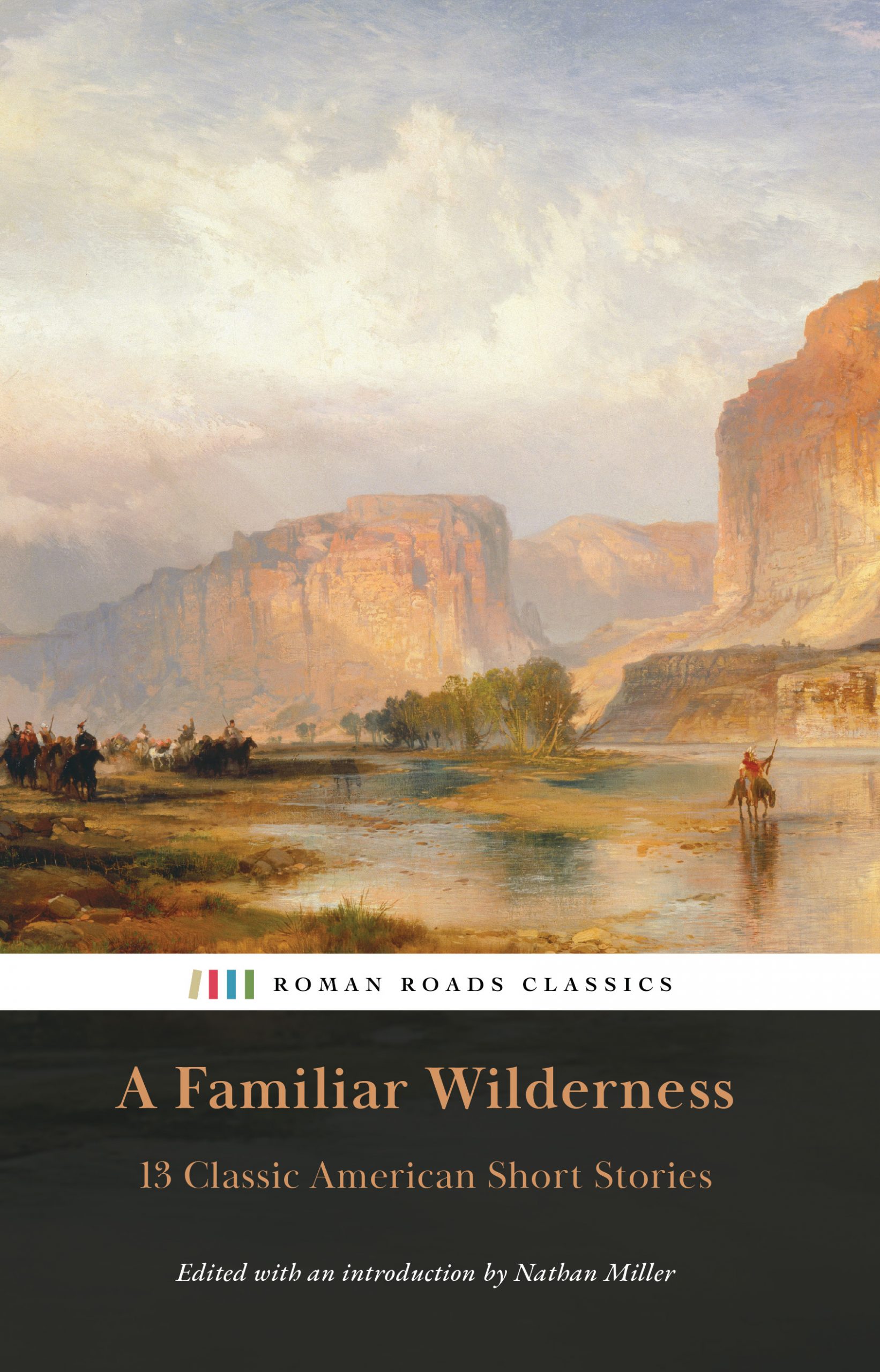
Title: A Familiar Wilderness: 13 Classic American Short Stories
Author: Nathan Miller (editor, introductions)
Publisher: Roman Roads Press
Series: Roman Roads Classics
ISBN: 978-1-963505-25-2 (paperback)
Size: 8.5 x 5.5
Pages: 294