Product Description
Included in bundle.
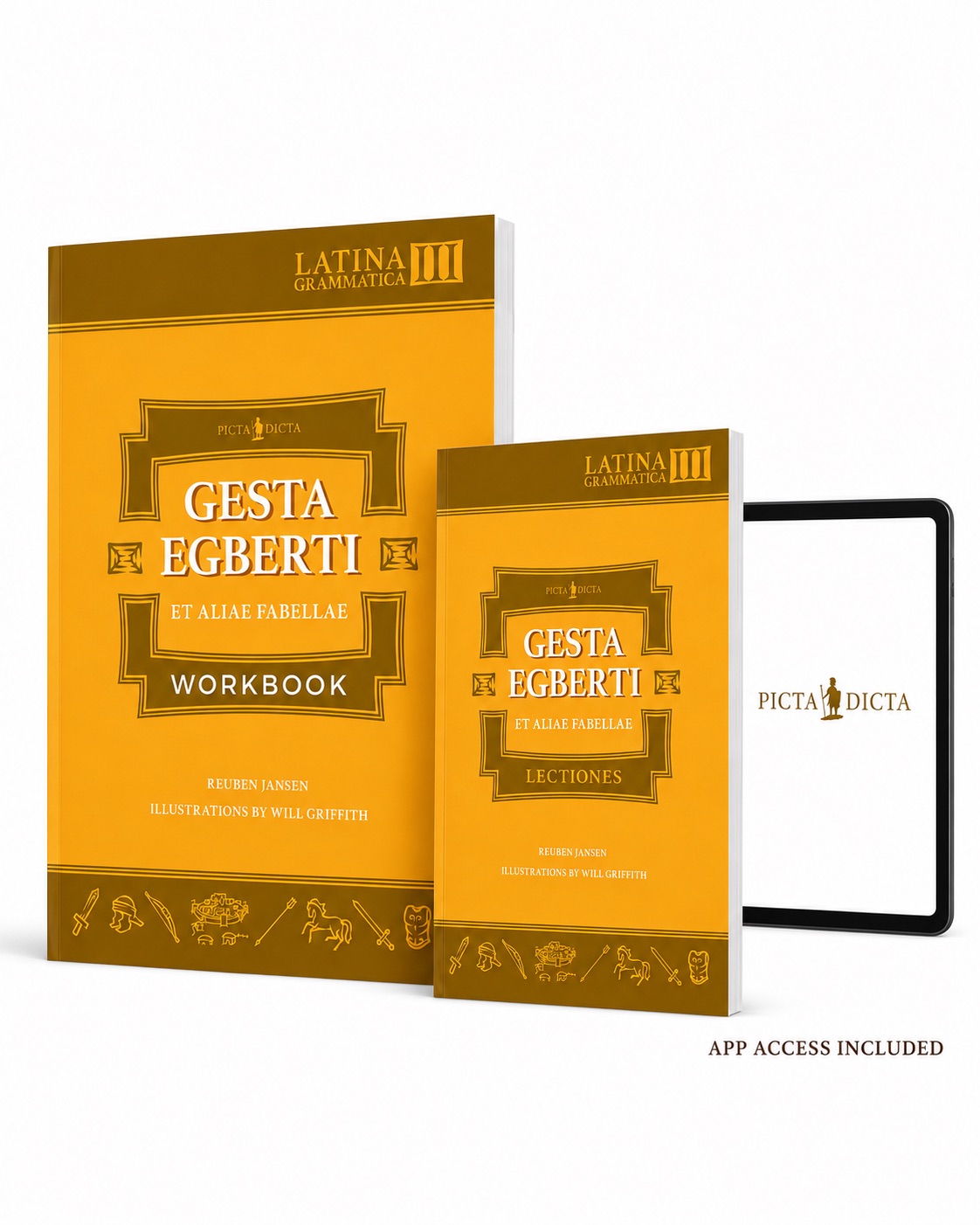
- Latin Grammar III Student Workbook (second edition)
- Latin Grammar III Reader: Gesta Egberti et Aliae Fabellae (NEW for the second edition)
- Latin Grammar III Companion (Answer Key). NOTE: cover matches version 1 of this text, but content matches.
- Latin Grammar III App Access (1, 2, or 3 student).
- Latin Grammar III Quiz Pack
If purchasing for additional students, the two and three student bundles will include additional Workbooks, Quiz Packs, and App Seats for each additional student.
About the Reader
Across thirty chapters and forty-seven readings, students will encounter the following:
- Chapters I–V: first- and second-declension nouns, various uses of cases, third-person verbs
- Chapters VI–X: third- through fifth-declension nouns
- Chapter XI: the imperative mood
- Chapter XII: third-person passive voice
- Chapter XIII: active and passive infinitives
- Chapters XIV–XV: first- and second-person verb forms
- Chapters XVI–XVIII: positive adjectives
- Chapter XIX: comparative adjectives
- Chapter XX: superlative adjectives
- Chapter XXI: present participles
- Chapter XXII: possessive dative, ablative of time
- Chapters XXIII and XXV: deponent verbs
- Chapter XXIV: neuter third- and fourth-declension nouns
- Chapter XXV: adverbs
- Chapters XXVI–XXX: pronouns and demonstratives
The first ten chapters each consist of a single reading and present a variety of short stories. Chapters XI–XV, also one reading each, relate stories about a greedy and ridiculous king. Chapters XVI–XXX, which consist of two or three readings each, recount the deeds of a hero named Egbert—depicting him in the first five chapters as a youth, in the next five as a knight, and in the final five as a king.
About the Text
These readings are written for the use of children who are just beginning to learn Latin. They are written and arranged in stages in such a way that at the beginning they are not overflowing with new vocabulary and are completely free from many grammatical forms.
In chapters I–X, the forms of nouns are primarily practiced;
in chapters XI–XV, simpler present-tense verbs;
in chapters XVI–XX, adjectives;
in chapters XXI–XXV, somewhat more difficult elements (e.g., participles, deponent verbs, etc.);
in chapters XXVI–XXX, pronouns and demonstratives.
How to Use this Text
This volume (the third) does not yet include the more difficult verb tenses (imperfect, future, perfect, pluperfect, future perfect); however, in the next volume (that is, the fourth), all these are explained gradually and thoroughly; and finally (in the fifth), the subjunctive mood and other matters are covered.
Each reading should be read in order, after the students have, through a few illustrated examples, learned not only the necessary vocabulary but also enough grammar so that the meaning of the reading may be understood without great effort.
Along with the readings themselves come other aids by which students may first learn the vocabulary and grammatical forms: an online program, grammatical exercises, and grammatical commentaries. The illustrations in the page margins offer opportunities for practice and review rather than explanation of the reading itself.
If anyone should complain that these contain many ridiculous, absurd, or strange things, let them remember that the ancient authors themselves (especially Ovid, Apuleius, Phaedrus, Martial, etc.) often joked—and did not always speak solemnly. In our opinion, the elements of any language are more easily learned, especially by children, when the material is lighter in tone; and whoever despises the basics will never reach the heights.
Someone might ask why we preferred new stories to ancient ones, why we neglected the gods and goddesses of the Greeks, or why we did not include the histories of the Romans? To such a person we would reply that our only aim was to pave the way by which children may reach proficiency in the Latin language; for we would rather that students read, understand, and recite those venerable readings in the very words of the ancients.