Book Review: How to Think, by Alan Jacobs
David Kern reviews Alan Jacobs’s How to Think: A Survival Guide for a World at Odds.
If you are reading this magazine, then you likely believe in the value of a Christian classical education grounded in the Seven Liberal Arts and geared toward the cultivation of wisdom and virtue. You are probably a full believer in the books (and other works of culture-making) that have come to define the classical education renewal. And I suspect that you are convinced of the mind-forming power of ancient languages such as Latin and Greek. You have, I expect, “bought in.”
You and me, both.
But what if we’re wrong?
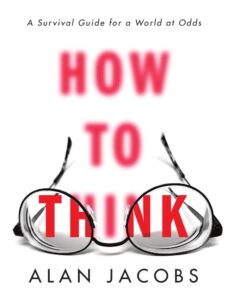
That’s the question that culture critic and professor Alan Jacobs asks us to consider in his latest book, How to Think: A Survival Guide for a World at Odds (Currency, 2017). Why do we believe what we believe? What does it mean to stand by our beliefs? And what are the metaphors that guide the way we think about those who disagree with us? These are the kinds of questions that direct this incisive and challenging (but also quite amiable) volume about one of the most important aspects of our cultural existence.
Jacobs writes with charm and grace, and without the cynicism that defines so much of modern cultural criticism. He’s witty—especially in his own self-deprecation—and his argument is assertive without being confrontational. Like any good critic, he challenges our preconceived notions and the various inadequacies therein, but he doesn’t exactly throw down the gauntlet. When making the case for why one’s readers are bad at thinking, it would be easy to come across as smug or pretentious, but Jacobs exhibits none of that, instead displaying a lightness of touch that models the very case he is trying to make. He invites the reader into a conversation—a long, wandering, delightful conversation possibly involving a delicious beverage and maybe a meandering walk. And in so doing, he can be mildly accusatory without violating the reader’s trust.
This goes a long way, especially when one of his more astute observations hits close to home.
According to Jacobs our culture thinks about thinking in the wrong way. “We’re worse at thinking than we think,” he claims. We’re too consumed with thinking for ourselves, which is usually a bad idea; and, in the end, keeping an “open mind” is not actually possible despite our collective obsession with the faux-generosity of supposedly not caring what other people think. We’re too consumed with our own thoughts, he writes, and with being part of the “right” group to think well. And thus the metaphors we assume in our thought lives turn combative and towards bulverism, a term Jacobs adopts from C. S. Lewis that refers to the argumentative “strategy [that] assumes that your opponent is wrong, and then explain[s] his error.”
Thinking, Jacobs claims, is an art, and thus, like any art, it demands patience, fearlessness, and attention. Just as the fiction writer must pay close attention to the world around her, so a good thinker must turn his attention outward. “Where there is no listening,” Jacobs writes, “there is no thinking.”
Yet modern thought is driven by what Jacobs calls Refutation Mode—the desire to prove others wrong—which in turn is motivated by our preoccupation with being a part of the Inner Ring (another term that Jacobs adopts from Lewis, this time from The Weight of Glory): some “group of people whom we happen to encounter and happen to find immensely attractive” and to whose ideas we therefore turn. Our thoughts are too often driven by the desire to gain access to the clubhouse. Because of this instinct, Jacobs argues, “the person who genuinely wants to think will have to develop strategies for recognizing the subtlest of social pressures, confronting the pull of the ingroup and disgust for the outgroup.”
What’s more, a good thinker, far from being consumed with Inner Ring–driven consensus, is interested in engaging with those with whom he disagrees in hopes of learning “from [each other] in a great many ways” such that he might “discover unexpected opportunities for membership: for there can be more genuine fellowship among those who share the same disposition than among those who share the same beliefs, especially if that disposition is toward kindness and generosity.” Or, as Wendell Berry might put it, good thought, like good teaching, is dependent on neighborliness.
Such an approach however, requires us to actually value the thoughts, opinions, and intellect of those with whom we disagree. For too long we’ve relied on war as our primary metaphor of disagreement, debate, and conversation in the public arena. As New York Times film critic A. O. Scott writes in his 2016 book, Better Living Through Criticism, “this is because the prevailing climate of argument favors and perpetuates clear and categorical, and frequently overstated or outright bogus distinctions [what Jacobs refers to as the “habit of dichotomizing”] . . . to participate in a debate on just about any topic is to state an allegiance, to declare oneself a partisan, and the difficult dialectical work of discerning the good, the beautiful, and the true is lost in the noise of contending pseudoprinciples.”
It’s easy to dehumanize those with whom we disagree, to see them not as people but as “representatives or mouthpieces of positions we want to eradicate.” It doesn’t take much work to implicitly (if not explicitly) dismiss the intelligence or question the principles of someone with whom we disagree simply because he doesn’t see things the way we do. But neighborliness demands empathy of us, and it demands that we see each other as people with value. And thus, Jacobs reminds us pointedly, our failures in this area are essentially ethical: “Such is the power of sheer animus . . . it disables our ethical and our practical judgment.”
Jacobs, again: “As long as someone remains to you merely ‘the other’ . . . not present to you in full humanness, then the temptation of Bulverism will always be right at hand.”
Of course this doesn’t mean that we ought not to have conviction. On the contrary: “About some things,” Jacobs writes, “people should not have open minds but settled convictions.” And he quotes Chesterton, who famously said that he was “incurably convinced that the object of opening the mind, as of opening the mouth, is to shut it again on something solid.”
But, Jacobs argues, “We need to be able to make reliable assessments about the state of our knowledge.” We need to be aware of our own limitations and biases and prejudices. We need to be aware of the areas we lack empathy and we need to seek to rectify them. As Wendell Berry writes in The Art of Loading Brush, published the same month as Jacobs’s book, “Apart from limits” the arts cannot exist. “The making of any good work of arts depends upon limits of purpose and station, and thus upon limits specific to the kind of art and its means.” When we allow for limitations, he writes, “we can imagine completeness of form.” And, in this case, I might add, completeness of thought.
Form itself, in any art—including in the art of thinking—is the very acknowledgement and recognition of limit. The sonnet is limited by its form not to restrain its capacity to explore human emotion, but to set it free to express that emotion in an appropriate fashion. The movements of a symphony are liberating, for in them is harmony. And the quotidian liturgies of our homes and classrooms do not strangle the flexibility of our teaching and learning, but instead are inherently unfettering. Thus, in accepting the limits of our arts, we imbue those arts with meaning.
Through contemplation of the True, the Good, and the Beautiful we offer our students the chance to close their minds on something solid that feeds their imaginations.
David Kern
However, our students have been conditioned to respond to the concept of limitation as anathema to creativity, as prohibitive to the development of personhood. They are overcome by what Berry calls “fantasies of limitlessness.” It is the job of the teacher to set them free from this scourge. Indeed, this is the great power of Christian classical education, for through contemplation of the True, the Good, and the Beautiful we offer our students the chance to close their minds on something solid that feeds their imaginations and thus their ability to fulfill the Great Commandment. For, as Vigen Guroian wri tes in Tending the Heart of Virtue, the power of the fully realized imagination is that it makes good neighbors of us.
We talk of molding our students into independent thinkers and creative communicators. And we speak of rigor and knowledge and accomplishment. We dream about it. But in How to Think, Alan Jacobs challenges us to remember that the truly wise and virtuous among us are those who “care more about working toward the Truth” than being the most right. “Thinking does not have a destination,” he writes, paraphrasing Thomas Aquinas. It’s not about an end-point or an arrival or a completion. “What is needed for the life of thinking is hope . . . hope of being more than we currently are.”
In the end, this is why we have bought into Christian classical education. As Jacobs says, “We have good cause for hope.” If we’re careful and empathetic and self-aware in how we do it, we might even find that in the wisdom of the ages we have discovered a membership worth being a part of. One in which, despite disagreement, we share the same disposition—where we see each other as humans worth walking alongside instead of combatants to battle.