In Medias Res
From Digressio Vol. 5“A Myriad Eyes”: Creating the Right Kind of Reader
C. S. Lewis proposed judging books by the kind of reading they invite. On forming readers who are neither picky eaters nor gluttons.
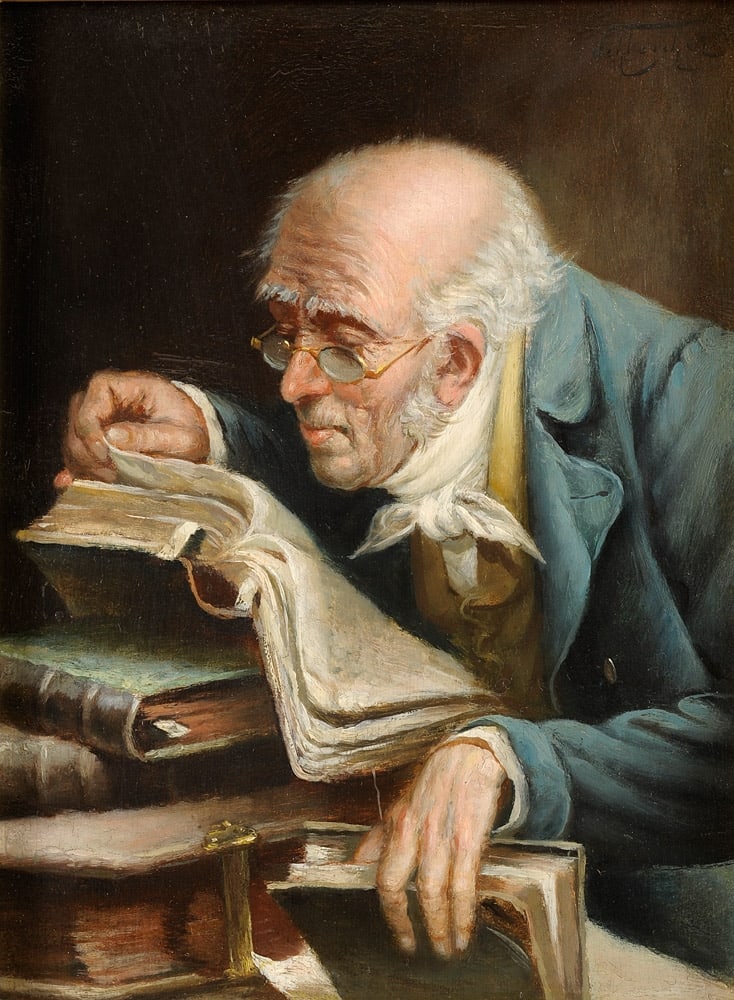
How should we define a “good book?” Who gets to decide on the metrics? Are there in fact metrics that a book must meet to be considered “good”? In C. S. Lewis’s book An Experiment in Criticism, he presents an alternative. Rather than classify a book by what kind of book it is, he suggests instead that books be classified by what kind of reader reads them. Perhaps, the book has no need of meeting an arbitrary list of metrics. Perhaps, a good reader isn’t someone who reads good books, but instead good books are those read by a certain sort of reader.
But if we adopt, for a moment, Lewis’s proposed method, a natural question will arise—how does this change our conception of what makes a good book? Suddenly, the world of “good books” expands to include any book in which a discerning reader finds something of value. It is not limited to “highbrow” books that some erudite academy of scholars has deemed (after much intense deliberation) to include on the list of great books. A great or good book is, quite simply, a book read by a great or good reader. Which leads to another question—what is a great or good reader?
A good reader is one who reads widely and deeply, who reads with discernment and enjoyment in equal measure.
Christiana Hale
Educators or parents often ask themselves how they can encourage their students to enjoy reading or perhaps how they can get them to read more “good books.” However, the focus should rather be less on the kinds of books we encourage our students to read and more on the types of readers we want them to become. We seek to shape readers who will create the lists of the good books—the next generation of the curators of culture and the archivists in the halls of great literature. What does this type of reader look like? A good reader is one who reads widely and deeply, who reads with discernment and enjoyment in equal measure.
And so, what then? If we want our students and children to be this type of reader (and we should), then first we must endeavor to be this type of reader ourselves. And it starts with first avoiding the common pitfalls of both the overly scrupulous and the indiscriminate.
A Diet of Words
Words feed us. Stories feed us. When we read, we take in what we are reading in a very particular way. Just as we digest food in such a way that it essentially becomes a part of us—breaking down and giving energy to our cells, sending nutrients where needed, causing us to grow and change physically—so too do our reading habits shape and mold us as individuals. We recognize this, even subconsciously, in the way that we talk about reading: we all know “voracious readers,” or that some people “devour books.” And just as it matters what and how you eat, it obviously matters how and what you read. Reading choices are shaping decisions, just as food choices are. It is common knowledge that a diet of corn dogs and ice cream not only affects the shape and function of your body, but it also affects your tastes. It is possible to lose the ability to enjoy a truly spectacular meal. After subsisting on Twinkies, a decadent French patisserie may present nuances and refinement that are beyond the partaker’s ability to understand or even enjoy. In much the same way, a steady diet of only one author, or even one genre, limits a reader’s ability to broaden their horizons. Certain types of literature will soon seem out of reach or beyond them. They are imprisoned by their own “taste” and so are not free to explore entire worlds that wait just out of reach.
Just as it matters what you read or eat, it also matters how you read or eat. Everyone recognizes a picky eater or glutton. When it comes to food, we typically spot the misuse of this blessing fairly easily. But when it comes to reading? What are the ditches to avoid there? If our goal is to create the types of readers who have the discernment and freedom to determine which books ought to be read, then we need to be aware of the pitfalls that await the unsuspecting.
The Picky Eater
The picky eater is someone who, for one reason or another, is limited to a few types of food by their own tastes or perhaps by outside pressures to conform to an expected standard. These are the same temptations that face readers. A picky reader is limited in what he enjoys and what he is able to enjoy. Perhaps this is a self-imposed state. They long ago decided that they prefer western romance to every other type of literature and so anything else is beyond their grasp. Or anything else does not live up to their expectations of what literature should be (i.e. western romance). The personal tastes of the reader have stolen the steering wheel and have, therefore, crossed many roads off the map for being “too steep” or “too long” or “too close to the mountains.” But if the mountains are never attempted, they will never have any idea of the sort of view they are missing from the top. The reader whose personal taste has become the standard by which all literature is judged is ill-suited to the task of declaring which books are “good” and which are not. They are not free to make those decisions. Their own tastes have chained them to an arbitrary standard that rejects the majority of literature out of hand, because it does not fit into their narrow category of “approved” reading.
Picky eaters can also arise because of outside pressures—pressures from the tastes of the group as a whole or the pressure from desire for excellence, a desire that can likewise stem from the individual or the group. Ironically, this kind of pressure is often exercised to push readers in completely different directions—either to reject what he sees as the common, crass “popular” fiction of the masses or to reject works of high literary merit simply because they have been lauded by the austere critic and appear on every list of “top 100 books you should read before you die.”
The desire to stand out or blend in, to only read that which is as deep as the Mariana Trench or to only paddle about in the warm, shallow waters of the kiddie pool—all of these are temptations of the picky eater. To reject certain books out of hand because they are a “certain kind of book” or because a “certain kind of person reads them” is to banish oneself from a myriad worlds, a myriad conversations, a myriad minds with a myriad thoughts that are all part of the reality of God’s world. Lewis says that “it sometimes sounds as if the reading of ‘popular’ fiction involved moral turpitude. I do not find this borne out by experience.”1 Lewis himself admits enjoying what he calls popular fiction. He was a broad reader, not afraid to spend a morning on the Alpine heights of what we would call “great literature” before descending to the shallows of the pool in the afternoon. Emulating this attitude towards reading involves training, discipline, and the desire to know and experience that which has been previously considered unapproachable. Whether they are there by choice or circumstance, because of pressure from within or pressure from without, the blinders on picky readers need to be removed before those readers can make larger claims about what constitutes good literature.
The Glutton
In contrast to the picky eater, we have the glutton. When it comes to eating, once again it is easy to spot extreme excess, either in the sheer amount of food consumed or in the disproportionate amount of “unhealthy” foods in an eater’s diet. But in reading, this weakness is harder to spot, in part because we are no longer a reading culture. In a world of video games and gaming apps on phones, movies and streaming services, social media and personalized algorithms (all entertainment platforms that don’t require literacy or even extended, focused attention), we are quick to see readers of any sort as automatically belonging to the intelligentsia, at least at some level. Parents are happy to see their kids read at all. Never mind what. In the realm of food, indiscriminate consumption is just as unhealthy, just as deadly, as excess consumption. In other words, what you put in is just as important as how much you put in.
While seeking to avoid the snobbery of the picky eater, we should be willing to paddle in the shallows. There is nothing inherently wrong with enjoying a fluffy piece of popular fiction, just as there is nothing wrong with going to the county fair and eating an elephant ear the size of three dinner plates. But if you eat elephant ears for breakfast, lunch, and dinner, seven days a week, fifty-two weeks a year, you will soon have a whole host of problems. Readers willing to consume junk food indiscriminately, perhaps out of disdain for the snobbishness of the picky eater, can quickly turn into picky eaters themselves, only veering the other direction. The shallows, after all, are warm and easy to paddle in. It’s colder out in the depths and the waves are high and choppy. Unfortunately, they don’t often stop to think about just why the shallows have so many warm patches.
Willingness to put a book down because it fails to deliver enough that is praiseworthy to pay for the time spent is called discernment, not cowardice.
Christiana Hale
But the other danger that the glutton faces is the refusal to put down a book. They read everything they can get their hands on and there is a sort of pride of place in the fact that they are a ravenous reader. Not finishing a book is quitting. It is a mark of shame or cowardice. But the fact is, there are some truly horrible books out there that simply ought not to be read. And if our goal is to create the sorts of readers that have the wisdom to make those calls, to call the bad literature bad and the good good, then they need to practice doing this. Some books need to be read all the way through, despite their error, in order to intelligently articulate precisely why they are so dangerous. Others do not deserve that time and attention. There are millions of books in the world, and lifetimes would not be enough to read them all. Willingness to put a book down because it fails to deliver enough that is praiseworthy to pay for the time spent is called discernment, not cowardice. The victory of finishing that massive deep-fried, triple-stacked hamburger in one go before washing it down with a jumbo soda and a ride on the Gravitron loses its luster when you’re puking your guts out in the parking lot. Finishing, all by itself, is no virtue. The virtue is found in the direct object—finishing what?
Conclusion
What guards the good reader from treating a tragedy […] as a mere vehicle for truth is his continual awareness that it not only means, but is. It is not merely logos (something said) but poiema (something made). The same is true of a novel or narrative poem. They are complex and carefully made objects. Attention to the very objects they are is our first step. To value them chiefly for reflections which they may suggest to us or morals we may draw from them, is a flagrant instance of ‘using’ instead of ‘receiving.’2
We return once more to Lewis’s suggestion in An Experiment in Criticism—that books are more accurately assessed by what kind of readers read them than what kind of books they are. Instead of saying that bad readers are those who read bad books, why don’t we try saying that good books are those read by good readers? We’ve seen what a good reader is not. So what then is a good reader?
A good reader is a free reader. Pickiness and gluttony, in different ways, shackle the reader and enslave him to his own tastes and appetites. A reader who is free reads with broad discernment. He can pick up any book, receive it with gratitude, knowing that he has the tools to assess it fairly and accurately. He picks up the book, not seeing it as an object to be placed under a microscope and dissected, but as a living whole, an organism that will act on the reader just as much as the reader is acting on it. “We are so busy doing things with the work that we give it too little chance to work on us. Thus increasingly we meet only ourselves. But one of the chief operations of art is to remove our gaze from that mirrored face, to deliver us from that solitude.”3 A spirit of criticism, Lewis argues, ought to be subjected to a spirit of receiving. We receive the work first as it presents itself. We should be open and willing to let the book, the author, work on us as they intend. Criticism only follows this readiness to enjoy what has been put before us.
In the beginning was the Word, and the Word was with God and the Word was God. He was in the beginning with God. All things were made through Him, and without Him nothing was made that was made. In Him was life, and the life was the light of men. And the light shines in the darkness, and the darkness did not comprehend it. (John 1:1–5)
If we are Christians, that means, by definition, that we must be people of words. Because we are people of the Word. The Word that is Christ, the Word that is a Person, the Word that created all things and that continues to uphold all things. You might not be a big reader. Your kids might not be big readers. But none of us has the option to not be in the Word. If you are in Christ, you are in the Word and this means, among other things, reading your Bible. And if you are going to read your Bible, you need to know how to read it. We need to know how to be the kind of readers that we ought to be—free readers, not chained to any preconceived tastes or prejudices. Readers that freely receive, prepared and willing to be shaped by what we receive.
[I]n reading great literature I become a thousand men and yet remain myself. Like the night sky in the Greek poem, I see with a myriad eyes, but it is still I who see. Here, as in worship, in love, in moral action, and in knowing, I transcend myself; and am never more myself than when I do.4

First published in
Digressio Vol. 5: Memory (Winter 2025)


