
Latin: Our Legacy
By Lydia Foucachon
Show me the person sold on the value of classical education, and you’ve shown me someone who’s had to reckon with Latin. Latin, the uncomfortable and ostensibly stern, wizened great-grand-uncle at family Thanksgiving. At every gathering he casts foreboding from his corner of the room.
One or two great-grand-nephews sit around him in his corner and to them he seems to tell the best of stories and they laugh. But to the other young ones he’s an enigma that can’t be avoided, but also can’t be befriended. Familial right guarantees him a place at the table, but the circle is small of those who really embrace getting to know him.
There are multiple ways to dispense with the “problem” of Latin. What should inform a classical educator’s perspective when encouraging families to pursue Latin study? A simple and perhaps the most common rationale showcases its utility. Latin furnishes us with the roots of English words. Latin helps us understand grammar. Latin can give students an advantage in the study of medicine. Latin nomenclature helps comprehend taxonomic terms in biology. Yet the noble ambition to teach truth and beauty eventually dispenses with this utilitarian approach. If Latin is merely useful as a means to an end, couldn’t we simply develop and spend more time on those ends themselves rather than “wasting time” developing Latin? The utility of Latin is demonstrable, and yet it isn’t a satisfactory defense for spending untold hours on its study. And precisely for this reason, a student who pursues its mere utility rarely delves past the bare minimum requirement.
Another rationale points to Latin’s ability to develop a logical mind. Again, this benefit is indeed evident. The organization and taxonomy of Latin words require holding details in the mind like a series of planned chess moves. It stretches the brain-sinews until they can span more things at once. Cultivating a disciplined mind – this role for Latin is perhaps more defensible than the last. It certainly can benefit or improve the student’s calling in more ways than one. And yet the ability to discipline the mind is not distinctive of Latin alone, and other means might seem more applicable to modern life.
A third approach and one that strikes more winsomely at the heart of the question, points to Latin’s beauty. Classical educators strive to pour out truth, beauty, and goodness into the lives of students. Surely the beauty of Latin, its order, its cadence, its deft ability to create rhetorical surprise and emphasis, must dispense with the “trouble” that must be spent in studying a language we have largely lost. And yet even here it is possible to suggest some other means – music, or English poetry, or mathematics or some other art – that could more easily inculcate this same awe, this same love for beauty that stirs the soul and instills love for God’s world.
What if, instead of merely defending Latin’s utility, organization, or beauty, the problem of Latin could be dispensed with far closer to the chest. For American Christians who are classical educators, both parents and teachers, what is Latin to us? Though we have largely forgotten it in the fleeting passage of the past 100 years, Latin is, in fact, who we are.
John Adams, American founding father, in 1788 wrote to his son, “Preserve your Latin and Greek like the apple of your eye.” 1 Teddy Roosevelt wrote in 1906 about his sorrow to have struggled with Latin and Greek, and his envy of his sons who learned the languages well. To his son Kermit: “I never got so that I could with any real pleasure read either Greek or Latin. It was a labor.” 2 And to his friend Perkins, “From the experiences of my son in Africa [Kermit read Homer’s Iliad and Odyssey in the original Greek], I am able vividly to realize this loss, for he gained an enjoyment from Homer in the original which I sincerely envied him.”3 Thomas Jefferson wrote to Joseph Priestley, on January 27th, 1800:
“To read the Latin and Greek authors in their original, is a sublime luxury; and I deem luxury in science to be at least as justifiable as in architecture, painting, gardening, or the other arts. I enjoy Homer in his own language infinitely beyond Pope’s translation of him, and both beyond the dull narrative of the same events by Dares Phrygius; and it is an innocent enjoyment. I thank on my knees, him who directed my early education, for having put into my possession this rich source of delight; and I would not exchange it for anything which I could then have acquired, and have not since acquired.” 4
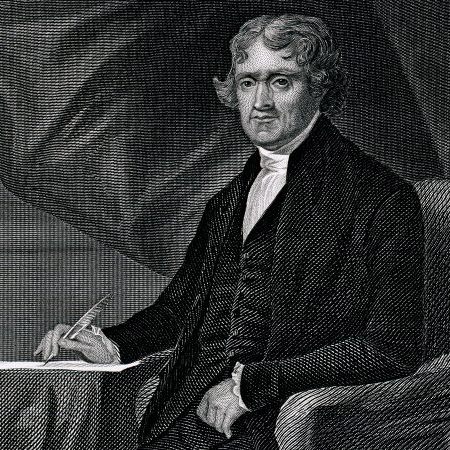
These quotes are a small percentage of those which illustrate how much Latin formed the mindset of the Founding Fathers. They were steeped in literature of Latin authors, and they read the material in the original language. Studying the founding of our country without a working knowledge of Latin is like a musician studying Beethoven while completely ignoring the study of the music which formed and influenced him.
As much as Latin is who we are as Americans, Latin is also who we are as a body of Christians. As Phillip Schaff puts it in his History of the Christian Church:
Jesus Christ came into the world under Caesar Augustus, the first Roman emperor, before the death of king Herod the Great, four years before the traditional date of our Dionysian aera. He was born at Bethlehem of Judaea, in the royal line of David, from Mary, “the wedded Maid and Virgin Mother.” The world was at peace, and the gates of Janus were closed for only the second time in the history of Rome.5
The world was at peace, and united by the Roman Empire. God used the Pax Romana and the Latin language to spread the Gospel. It is a simple task to list name after name from Church Fathers like Augustine to Protestant Reformers like John Calvin who studied, wrote, and thought in Latin. The language itself formed them, as it later formed the American Founding Fathers, and we trace our own heritage back through both.
In the famous and poignant scene of Aeneas’ flight from Troy in book 2 of the Aeneid, his father plans to go down fighting in the losing fight, but “Pious Aeneas” as the epithet is rendered, takes his father up on his shoulders and carries the founder of his own family legacy out of the ruins. Men in our past who built up the church and men who built up our country knew this image as if an illustration was laid out before them in vivid paint (and in fact it often was portrayed in large scale by artists over centuries). Such images, both verbal and pictorial are formative. Vergil’s poetic piety in the form of Aeneas’ preserving his aging father instilled that value of honor for heritage in other men.
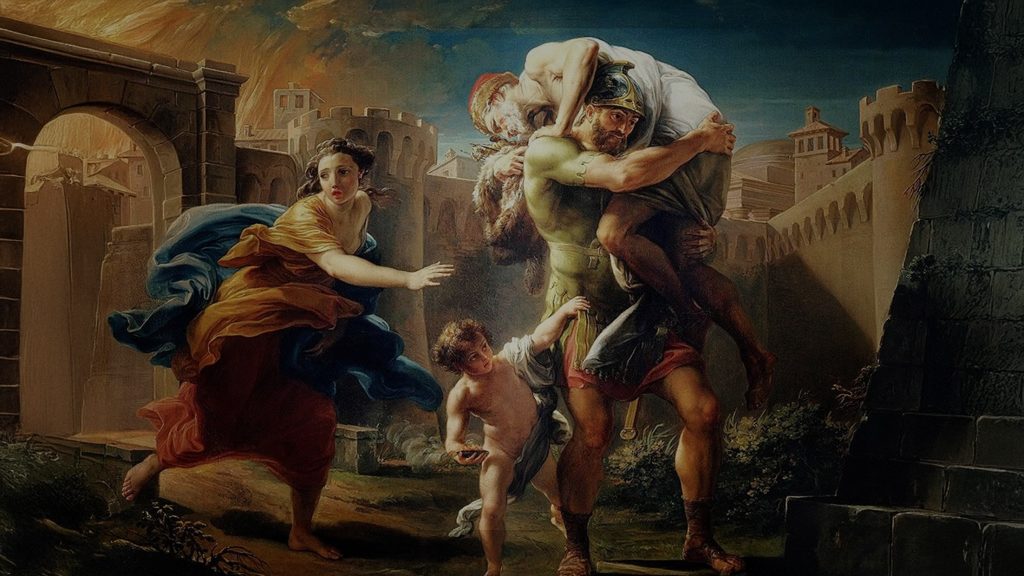
The apology for Latin comes down to this: Will we remember who we are? Will we, like Aeneas, remember our father and place him on our shoulders, carrying that legacy along with us as we move forward to found our new ventures? The reward of knowing our own heritage and identity – and that of our forebears – will be the prize.

Lydia Foucachon is married to Daniel, founder at Roman Roads Press, and oversees customer service. She was homeschooled k-12, including classes with Wes Callihan through Schola Classical Tutorials, and then graduated from New Saint Andrews College in 2009 with a BA in Liberal Arts and Culture. She hosts the Muse and Hearth podcast, and is slowly pursuing her Masters of Classical Christian Studies at New Saint Andrews while teaching literature to high school students at White Horse Hall, a local homeschool coop. She and Daniel have 7 children, and live on 5 acres north of Moscow, Idaho.
- National Archives, “John Adams to John Quincy Adams 23 January 1788.” ↩︎
- Theodore Roosevelt Center, “Letter from Theodore Roosevelt to Kermit Roosevelt.” ↩︎
- Theodore Roosevelt Center, “Letter from Theodore Roosevelt to Albert Perkins.” ↩︎
- Library of Congress, “Thomas Jefferson to Joseph Priestley, January 27,1800.” ↩︎
- Philip, Schaff. History of the Christian Church. (New York: Charles Scribner’s Sons, 1910), Chapter 15 ↩︎
